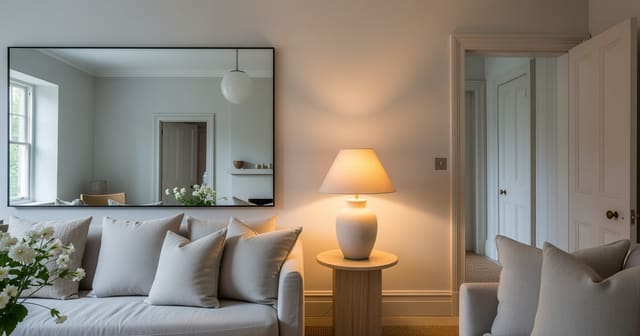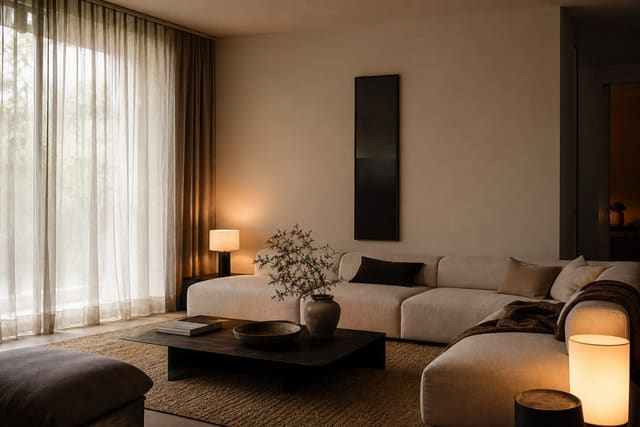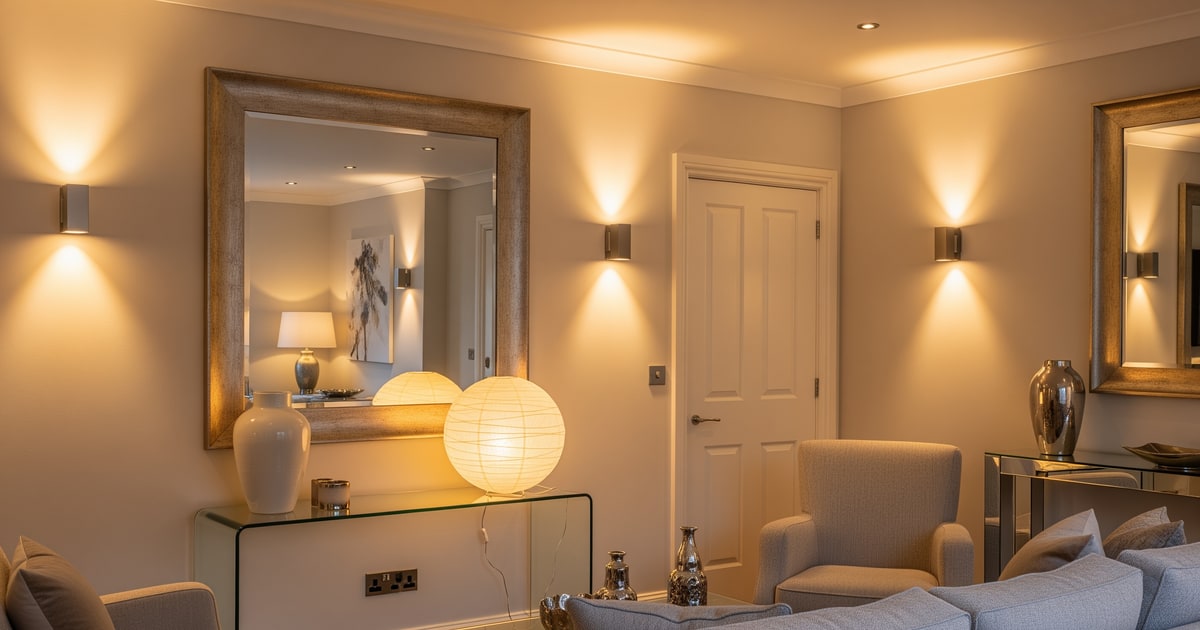
Faking natural light works by layering a 2700-3000K mix of overhead, table, and accent lamps positioned where windows would be, repainting walls in a warm reflective off-white, adding a tall mirror opposite the brightest light source, and using sheer or no window treatments where windows do exist. Natural light is the highest-ROI element in any room, but not every room has it. If your floor plan starts with no windows or weak light, you can still make the room look and feel brighter with optical and practical tricks.
How do I fake natural light in a room?
You cannot replace daylight, but you can design the light and finish stack so the room reads as naturally lit. Use a warm white anchor, layered reflectance, and a single visual focal glow. Your target is not “brighter at all costs,” it is a coherent light direction and rhythm that tricks the eye into reading warmth and openness.
Seven practical techniques
- Warm color baseline (2700K–3000K). Human vision associates warm daylight simulation better with natural spaces when the light stays consistent.
- Reflective surfaces on opposite walls. A mirror on the far wall can double perceived depth when paired with a low-angle lamp.
- Light at multiple heights. Use overhead, mid-wall, and corner-level sources; flat layers make every room feel flatter than it is.
- Shorter throws, higher diffusion. Diffusers and soft shades spread light and remove hard shadow edges.
- Use glass or gloss for return paths. Cabinet tops, table legs, and a glossy tray can bounce back useful ambient light.
- Add an art-light horizon. Place one bright visual endpoint (frame, lighted piece, or lit object) at the room edge.
- Keep color temperature uniform. Mixed 4000K and 2700K creates visual confusion and reads artificial.
Test this on your own room photo with ReDesign before you choose the final direction; keep the doorway, walls, windows, main furniture, lighting, and awkward fixed features visible so the preview solves the room you actually have.
What to pair with this technique
Paint, textiles, and objects must support your lighting plan. High-light-reflectance walls, pale textiles, and matte contrast only where needed all improve the “window-like” look.
Fake daylight needs direction. Start by deciding where the imaginary window would be, then place the brightest diffused source on that side of the room. A paper lantern, opal globe floor lamp, or wall washer aimed at a pale wall usually looks more believable than a bright panel in the ceiling. Keep the source around 2700K to 3000K with 90+ CRI; the room should feel warm and alive, not blue-white. A second spec is shade size: a 16 to 20 inch globe or drum spreads light better than a tiny exposed bulb. Once the glow exists, use the placement rules in mirrors that amplify light to bounce it toward the darker half of the room.
Surfaces have to cooperate. Warm white paint, pale wood, linen curtains, light rugs, and satin finishes make artificial light travel farther. A glossy white surface can help in a kitchen or bath, but in bedrooms and living rooms it often creates glare instead of softness. Renters can build a false window with a plug-in sconce behind a linen shade, a rice-paper floor lamp, and a mirror angled toward the lamp. Owners can add a wall washer, cove light, or concealed LED above built-ins. In basements, the same daylight trick needs more total output, so the basement lighting guide is the better spec reference when the ceiling is low.
The most convincing fake daylight comes from layering big soft sources with one visible direction. Put the broadest lamp high enough that it washes a wall or shade, then add a lower lamp across the room so the shadows are gentle. If the room has no windows, do not scatter five tiny lights everywhere. That creates brightness without orientation, and orientation is what your brain reads as daylight.
Choose the surfaces before adding more bulbs. A pale rug can bounce a surprising amount of lamp light upward, while a dark rug drinks the effect. Linen curtains can still help in a windowless room when they hide a light source or soften a wall, even though they are not covering glass. A matte warm-white wall will do more than a glossy one in living spaces because it spreads light evenly instead of flashing it back.
Fixture shape matters. Rice-paper lanterns, opal glass globes, shaded floor lamps, and fabric drums make the light source feel larger. Exposed LED panels, bare bulbs, and narrow spotlights feel artificial because the source is too concentrated. If the room needs a ceiling fixture, choose a flush mount with a wide diffuser rather than a downlight that creates one bright floor circle.
Rental and owner versions should be different. Renters can build a believable setup with a plug-in wall washer, a floor mirror, pale textiles, and a smart plug scene. Owners can add a cove, concealed shelf light, or a switched sconce that makes the effect permanent. In both cases, keep every lamp on the same warm family so the room does not reveal the trick through mismatched color.
Photograph the room from the doorway after each change. If the first image shows a believable bright side and a softer shadow side, the setup is working. If the image is evenly bright but still flat, remove one small source and make the main source larger.
A convincing setup also needs shadow. Real daylight is not flat; it has a direction, a bright side, and a gentle falloff. Leave one corner slightly quieter so the room has depth. When every wall is equally lit, the room starts to feel like a retail fitting room. A dimmable main source helps because you can tune the contrast instead of adding another lamp.
Plants are a useful honesty test. If every plant in the room looks gray or plastic under the new lighting, the color rendering is wrong. Use realistic low-light plants or high-quality faux greenery sparingly, and put them where the imaginary daylight would naturally land. The goal is not to trick a botanist; it is to make the room feel visually alive from the doorway.
Window-like art can help, but only when it is subtle. A pale landscape, a framed textile, or a light-toned photograph near the main lamp can suggest openness. Literal fake-window panels and blue LED skylights usually call attention to the absence of real daylight.
Small rooms should get the softest version of the trick. A 10 by 10 bedroom may need one large globe and one mirror, while a long basement room needs a stronger wall wash and a visible endpoint. Scale the daylight illusion to the room, not to the product photo.
Common mistakes
- Choosing cool-white strips and warm bulbs in the same control group.
- Relying on one large overhead fixture with no side light.
- Installing direct-only fixtures that flatten textures.
- Trying to imitate noon daylight exactly. A low-light room rarely fools anyone with blue-white bulbs. It feels better when the light is warm, layered, and believable for the space.
- Using a daylight-blue bulb to imitate the sun. Cool color temperature usually announces the fake instead of making the room feel naturally bright.
Use AI design for low-risk testing
Photograph the current room and test these lighting ratios with Re-Design before buying anything. The right combination of fixture heights and finishes usually appears obvious in 2–3 generated previews.
Frequently Asked Questions
Can lighting alone make a dark room feel naturally lit?
Yes — three sources of 2700-3000K light, one positioned high (overhead or wall sconce), one mid (table or floor lamp), and one low (accent or task) mimics the way daylight stacks vertically in a sunny room. Use the room photo to compare the visible layout and fixed constraints before committing, because door swings, windows, outlets, storage reach, circulation, and existing furniture decide whether the idea survives daily use.
What wall color reflects the most light?
Warm off-whites (Benjamin Moore White Dove, Sherwin Williams Alabaster) reflect 80-85% of light while looking warm; pure cool whites reflect slightly more but read cold in a dark room. Keep the preview honest by leaving the problem area visible in the frame, then compare one conservative version against one bolder version before you buy lighting, paint, furniture, or storage.
Where should I put a mirror in a dark room?
Opposite the brightest light source — opposite the only window, opposite a tall lamp, or opposite a wall sconce; this doubles the apparent light count in the room. Check the result against ordinary movement first: drawer clearance, chair pullout, walkway width, glare, switch access, and sightlines matter more than a perfect catalog angle.
Should I use smart bulbs to fake natural light?
Yes — tunable-white smart bulbs (Philips Hue, Lutron Caseta) shift from 2700K warm at dusk to 4000-5000K daylight by midday, mimicking how sunlit rooms feel through the day. Use the image to narrow priorities and measurements before ordering anything custom; final purchases still need real dimensions, outlet locations, installation limits, and product clearances.
Does AI help me plan light layering?
Yes — upload the dark room photo and AI previews lamp placement and wall paint shifts against the existing window count. If the preview invents architecture or hides the awkward feature you need solved, rerun it with stricter instructions so the result remains tied to your actual room.
> Try this: Ready to see this on your own room? Open ReDesign and run the preview.
Three transformations to try
1. Three-source light layering in dark room 2. Tall mirror opposite single window 3. Warm off-white walls with sconces