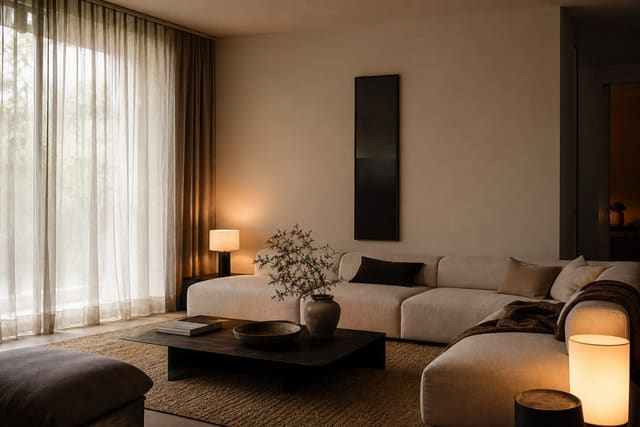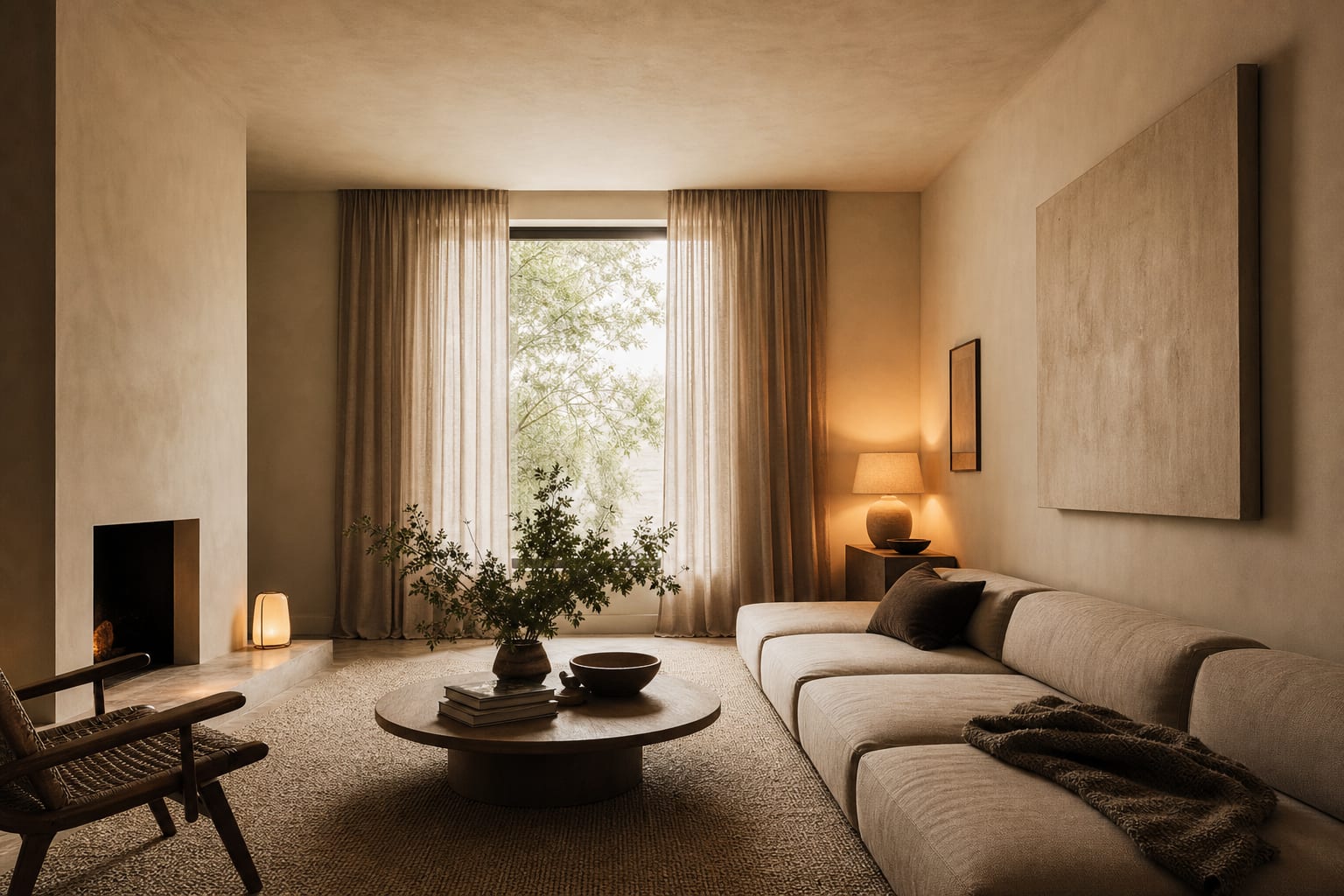
Low-ceiling rooms feel taller when curtains mount at the ceiling instead of the window, walls and trim share one color top-to-bottom, vertical paneling or stripes pull the eye up, and furniture stays under 32 inches tall — none of it requires construction. The real problem usually isn't the ceiling height itself; it's a room full of choices that make the lid feel lower. Fewer horizontal breaks, lighter furniture profiles, and stronger vertical cues fix it.
How do you make a room with low ceilings feel taller?
Lower the visual weight of the furniture, draw vertical lines up the walls, hang treatments close to the ceiling, and soften contrast where wall meets ceiling. The goal isn't hiding the ceiling — it's stopping the eye from measuring the room as a short box.
Start with the biggest horizontal line in the room. In a living room that's often the sofa back: choose 30–34 inches high, open legs, arms that don't look like padded barricades. In a bedroom, a 42–54 inch headboard usually beats a towering 72 inch panel unless the wall is wide and calm.
Keep the floor plan simple enough for the eye to travel. Leave about 30 inches for the main walking path and don't ring the room with side tables, baskets, and plant stands. A low-ceiling room needs negative space more than another accent chair.
Vertical cues help, but need restraint: narrow bookcases painted close to the wall color, slim sconces, vertical art, reeded cabinet fronts, or curtain folds. For more tricks that add visual height to a room, use them as architecture, not scattered decoration.
Which furniture, rugs, and built-ins make the ceiling feel lower?
Furniture that hurts a low room usually isn't too large in footprint — it's too heavy in profile. A blocky sectional with a 38 inch back, thick arms, and skirted base pulls the room down. Open legs, a lower back, and a single long seat cushion keep the same capacity while showing more floor.
Use a rug to stretch the room horizontally without chopping it. An 8' x 10' rug usually looks calmer than a 5' x 7' floating under just the coffee table; go 9' x 12' if the room tops 12 feet wide or holds a full sectional. Let at least the front legs sit on the rug so the seating reads as one zone.
Built-ins should be shallow and disciplined — 12–15 inches deep, shelves visually light and painted to match the wall, not packed edge to edge. A dark, chunky unit that stops 10 inches below the ceiling leaves an ugly shadow gap above it.
Coffee tables and ottomans should stay visually quiet: 14–18 inches high, pale wood, stone, or upholstered with slim legs rather than a glass block reflecting every ceiling fixture.
Test this on your own room photo with ReDesign before you commit — keep the doorway, walls, windows, main furniture, lighting, and fixed features visible so the preview solves the room you actually have.
How should curtains, paint, and lighting change in a low ceiling room?
Curtains are the fastest non-construction fix. Mount the rod 2–4 inches below the ceiling or crown line, not above the window casing, and extend it 6–10 inches beyond each side so panels stack off the glass.
Let fabric skim the floor with about 1/2 inch clearance. Short curtains chop the wall; puddled curtains work in formal rooms but collect dust with kids or pets. Choose linen, cotton, or matte polyester — shiny fabric catches the low ceiling line too aggressively.
Paint should soften the wall-to-ceiling stop. Same color as the walls, or one step lighter in the same undertone, usually beats bright white over dark walls, which can read as a lid. Soft warm white, pale clay, muted mushroom, or barely-there blue-green work well.
Lighting needs layers at human height. Replace a dangling pendant with a shallow flush mount (drop no more than 8–12 inches if clearance is tight), then add table lamps, plug-in sconces, and picture lights so the room glows from the sides at 2700K–3000K.
If the room is also dark, don't make the ceiling carry the whole brightness problem — apply the same logic as faking natural light in a darker room: matte pale surfaces, warm layered lamps, mirrors aimed at real light instead of a cold overhead disk.
What decorating mistakes make a low ceiling worse?
- Bright white ceiling by default. It only helps when it relates to the wall color; over warm beige walls, a blue-white ceiling sharpens the height break.
- Thin crown molding under 8 feet. It adds an extra stripe exactly where the eye should keep moving — paint it wall color or skip it.
- Art hung too high. Center artwork around 57–60 inches from the floor, aligned with furniture below; art near the ceiling only proves the wall is short.
- Long-downrod ceiling fans. Blades need roughly 7 feet of clearance; choose a low-profile fan or flush fixture instead.
- Too many small pieces. One properly scaled sofa, one larger rug, and two tall curtain panels beat six undersized objects trying to be discreet.
How can AI design help you see the fix before you commit?
Low-ceiling fixes are hard to judge from a shopping cart because the effect comes from relationships: sofa height, curtain height, wall color, light placement, rug scale. Uploading a photo to an AI interior design tool lets you test those relationships before repainting, ordering curtains, or swapping a fixture.
Start with a straight photo from the room entry. Ask for a 32 inch sofa, floor-length curtains mounted 3 inches below the ceiling, an 8'x10' rug, warm 2700K lamps, continuous wall-and-ceiling color, and no heavy overhead pendant. Run a second version with darker walls, no curtains, or a higher headboard to see exactly what makes the ceiling feel lower.
For bedrooms, test a 48 inch headboard, 24 inch nightstands, slim sconces at 58–62 inches, and floor-skimming curtains. For rentals, preview tension-mounted curtain systems, adhesive picture lights, low bookcases, and removable wall color before drilling holes or buying custom panels.
AI won't measure your ceiling or confirm code compliance, but it will show whether the room wants softer contrast, taller fabric, lower furniture, or more side light. If a mirror is part of the plan, compare versions using mirrors that amplify light so the reflection brightens the room instead of doubling clutter.
What final checks keep the room feeling taller every day?
Measure ceiling height, window casing height, sofa back, headboard, curtain rod location, and fixture drop before buying anything — a 7'6" ceiling has different tolerance than an 8-foot ceiling broken up by beams.
Stand at the doorway and find the first hard horizontal line: curtain rod, trim, sofa back, bookcase top, or fixture. Soften that line first — paint it closer to the wall color, raise it, choose a lower profile, or remove it.
Check the room after dark. Overhead fixtures flatten a room that looks fine in daylight. Turn off the central light and use a table lamp, a sconce, and a shaded floor lamp instead — if the room suddenly feels taller, lighting was the real problem.
Keep the top 12 inches calm: no garlands, tiny shelves, high art, exposed cords, or storage bins above cabinets. A low-ceiling room needs a clean upper edge so the eye has somewhere to rest.
Frequently Asked Questions
Where do I mount curtains in a low-ceiling room?
Mount the rod at the ceiling line, not just above the window frame. The floor-to-ceiling fall reads as a tall window even when the actual glass is short, and extending the rod past the frame widens the opening further.
Should walls and trim match in a low-ceiling room?
Usually yes. Painting trim, walls, and ceiling the same warm white, or a tone-on-tone scheme, removes the horizontal break that shortens the room. High-contrast trim does the opposite by emphasizing exactly where the ceiling sits.
Does vertical paneling help low ceilings?
Yes. Vertical board-and-batten, shiplap, or beadboard adds visual lift by pulling the eye upward, while horizontal paneling shortens the room further and should be avoided in tight-ceiling spaces.
How tall should furniture be in a low-ceiling room?
Keep sofas under 32 inches tall, choose low-back chairs, and use short-leg coffee tables around 14–18 inches. Tall wing chairs and high-back sectionals add bulk that visually closes off the ceiling.
Does AI preview these moves on my room?
Yes. Upload a photo of your low-ceiling room and AI can preview ceiling-height curtains, tone-on-tone paint, and vertical paneling against your existing trim before you buy or paint anything.
> Try this: Ready to see this on your own room? Open ReDesign and run the preview.
Three transformations to try
1. Ceiling-mount curtains floor-to-ceiling drape 2. Tone-on-tone walls and trim 3. Vertical board-and-batten paneling