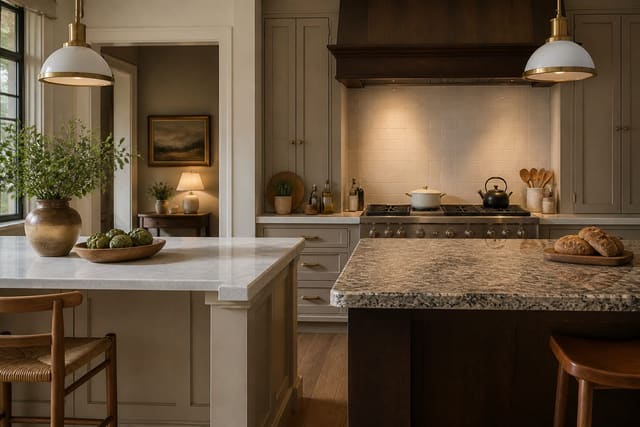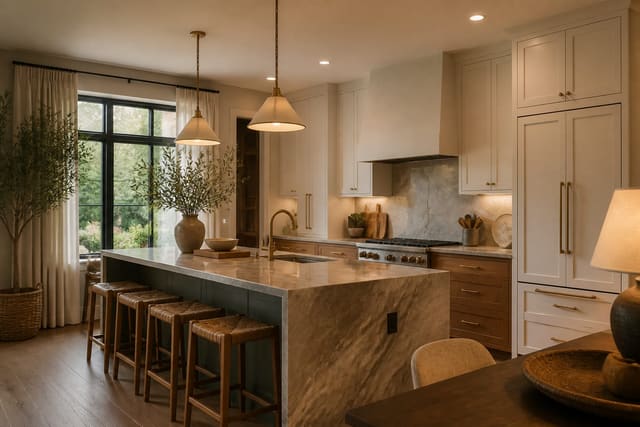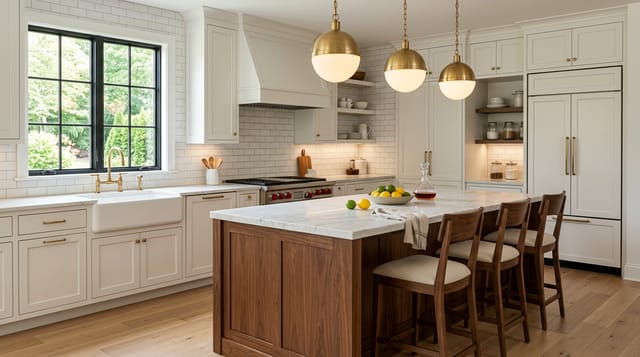
For most kitchens in 2026, quartz is the smarter default and granite is the better choice for one specific kind of cook. Quartz wins decisively on consistency and zero maintenance; granite wins when you want a genuinely one-of-a-kind natural slab and you are completely fine sealing it once a year. Anyone who tells you one material is universally better than the other is just trying to sell you a slab.
Both are hard, premium surfaces that will outlast a laminate counter by several decades. The real decision comes down to how you actually cook, how much routine upkeep you will tolerate, and whether you want a uniform engineered look or a natural one.
How they are made and what that changes
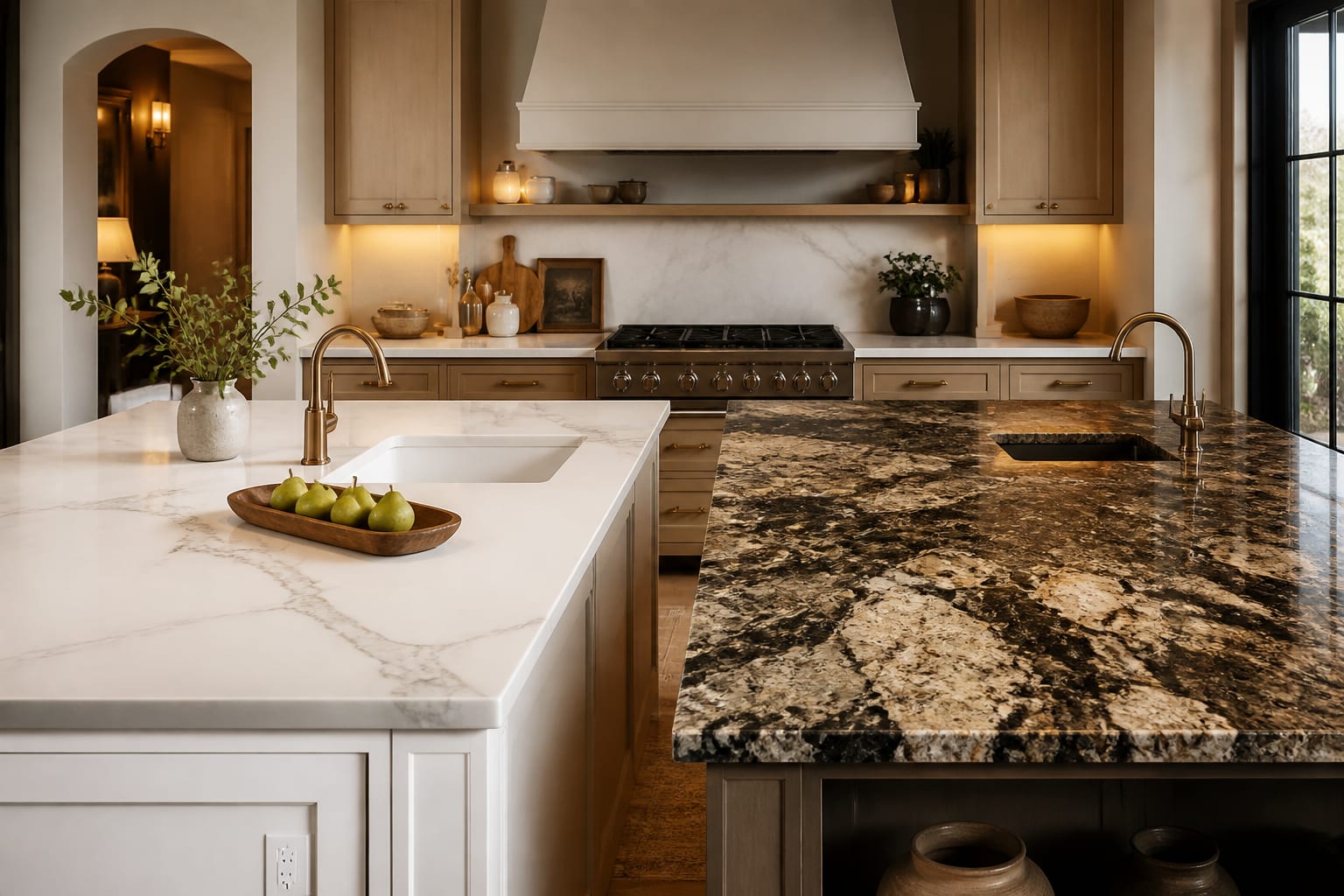
Granite is quarried natural stone, cut directly into slabs, so every single piece is unique in its veining, movement, and color. That uniqueness is both the appeal and the catch: you really should view the actual slab in person before the fabricator cuts it, because a 4-inch sample chip almost never matches the full pattern across a 6-foot run. Granite is also porous, which means coffee, oil, and red wine can soak in and stain if the surface is not properly sealed.
Quartz is engineered, typically around 90% to 93% ground natural quartz bound together with resin and color pigment. That resin binder makes the finished surface completely non-porous, so it never needs sealing and shrugs off red wine, lemon juice, and turmeric without a mark. The trade-off is appearance consistency: quartz looks far more uniform tile to tile and slab to slab, which some people love for its calm and others find less interesting than the drama of real stone.
There is also a sustainability and indoor-air angle some buyers care about. Granite is a natural product with minimal processing, while quartz involves resins and more manufacturing energy, though modern low-VOC quartz lines have narrowed that gap considerably. If you are still shaping the overall look, the kitchen countertop ideas gallery shows how each material reads against different cabinet colors and floors.
Fabrication is worth understanding before you sign anything, because it affects both cost and the final look. Both materials are templated to your exact cabinet run, then cut and polished at the shop, so seams, sink cutouts, and the edge profile are all decided during that visit. Quartz seams tend to disappear more easily because the color is consistent, while granite seams take real skill to align veining across two pieces. Ask to see the seam plan and the slab layout before the saw runs, since a poorly placed seam on a 9-foot island is the kind of mistake you live with for twenty years.
Side-by-side comparison
| Factor | Quartz | Granite | |---|---|---| | Material | Engineered, ~90% quartz + resin | 100% natural quarried stone | | Sealing | Never required | Reseal about once per year | | Heat tolerance | Up to ~300°F, use a trivet | Higher, handles hot pans better | | Stain resistance | Excellent, non-porous | Good once sealed | | Look | Uniform, predictable | Unique, natural veining | | Installed cost | ~$50 to $115 per sq ft | ~$50 to $120 per sq ft |
The two specs that decide most kitchens come down to heat and upkeep. Quartz tops out around 300°F before the resin binder can scorch, soften, or discolor, while granite tolerates a hot pot pulled straight off the burner without flinching. And granite needs roughly 1 reseal per year to stay stain-resistant, while quartz needs exactly zero. If you regularly slide a cast-iron pan off the flame onto the counter, that heat gap matters far more than any price difference between the two.
Edge profiles and thickness behave the same for both. A standard slab runs about 1.25 inches (3 cm) thick, and both materials support eased, beveled, or waterfall edges equally well, so the look you want is not limited by the material you pick.
Cost, resale, and the practical call
Pricing overlaps so heavily that budget rarely makes the decision for you. Both land squarely in the $50 to $120 per square foot installed range, with exotic granite and high-end designer quartz pushing past that ceiling. A standard 40-square-foot kitchen lands somewhere around $2,000 to $4,800 installed for either material, fabrication and template included.
Use this quick filter to break the tie:
- Choose quartz if you want zero maintenance, a uniform look, and stain-proof daily use.
- Choose granite if you cook hot, want a natural slab, and accept the yearly sealing.
- Choose either if resale value is the main goal, since both read as premium to buyers.
Counter choice also interacts directly with your cabinets, and overspending on stone above tired boxes is a common regret. If the cabinets themselves are dated, the cabinet refacing vs replacement cost breakdown helps you decide where the budget should actually go before you splurge on a slab.
Maintenance reality and which look fits your kitchen
The day-to-day difference is smaller than the marketing suggests, but it is real. Quartz wipes clean with dish soap and a cloth, full stop, and that is genuinely the entire maintenance routine for the life of the counter. Granite asks for a yearly seal, a quick water-bead test to check whether the seal still holds, and slightly more care around acidic spills like lemon and vinegar sitting overnight.
Look and movement matter just as much as upkeep, and this is where personal taste should win. Quartz now convincingly mimics marble, with soft grey veining on a white field, so people who love the Carrara look without the staining can get it in a maintenance-free surface. Granite, by contrast, gives you dramatic natural movement, flecks, and depth that no engineered slab fully reproduces, which is the whole reason some cooks will never switch away from it.
Quick gut checks before you order:
- Want it to look exactly the same in ten years? Quartz holds its appearance better.
- Want a surface no other kitchen on earth has? Granite is genuinely one of a kind.
- Bake and cook constantly with hot cookware? Lean granite for the heat headroom.
Either way, order a full slab viewing and a large sample, not just the showroom chip, so the pattern you approve is the pattern you actually get.
Use AI design to preview your countertop before you commit
Stone is the one kitchen decision you genuinely cannot undo cheaply, and a small sample chip never shows how a full slab will read next to your real cabinets, backsplash, and floor. Re-Design lets you upload a photo of your own kitchen and drop a crisp white quartz, a veined marble-look quartz, or a dramatic movement-heavy granite onto the actual counters in seconds.
Compare a calm uniform quartz against a busy natural granite in your own kitchen light, against your own cabinet color, before the fabricator cuts a single thing. For more layout-driven planning beyond the surface itself, the AI kitchen design ideas walkthrough shows how to test full kitchen schemes the same way.