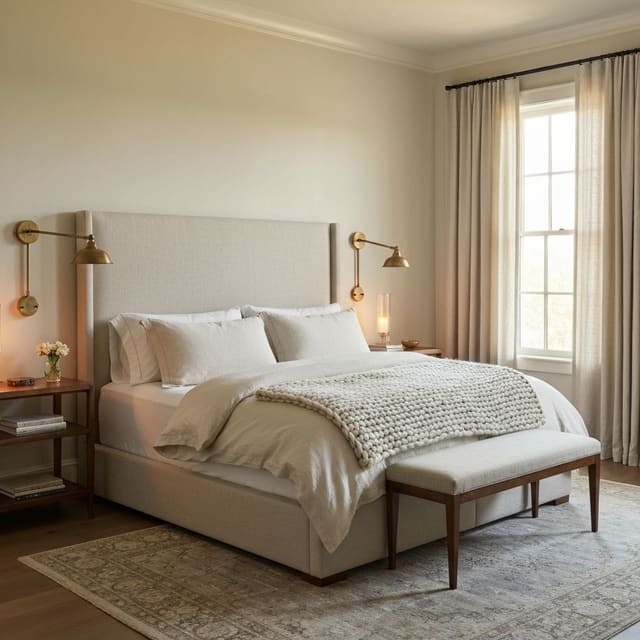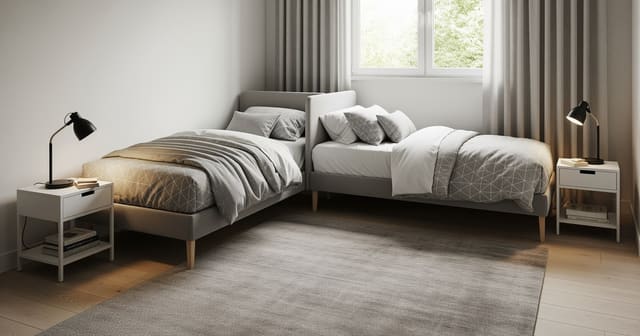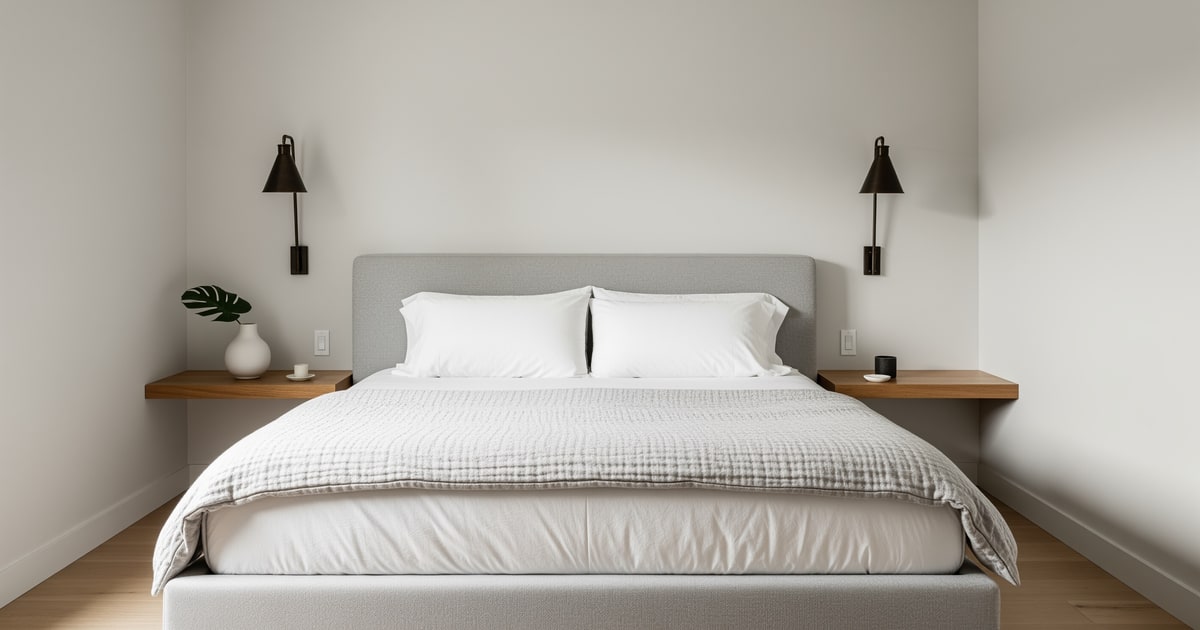
A king bed fits in a small bedroom of 110 square feet or more when the bed centers on the longest wall with at least 22 inches of walkway on each side, the side tables drop to 18 inches wide instead of 24, and the dresser moves to the closet or the opposite wall as a low credenza to keep the floor visually open. A king-size bed in a small bedroom is absolutely possible — it requires accepting a constraint on everything else. The bed is 76"x80". Most small bedrooms are 10'x10' to 11'x12'. The math works, but only if you commit to getting the clearances right, choosing furniture that's designed for the function and no larger, and letting go of the idea that the room needs to hold everything it currently holds. A bedroom centered on a king bed with two nightstands and nothing else reads far more considered than a bedroom trying to hold a king, a dresser, two chairs, and a reading nook.
Can you fit a king-size bed in a small bedroom?
Yes, if the room is at least 10'x10'. A standard king (76"x80") in a 10'x10' room leaves 12" on the headboard wall, 24" on each long side (the minimum for squeezing past), and 44" of foot clearance to the opposite wall. That clearance is tight but functional. An 11'x12' room is comfortable — 38" on each long side, 64" at the foot. The non-negotiable clearances: 24" on each side of the bed for circulation, 36" at the foot for the door and dresser clearance.
Minimum room dimensions and clearance specs
| Room width | King clearance per side | Verdict |
|---|---|---|
| 10' 0" | 14" | Very tight — no room for nightstands |
| 10' 6" | 17" | Tight — wall-mounted nightstands only |
| 11' 0" | 20" | Workable — narrow nightstands (14"–16" wide) |
| 11' 6" | 23" | Comfortable — standard nightstands |
| 12' 0" | 26" | Generous |
| Room length | Foot clearance | Verdict |
|---|---|---|
| 10' 0" | 40" | Comfortable foot clearance |
| 11' 0" | 52" | Dresser fits at foot |
| 12' 0" | 64" | Full dresser + door swing |
A 10'x10' room can hold a king, but only the king. Nightstands, dresser, and chair will need different solutions than you're used to.
Test this on your own room photo with ReDesign before you choose the final direction; keep the doorway, walls, windows, main furniture, lighting, and awkward fixed features visible so the preview solves the room you actually have.
The furniture trade-offs you have to make
The king takes the room. Everything else adapts.
- Nightstands become wall-mounted or floating. A standard nightstand is 24"–28" wide; in a 10'–11' room that's the entire clearance zone. Wall-mounted floating shelves at 24"–26" height and 10"–12" deep give you a surface for the lamp, phone, and water glass without blocking the circulation path.
- The dresser moves out of the bedroom. In a 10'x10' room with a king, the dresser doesn't fit without blocking a door or closing off a circulation path. Solutions: a wardrobe or built-in closet in the room, a dresser in the hallway (common in European apartments), or under-bed storage drawers.
- Under-bed storage becomes the primary drawer system. Platform beds with integrated drawers (IKEA Malm, Room & Board Metro, Pottery Barn Stratton) add 6–8 full drawers at no additional floor cost.
- Seating disappears. No bedroom chair or bench at the foot of the king in a room under 11'x12'. The foot of the bed is the bench; it's fine.
Bed frame choice matters more than you think
The frame adds visual volume to the king. In a small room, the wrong frame makes the bed dominate the room; the right frame disappears into it.
- Low-profile platform bed. A frame with a 6"–8" total height (no box spring needed) gives the room 3"–4" of additional perceived height and more visual floor plane. Compare this to a bed with a 16"–18" frame that cuts the room in half.
- No footboard. Footboards in small rooms block circulation at the end of the bed and make the bedroom feel smaller. Eliminate it.
- Upholstered headboard only, not wooden side rails. A fabric or upholstered frame reads softer and more integrated than a wooden platform with exposed rails.
- Color: match the wall tone or go lighter. A dark bed frame in a small room anchors too heavily. A lighter frame — natural wood, linen-upholstered, white oak — recedes into the room.
Lighting strategy for a king in a small room
A king in a small room already fills much of the visual field. The lighting needs to stay wall-mounted or ceiling-only — floor and table lamps compete for the limited floor space.
- Wall-mounted sconces at 60"–66" from the floor, one on each side of the bed. These replace the table lamps that would otherwise require nightstand real estate.
- Dimmable flush-mount ceiling fixture. Low-profile, diffused, 2700K. No ceiling fan unless the room is extremely hot — the blade span of a standard fan (52") takes up 30%+ of the ceiling visual field in a 10'x10' room.
- An LED strip under the bed frame. At 2700K, it adds a floating effect to the frame and provides enough ambient light for navigation without turning on the overhead.
The honest minimum for a king is not the mattress size; it is the circulation left after the frame. A king mattress is 76 by 80 inches, and many upholstered frames add 3 to 6 inches in both directions. In a 10 by 12 room, that can leave only 22 to 26 inches on the sides, which is workable for adults who do not need dressers beside the bed but too tight for bulky nightstands. Use wall-mounted sconces, 18 to 22 inch nightstands, and a bench only if the foot of the bed still has 30 inches clear. The calmer styling principles from master bedroom design matter more when the bed dominates the room.
The frame should be low and quiet. Platform beds with slim rails, spindle beds with open legs, or simple upholstered frames without wings make the king feel less massive. Avoid sleigh beds, storage drawers that cannot open fully, and footboards in rooms where the path crosses the bed. Renters can solve a lot with plug-in sconces and a headboard-only frame; owners can move outlets or add sconces so the layout feels intentional. If the room has only one window, check the light and curtain placement in single window bedroom lighting before centering the bed on the wrong wall.
Common mistakes when adding a king to a small room
- King and a queen-size dresser both in the same 10'x10' room. Pick one or move the dresser.
- King with footboard. Adds 12"–18" to the foot of the bed and blocks circulation.
- High-profile box-spring-plus-mattress setup. Adds 6"–10" of height and makes the room feel half the size.
- Dark frame in a dark room. Heavy dark bed in a low-light room makes the bed the room.
- Oversized nightstands. Must be wall-mounted or under 16" wide in rooms under 11' wide.
- Keeping oversized matching nightstands. The bed may fit, but the old nightstands often make the room fail. Scale the support pieces to the room, not the mattress.
- Buying a thick frame before measuring the path. The mattress may fit while the frame steals the last usable inches beside the bed.
Use AI design to preview your king before buying the frame
Committing to a king-size bed in a small room is an act of faith without a preview. AI design lets you photograph your bedroom and see the king frame, wall sconces, and floating shelves in the actual room — at the actual scale — before you order anything. The most common outcome: owners realize the king fits, feel confident, and order without second-guessing.
Frequently Asked Questions
What is the smallest room that fits a king-size bed?
A king (76 by 80 inches) fits in a room 11 by 10 feet or larger with at least 22 inches of walkway on each side and a path to the closet; below 10 by 10, a queen reads more designed. Use the room photo to compare the visible layout and fixed constraints before committing, because door swings, windows, outlets, storage reach, circulation, and existing furniture decide whether the idea survives daily use.
How do I balance a king bed visually in a small room?
Use two slim 18-inch bedside tables (not 24), two equally-sized lamps, and an oversized headboard so the bed wall reads symmetrical and intentional; small bedsides on a king look apologetic. Keep the preview honest by leaving the problem area visible in the frame, then compare one conservative version against one bolder version before you buy lighting, paint, furniture, or storage.
Where does the dresser go in a small king-size bedroom?
Move the dresser to the closet (as a low credenza inside), or to the wall opposite the bed as a low 36 to 48-inch wide piece; tall dressers compete with the bed for visual weight in a tight room. Check the result against ordinary movement first: drawer clearance, chair pullout, walkway width, glare, switch access, and sightlines matter more than a perfect catalog angle.
What rug size works under a king bed in a small room?
A 9 by 12 rug centered with two feet of bed on the rug works in 110 to 130 square feet; an 8 by 10 floats too narrow under a king and reads undersized. Use the image to narrow priorities and measurements before ordering anything custom; final purchases still need real dimensions, outlet locations, installation limits, and product clearances.
Should a small bedroom with a king have a footboard?
No — skip footboards, storage benches deeper than 16 inches, and tall trunks at the foot of the bed; a clear footboard zone lets the eye flow through the room and the floor reads larger. If the preview invents architecture or hides the awkward feature you need solved, rerun it with stricter instructions so the result remains tied to your actual room.
> Try this: Ready to see this on your own room? Open ReDesign and run the preview.
Three transformations to try
1. King bed with slim 18-inch bedsides and matching lamps 2. Low credenza opposite king bed replacing tall dresser 3. Footboard-free king bed with clear floor flow