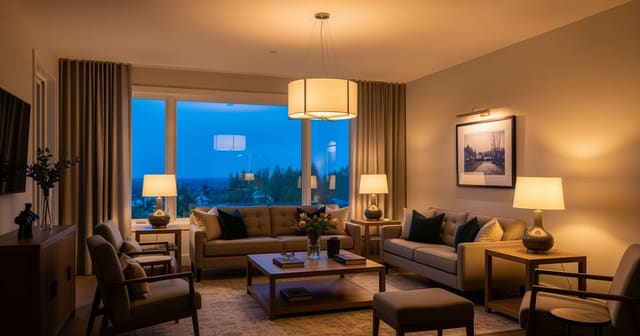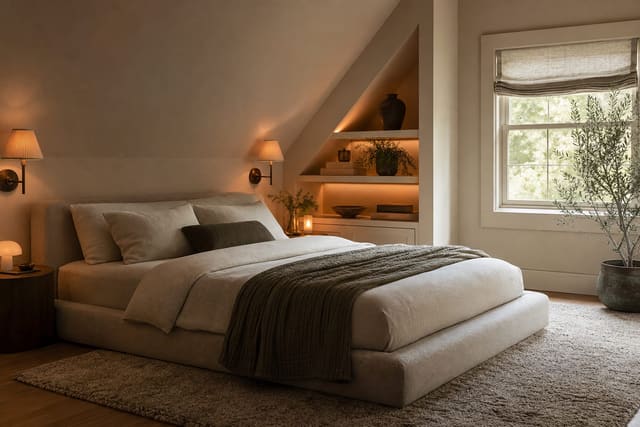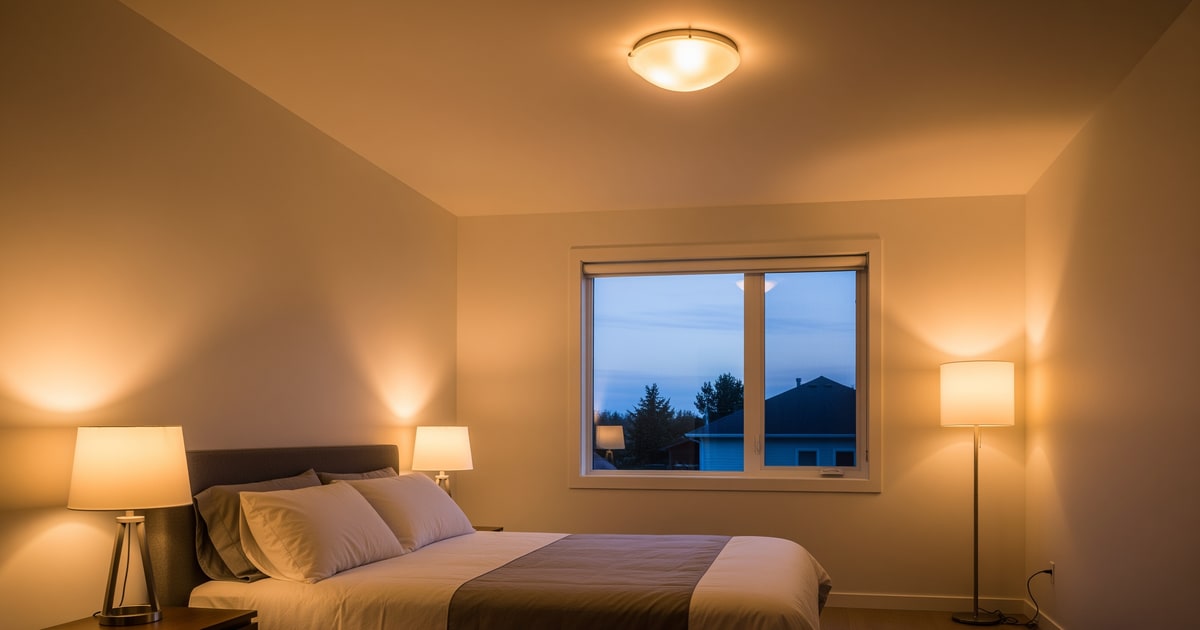
A single-window bedroom reads bright when the daylight side carries no curtain stack blocking the glass, the wall opposite the window gets a 30 to 40-inch mirror or pale art to bounce the light back, and three layers of artificial light (two 2700K bedside lamps, one floor lamp opposite the window, one overhead on a dimmer) take over from sundown. A bedroom with one window has more lighting decisions than a bedroom with three. The single window pushes daylight to one side of the room and leaves the rest dim; the standard fix is one overhead fixture, which then flattens the room and makes it feel even smaller. The actual fix is a four-zone plan that adds light where the window doesn't reach, at a Kelvin temperature that supports both getting ready in the morning and winding down at night.
How do I light a bedroom with only one window?
Light a bedroom with only one window by building four zones of light — overhead ambient, two bedside task, one accent — all at 2700K, all on dimmers, with the overhead and bedside layers wired or set up so you can run them independently. The morning routine wants the overhead and the bedside both at full; the wind-down routine wants the bedside at 20% and the overhead off entirely. The single biggest mistake in single-window bedrooms is putting every fixture on one switch.
The four zones, in priority order
- Two bedside lamps or wall-mounted reading lights. Non-negotiable. Symmetrical bedside lights make the bed read as the design anchor, double the available light at the brightest part of the room (where you read, scroll, or dress), and replace the overhead for late-night use. Plan on 60"–66" off the floor for a wall-mounted reading sconce or 24"–28" total fixture height for a table lamp on a 26" nightstand.
- One central overhead with a diffuser. A flush-mount or semi-flush with a glass globe, alabaster, or fabric drum at 2700K. Skip bare-bulb domes — they cast hard shadows and make the room feel rented. A modest ceiling pendant (10"–14" wide) works in rooms with 8'–9' ceilings; larger pendants and chandeliers work above 9'.
- A floor lamp in the corner opposite the window. This is the zone that single-window bedrooms most often miss. A 60"–66" floor lamp with a diffused shade fills the dark corner and balances the room visually. Spend $80–$150; Target, IKEA, and West Elm all make versions that look more expensive than they cost.
- One accent — a picture light, sconce, or table lamp on a dresser. Adds the warm low-angle glow that makes the room feel hotel-like rather than functional. A small ceramic lamp on the dresser with a 25W LED is plenty.
Test this on your own room photo with ReDesign before you choose the final direction; keep the doorway, walls, windows, main furniture, lighting, and awkward fixed features visible so the preview solves the room you actually have.
Bulb color temperature and dimming strategy
- 2700K everywhere. Cooler temperatures sabotage melatonin production. Even if you love a crisp morning light, you'll regret it at 10:45 p.m.
- Every fixture on a dimmer. A non-dimming bedroom light is a design crime. Even bedside lamps can be retrofit with a $15 in-line dimmer.
- Smart bulbs only if you want a sunrise/sunset routine. A Philips Hue or Wiz bulb on a schedule can simulate dawn and dusk, which is genuinely useful in single-window bedrooms where the window doesn't catch the actual sunrise. ~$15–$30 per bulb. Optional but powerful.
- No backlit screens count as part of the lighting plan. A TV on the wall opposite the bed is bedroom light pollution. If you have one, plan a bias light strip (2700K LED) behind the TV to soften the contrast.
Where the window goes wrong (and how to make it work harder)
- Hang curtains 4"–8" wider than the window and at least 4" above the trim so the visible window appears larger than it is.
- Linen Roman shades or wood blinds, not heavy drapes. Heavy drapes filter daytime light too aggressively in a single-window room.
- Add a sheer behind the primary curtain if you need privacy without blocking daylight. Two layers of fabric on one window do more than a heavier single layer.
- Mirror on the wall opposite the window. Bounces daylight into the far side of the room. A 30"x40" minimum is enough to make a difference.
The window should be treated as one layer, not the whole lighting plan. Place the bed so daylight lands across the side of the mattress or the foot, not directly into your eyes from behind the headboard. At night, use bedside lamps or sconces with shades 16 to 18 inches wide, warm bulbs at 2700K, and dimmers that can drop below 25 percent. Plug-in swing-arm sconces mounted 54 to 60 inches from the floor are often better than small table lamps because they free the nightstand and put light closer to reading height. That is the same retreat logic used in master bedroom design, just adapted to a room with weaker daylight.
Window treatment is the hidden product pick. Layer a light-filtering linen or cotton shade with blackout drapery that stacks beyond the glass by 8 to 12 inches on each side; the room gets daytime softness without giving up sleep. If you rent, a no-drill tension shade plus plug-in sconces handles most of the fix. Owners can add a ceiling box centered on the bed or switch-controlled sconces, but they should still keep the evening plan lamp-led. For rooms that also double as TV or reading spaces, borrow the ambient-task-accent split from living room layered lighting rather than asking one ceiling fan light to do everything.
Furniture finish decides whether the single window feels generous or isolated. Pale oak, cane, linen, matte plaster, and warm white painted pieces keep daylight moving deeper into the room. Heavy espresso furniture, glossy black frames, and blue-gray bedding absorb the one light source before it reaches the far corner. A small mirror can help, but only if it reflects the window or a lamp; over the dresser facing a closet door, it is just another object.
Common single-window bedroom mistakes
- One overhead light, nothing else. The default. Flat, harsh, makes the room feel small.
- Cool-white bulbs to "wake up better." Wake up with a sunrise lamp instead and protect the rest of the room from cool light.
- Skipping the dark-corner floor lamp. The single most consequential fix for a single-window room.
- A bedside lamp on only one nightstand. Asymmetry in bedside lighting reads as unfinished, even if only one person sleeps in the bed.
- Heavy black-out curtains hung tight to the window. Crushes the daylight you do have.
- Forgetting the dimmer. Required for both ends of the day.
- Putting the mirror wherever it fits. A mirror that reflects the closet door or a dark corner adds clutter, not light. Angle it toward the window or a pale wall instead.
- Treating blackout curtains as the only window decision. Sleep matters, but daytime filtering and curtain stack width decide whether the room feels dark all day.
Use AI design to preview your bedroom with the lighting plan
It's hard to picture how three lamps, a mirror, and a flush-mount transform a bedroom until you see it. AI design lets you photograph the existing room and preview the four-zone version — with the right curtain treatment and a mirror on the opposite wall — alongside the current state. Owners who hesitate on a $300 lamp purchase commit instantly when they can see the result.
Frequently Asked Questions
How do I make a one-window bedroom feel less dark?
Mount curtains 6 inches above the casing and extend 12 inches past on each side so the curtain stack does not block the glass; this alone increases morning daylight by 20 to 30 percent. Use the room photo to compare the visible layout and fixed constraints before committing, because door swings, windows, outlets, storage reach, circulation, and existing furniture decide whether the idea survives daily use.
Where should the bed go in a one-window bedroom?
Perpendicular to the window wall whenever possible — the bed gets indirect light, the dresser or workspace gets direct daylight, and the room reads brighter than placing the bed under the window with the dresser in shadow. Keep the preview honest by leaving the problem area visible in the frame, then compare one conservative version against one bolder version before you buy lighting, paint, furniture, or storage.
Can a mirror help a dark bedroom?
Yes — a 30 to 40-inch mirror on the wall opposite the window bounces 15 to 25 percent of the daylight back into the room; tilt the mirror toward the window, not the floor. Check the result against ordinary movement first: drawer clearance, chair pullout, walkway width, glare, switch access, and sightlines matter more than a perfect catalog angle.
What artificial lighting setup works in a one-window bedroom?
Two matching 2700K bedside lamps on dimmers, one floor lamp on the wall opposite the window, and one overhead on a dimmer; cool overhead bulbs make a dim room read clinical instead of warm. Use the image to narrow priorities and measurements before ordering anything custom; final purchases still need real dimensions, outlet locations, installation limits, and product clearances.
What wall color works best in a one-window bedroom?
Warm off-white, warm greige, or pale linen — colors with a yellow or red undertone — keep a dim room from reading cold; cool grays and white-whites read gray and gloomy in low daylight. If the preview invents architecture or hides the awkward feature you need solved, rerun it with stricter instructions so the result remains tied to your actual room.
> Try this: Ready to see this on your own room? Open ReDesign and run the preview.
Three transformations to try
1. Curtains mounted high and wide above window 2. Mirror opposite window bouncing daylight 3. Three-layer lamp setup at evening