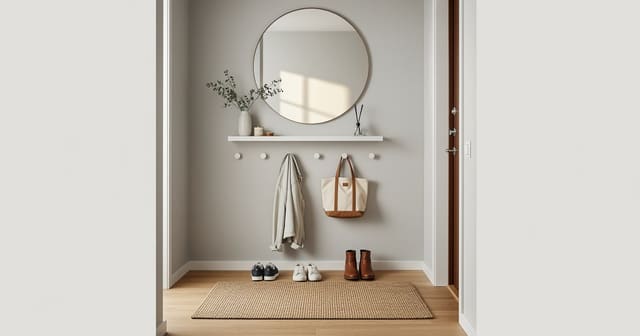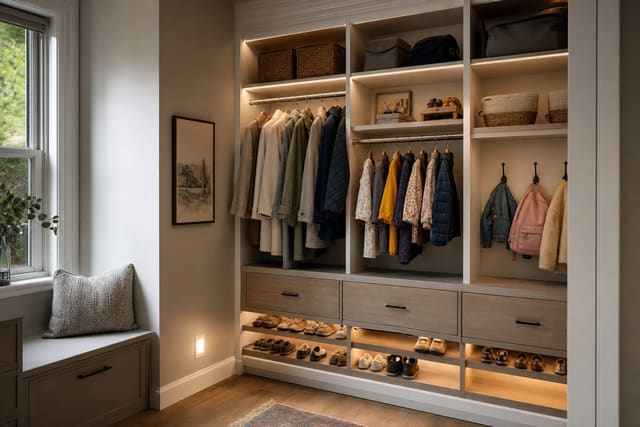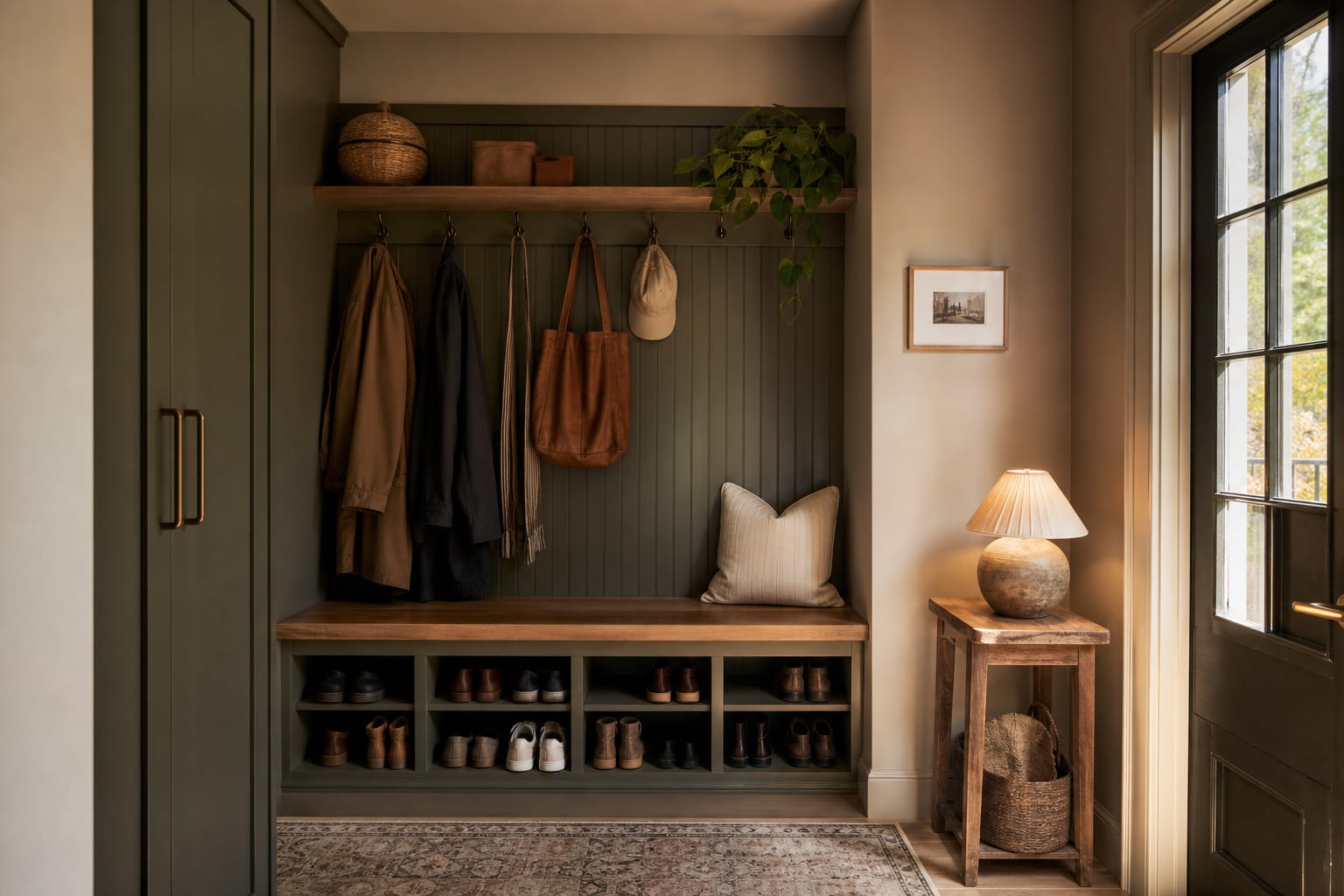
A closet becomes a real mudroom when the door comes off (or becomes a barn slider), a 16 to 18-inch deep bench at 18 inches off the floor anchors the seated zone, a 60 to 72-inch hook or peg rail handles coats, and one bin per person sits below for shoes and gear. The goal is a narrow, honest entry station that catches jackets, bags, keys, and wet shoes before they spread through the house — not a coat cave that keeps its old closet habits.
How do you make a mudroom out of a small closet?
Turn the closet from hanging storage into open entry storage: remove or swap the door, install hooks, add a shallow seat or shelf, use the floor for shoes, and reserve the top for closed bins. Order matters, because a 30-inch-wide closet cannot forgive random storage.
Start with the door. A hinged door often steals the exact floor space where a bag or boot tray needs to land. In a narrow hall, removing it and finishing the trim can make the entry feel wider; if you want visual calm, use a flat panel curtain on an inside-mount track rather than billowy fabric that catches backpacks.
Use the back wall as the command wall. Mount hooks 60 to 66 inches up for adults and 42 to 48 inches for kids, in two staggered rows so wet sleeves get air. Leave 4 inches between hooks for slim coats, 6 inches for winter gear or backpacks.
Give the floor a real shoe plan. A boot tray 12 to 15 inches deep works in most closets; a two-tier rack doubles capacity if tall boots live elsewhere. A low cubby with 10- to 12-inch openings keeps shoes visible enough that people actually use it.
Should the closet stay closed or go fully open?
Closed storage hides mess but also hides the system; open storage exposes bad habits but makes the drop zone easy for tired people to follow. If the entry is visible from the living room, keep the opening visually quiet: paint the interior to match the wall or one shade deeper, in a scrubbable satin or eggshell finish.
If the closet sits near a side or garage door, function should outrank minimalism. Mudroom ideas for busy entries accept that keys, forms, umbrellas, and pet gear all arrive at once — every category needs a predictable inch.
Think in zones bottom to top: the bottom 16 inches for shoes or a waterproof tray, the middle 18 to 48 inches for kids' hooks, leashes, and bag hooks, and 60 to 84 inches up for adult coats and seasonal bins. A bench isn't mandatory — in a closet under 36 inches wide, use a 10- to 14-inch ledge instead, or a slim stool beside the closet.
Test this on your own room photo with ReDesign before committing; keep the doorway, walls, windows, and fixed features visible so the preview solves the room you actually have.
Which small mudroom ideas earn their space?
The best ideas remove friction from the first 30 seconds after walking in: coat off, shoes contained, keys landed, floor still passable.
- Hook rail over individual hooks on crumbly or unknown walls — a 24 to 36-inch rail anchors into studs and spreads weight.
- Shallow shelf above hooks, 10 to 12 inches deep, only if heads and bags still clear it (a 15-inch shelf can flare coats forward in a shallow reach-in).
- Washable back wall — beadboard, paneling, or painted plywood run at least 48 inches high; renters can use peel-and-stick vinyl panel.
- Warm lighting first — a battery picture light or rechargeable puck at 2700K to 3000K before you buy baskets.
- Locker logic without lockers — one hook, one shoe spot, one bin per person; see mudroom locker ideas for narrow spaces for slimmer lanes.
- Small mirror, off to the side — 12 to 18 inches wide, away from the bag impact zone and not on the back wall opposite the front door.
What mistakes ruin a closet mudroom conversion?
| Mistake | Why it fails | Fix |
|---|---|---|
| Keeping the full hanging rod | Wastes the back wall, shoes fight for floor space | Shorten hanging to one side; give the rest to hooks and shelves |
| Bench too deep (20+ in) | Pushes knees into the hall, no room for a tray | Use 12 to 16 inches deep |
| One giant shared basket | Becomes a family argument with handles | Smaller bins by person or item, loosely labeled |
| Ignoring the floor finish | Mud, salt, and wet leaves damage wood or carpet | Add a removable runner, rubber tray, or cut-to-fit vinyl mat |
| Copying a full-size bench wall | Thick trim and deep cubbies stuff a small space | Keep only what fits: mudroom bench storage ideas scaled down |
How can AI help preview a closet mudroom conversion?
AI design suits a closet mudroom because the project is small but the visual tradeoffs are immediate. Upload a straight photo of the closed closet, one with the door open, and one wider shot of the surrounding hallway.
Ask for specific versions: door removed, warm paneling, two rows of black hooks, wood shelf bench, black boot tray — versus a curtained version with closed upper bins and hooks on one side only. Compare whether your entry needs openness, concealment, or stricter zones.
Check depth in the preview: does the bench project too far into the hall, will backpacks hit the trim, does a dark interior read richer or smaller? AI can't confirm studs or wall strength, but it exposes the design direction before you buy hooks, bins, and lumber.
Before ordering, tape it out in real life. Mark hook heights at 44 and 64 inches, tape the bench depth on the floor, stack shoes where the tray would sit, and have a child or partner hang a coat without instructions.
Frequently Asked Questions
How small can a mudroom be and still function?
A converted closet at 12 to 16 square feet (24 to 36 inches wide by 24 to 30 inches deep) works for a 2 to 4-person household with a bench, hooks, and one bin per person.
Should I remove the closet door when converting to a mudroom?
Yes for daily use — the door takes up needed space and slows access. Switch to a barn slider, café curtain, or pocket door instead if visual closure matters when guests arrive.
How tall should mudroom hooks be?
Mount adult hooks 60 to 66 inches off the floor and kid hooks 36 to 48 inches. A single peg rail at 60 inches can serve both if kids reach the lower pegs.
What bench depth works in a mudroom closet?
A 16 to 18-inch deep bench at 18 inches off the floor seats an adult comfortably while leaving room for hung coats behind it. Deeper than 18 inches eats into the walkway in a tight closet.
How do I store shoes in a small mudroom?
Use one labeled bin per family member under the bench, or a 4 to 6-tier stacked shoe shelf along one wall. Floor-pile shoes turn a designed mudroom back into a plain closet within a week.
> Try this: Ready to see this on your own room? Open ReDesign and run the preview.
Three transformations to try
1. Doorless closet mudroom with bench and peg rail 2. Barn slider closet mudroom with hidden bins 3. Kid-height hooks and labeled shoe bins