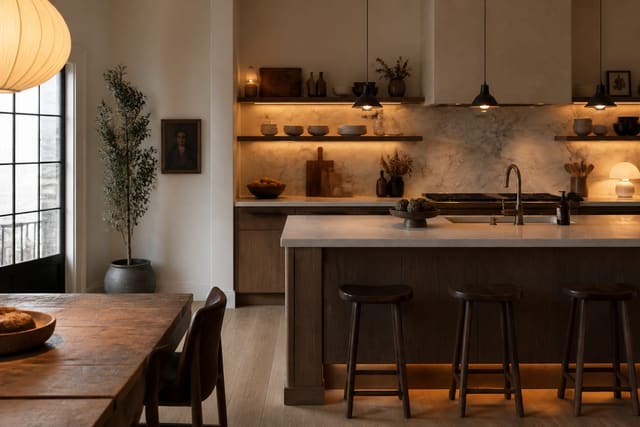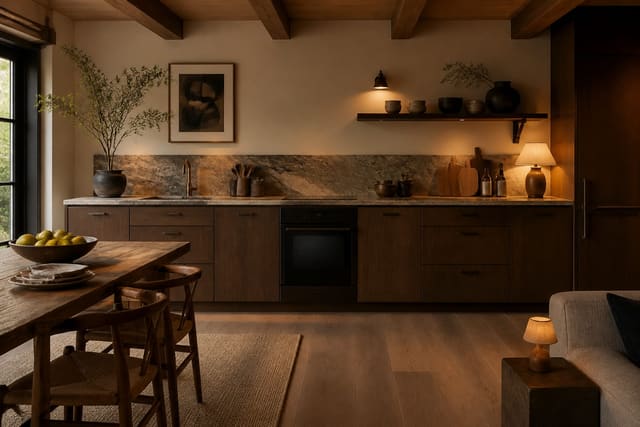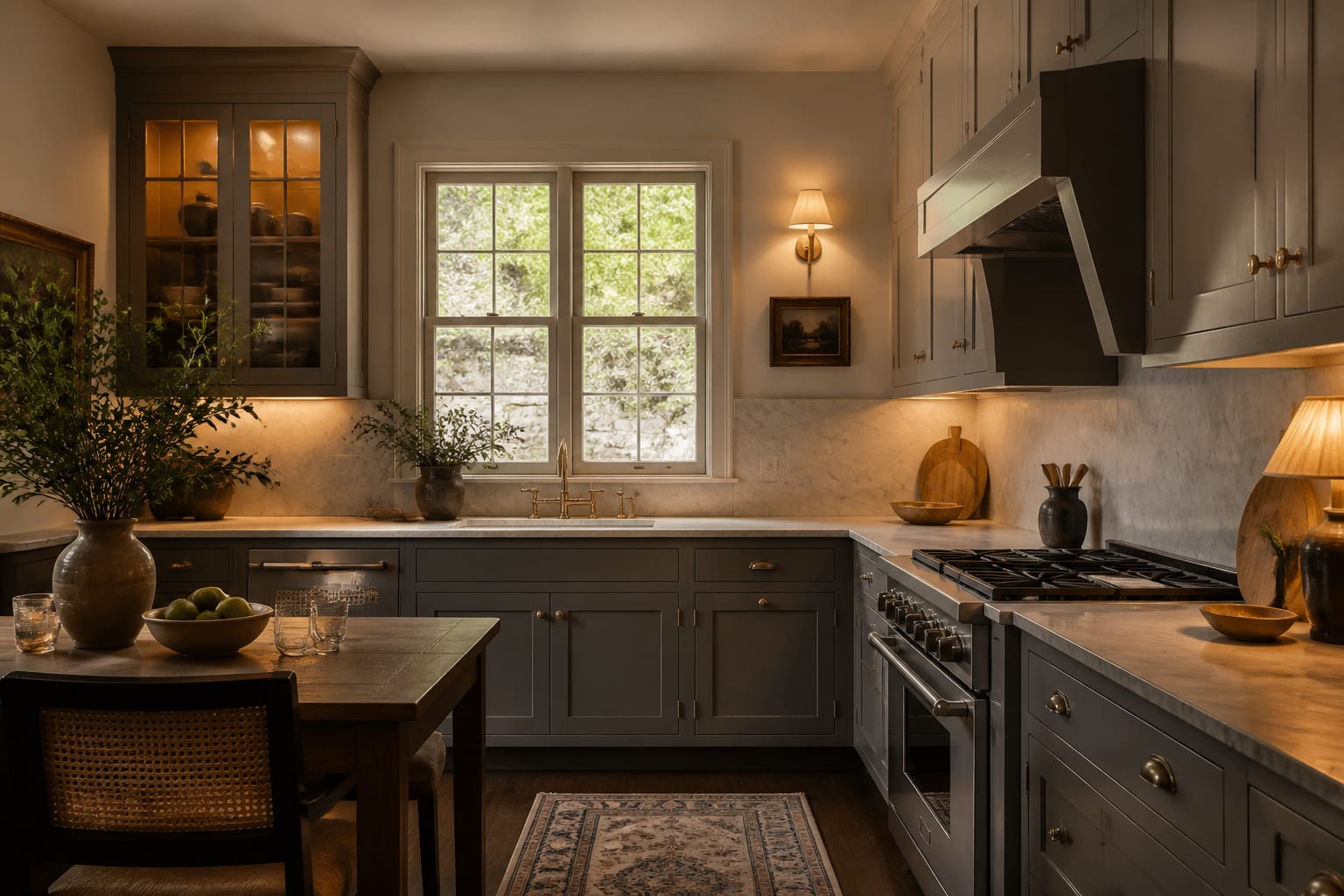
A U-shaped kitchen surrounds the cook with counter and storage on three connected runs, and that abundance is both its gift and its trap. Wrap the walls too tightly and the interior turns into a collision zone; open them up and you lose the very efficiency the shape promises. The number that governs everything is the clear distance across the inside of the U, because it decides whether two people can work without bumping or whether one cook feels boxed in. Get that interior width right, solve both corners deliberately, and a U gives you more usable counter than any other single layout.
Why does a U-shaped kitchen need 60 inches of interior width?
The defining measurement of a U is the clear gap between the counter faces on the two parallel runs, and 60 inches is the floor you should not go below. At that width one cook can turn from the sink to the opposite counter without shuffling, and an open oven or dishwasher door still leaves room to step past. Drop under 48 inches and the U becomes a trap where two appliance doors can meet in the middle and pin you in place.
If the room allows, widen the interior to 64 or 72 inches when two people will cook together, because each open door and each body needs its own slice of that gap. The trade-off cuts the other way too: stretch the interior past about 10 feet and the U stops feeling efficient, since you start walking across the room for every ingredient instead of pivoting. The sweet spot keeps the three runs close enough to form a tight triangle yet far enough apart that opposing doors and elbows never argue over the same patch of floor.
See also our guide to Open Shelving Kitchen Ideas for more on u shaped kitchen ideas.
How do you solve the two corners in a U-shaped layout?
A U has two inside corners rather than the single one an L deals with, so corner planning carries double the weight here. Each junction wants its own solution, and mixing types often works best: a lazy Susan in the corner you load with pots and pans, and a magic-corner pull-out in the one nearer the prep zone where you want everything to come forward. Planning both before you order is essential, because each corner cabinet sets the width of two adjoining runs at once.
The uppers add a second corner puzzle above the counter. Wall cabinets meeting at a corner can clash, so either use a dedicated corner wall unit or stop one run short and let the other continue past it. Some cooks skip a corner upper entirely and hang a shelf or leave the wall open, which lightens a layout that already carries a lot of cabinetry. Treat the two corners as a pair and design them together, since a decision made for one bottom corner ripples through the cabinet runs feeding the other.
For a related angle on u shaped kitchen ideas, read One Wall Kitchen Ideas.
Should a U-shaped kitchen keep full upper cabinets or open up?
Three walls of base and wall cabinets deliver enormous storage, but full uppers on all three runs can make a U feel like a cockpit. The fix is to choose where to relax. Keeping uppers on the two side runs while opening the back run with a window, open shelving, or a tall pantry gives you both ample storage and a place for the eye to rest.
Light is the other lever. Because three walls of cabinetry cast shadows, generous under-cabinet task lighting and a wide window on one run keep the interior from feeling cave-like. If you crave the storage but fear the closed-in feeling, raise the uppers to a 10 foot ceiling and add glass fronts so the upper tier reads lighter. The decision comes down to how much you cook versus how open you want the room to feel: a serious cook will trade some airiness for the counter and storage that three full runs provide, while an open-plan home often opens at least one wall to stay connected to the living space.
What kind of cook is a U-shaped kitchen best for?
A U-shaped kitchen rewards the cook who values counter and storage above all, because no other single-room layout wraps as much working surface around one person. The three runs put the sink, range, and refrigerator on separate walls, forming a compact triangle where every fixture sits a short pivot away. For batch cooking, baking, or a household that genuinely uses the kitchen every day, that surrounding counter is hard to beat.
The shape asks for a certain amount of floor in return. You need enough width to honor the 60 inch interior and enough wall length on all three sides to make the wrap worthwhile, which is why a true U suits medium to large rooms more than tiny ones. In a generous space you can even add an island in the open mouth of the U, though only if the interior aisles still clear 42 inches all around. For the dedicated home cook with the room to spare, the U remains the most productive kitchen you can build.
Here are the common mistakes to avoid: - Letting the interior width fall under 48 inches so opposing appliance doors collide in the middle. - Planning only one corner solution when a U-shape actually hides two inside corners to solve. - Wrapping all three runs in full upper cabinets until the kitchen feels like an enclosed cockpit. - Stretching the U so wide that you walk across the room instead of pivoting between stations. - Skipping under-cabinet lighting and leaving the three-walled interior shadowed and cave-like. - Dropping an island into the mouth of the U without keeping a 42 inch aisle on every side.
Bring the look home with Re-Design
The biggest U-shaped risk, an interior that feels boxed in, is exactly what a preview catches before you build. With Re-design you upload a photo of your room and see three runs wrapped onto your real walls, then test full uppers against an open back wall to judge how enclosed each version feels in your own light. Widen the interior in the preview and watch the floor open up, or add glass-front cabinets and see the upper tier lighten instantly. Working through these choices from a single upload means you commit to the storage-versus-openness balance you actually liked, not a guess on paper.
Frequently Asked Questions
What is the minimum room size for a U-shaped kitchen?
You need enough width to hold a 60 inch clear interior plus two 24 inch counter depths, so the room should span at least 108 inches, roughly 9 feet, wall to wall. The runs also need useful length on all three sides, which is why true U-shapes suit medium and larger rooms rather than very small ones.
Can a U-shaped kitchen have an island?
Only if the interior is generous. You can place an island in the open mouth of the U when the room is large enough to keep 42 inches of aisle on every side of it. In tighter U-shapes the three runs already provide ample counter, so an island usually crowds the interior rather than helping.
How do I stop a U-shaped kitchen from feeling closed in?
Open at least one run by replacing upper cabinets with a window, open shelving, or a tall pantry, and add strong under-cabinet task lighting to lift the shadows three walls create. Glass-front uppers and a 10 foot ceiling height also lighten the top tier so the wrapped layout breathes more easily.