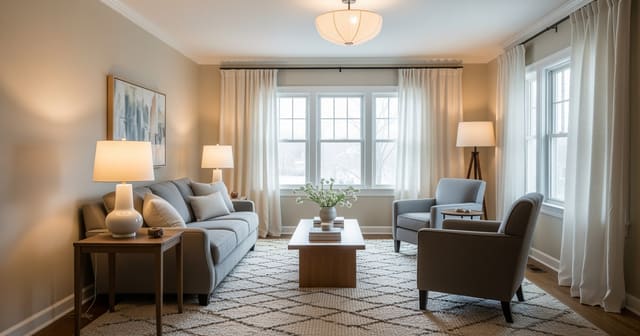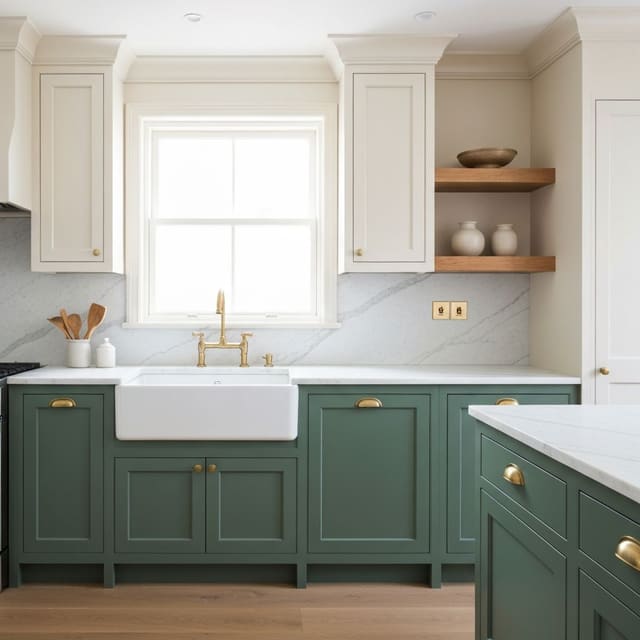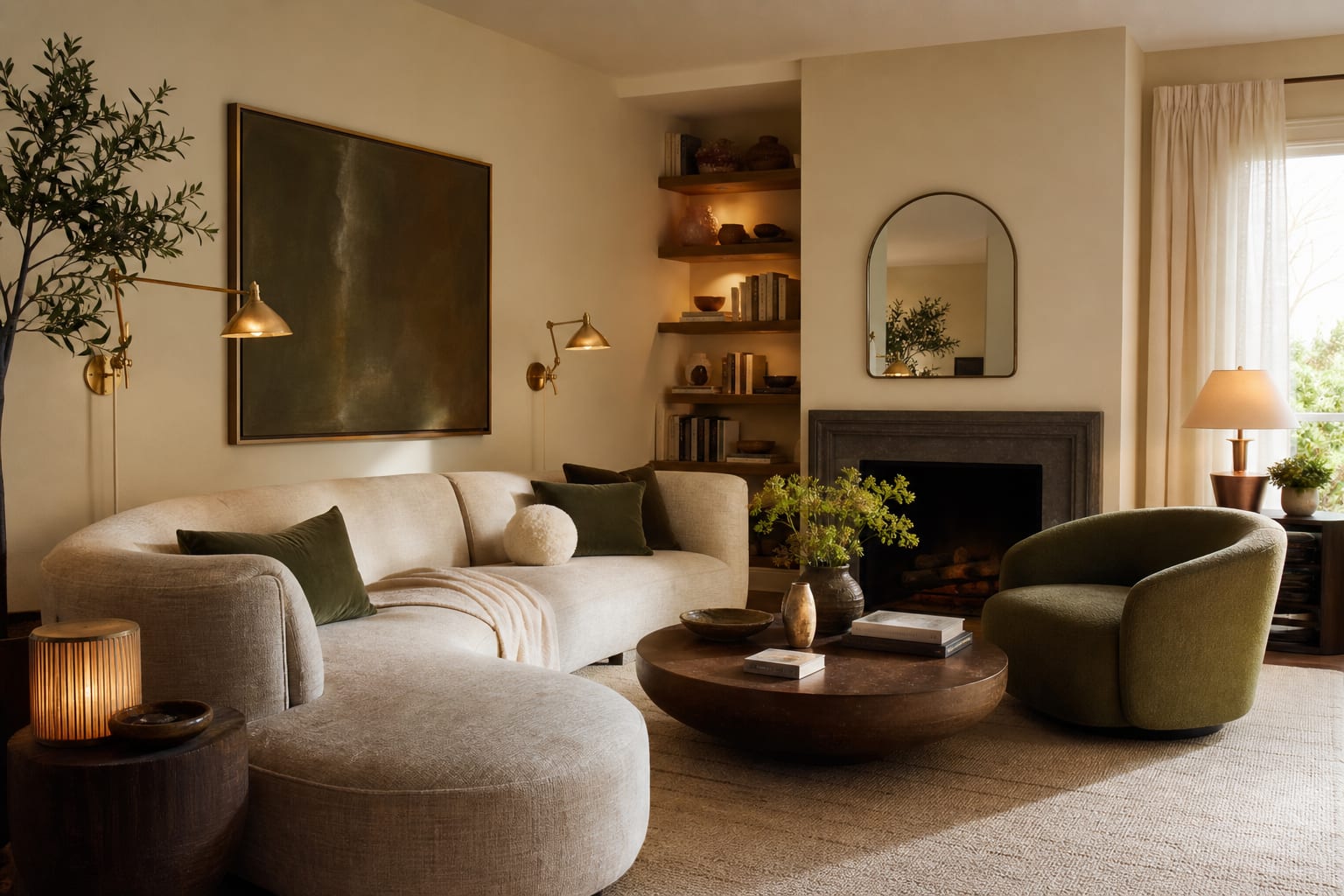
A 1990s color scheme updates with AI when you photograph the room, mark the dated finishes to swap (oak cabinets, hunter green accent wall, brass-and-glass fixtures, salmon-pink carpet), and preview palette directions — warm modern neutrals, sage and walnut, or warm whites and brass — before paying for paint or replacement work. The usual mistake isn't one bad color; it's treating every dated color as equally important. A stricter palette, better light, and the right sequence fix more than a full gut job.
What is the cleanest way to update a 1990s color scheme?
Choose one fixed finish to respect, mute the dated accent colors, replace shiny brass selectively, and repeat a calmer neutral through paint, textiles, lighting, and hardware. This is a ranking exercise, not a total purge.
Start with surfaces that cost real money to change: flooring, tile, countertops, large sofas, built-ins, and cabinets. If the house has pink beige tile, cherry cabinets, or honey oak floors, those finishes vote before any paint swatch does. Fighting them with cold gray usually makes an update look newer but not better.
Most 1990s palettes need one of three routes:
| Fixed finish | New direction |
|---|---|
| Warm beige, honey wood, cream tile | Softened white, oatmeal, camel, olive, tobacco, warm black, aged brass |
| Pink beige or mauve | Taupe, mushroom, plum-brown, stone, muted blue, dark bronze |
| Hunter green or burgundy still dominant | Keep one deep color as accent; reduce the rest to small moments |
A practical balance is 70% calm background, 20% warm or earthy support, and 10% sharper contrast — cream walls, walnut furniture, olive textiles, black frames, for example. Stop letting mauve, brass, green, burgundy, oak, and beige all speak at full volume.
If the walls are still original tan, see the strategy in updating builder beige walls without a big renovation. Beige from the 90s often looks worse because the lighting and textiles around it are vague, not because beige itself is impossible.
Which 1990s colors and finishes deserve to stay?
Keep pieces with good material, useful scale, or architectural value. Replace what's flimsy, glossy, undersized, or repeated so often it feels packaged.
Honey oak can stay when it's real wood in good condition, balanced with cream, olive, black, clay, or muted blue — it struggles beside icy gray walls and chrome everything. Burgundy can become elegant in a single rug, print, or pillow but dated when it covers a sofa, valance, and dining chairs.
Mauve needs the most discipline. A small amount of dusty rose works with mushroom, taupe, cream, walnut, and black; a full mauve-and-green scheme usually needs editing. If mauve carpet stays for budget reasons, don't add more pink beige — use cream, warm charcoal, olive-gray, and walnut to quiet it.
Brass itself isn't the enemy — high-gloss yellow brass on every hinge and knob is. Keep brass where the shape is clean and the tone is softer, like aged brass picture lights or simple cabinet pulls. Tiny shiny knobs and scroll chandeliers age a room from across the doorway.
Dark stained paneling deserves its own judgment: some rooms hide genuine woodwork under bad styling, others just have thin sheet paneling. Compare paint, removal, and preservation options in the dark wood paneling update guide before covering everything in white primer.
Test this on your own room photo with ReDesign before choosing a final direction; keep the doorway, walls, windows, main furniture, and awkward fixed features visible.
Common mistakes that make a 90s update look worse
The first mistake is replacing every dated color with cool gray. Blue-gray walls beside honey oak, mauve tile, or warm brass can make old finishes look louder. Choose warm white, mushroom, olive-gray, flax, or putty instead when fixed surfaces are warm.
The second mistake is keeping the wallpaper-border spirit alive in new form — swapping a floral border for tiny gallery frames or patterned valances keeps the same chopped-up feeling. Use fewer, larger moves: one 30 by 40 inch artwork, full-height curtains, or a single rug with real scale.
The third mistake is changing hardware without changing lighting. Choose bulbs in the 2700K–3000K range for living spaces and 90 CRI or higher so paint, wood, and fabric read accurately. A 14–18 inch fabric lampshade often does more for a dated room than another decorative tray.
The fourth mistake is buying tiny accents in a trendy color — one sage pillow can't pull a whole palette forward. Repeat the new direction at low, middle, and high levels: a rug, a fabric, and art above eye level.
The fifth mistake is ignoring window treatments. Short balloon valances and shiny rods are fast 1990s tells. Mount rods 7–10 inches above the casing, extend them 8–14 inches wider than the window, and let linen or cotton panels in cream or mushroom finish just above the floor.
How AI design helps you preview the update before you buy
AI design works well here because the problem is relational: mauve changes beside oak, brass changes under warm bulbs, and hunter green changes when the rug gets lighter. Uploading a real photo lets you test a palette before buying paint or donating furniture that may only need better surroundings.
Photograph the room from the main doorway so the image includes the floor, windows, largest furniture, and trim. Don't crop out the awkward tile or dated brass — those fixed pieces are what the preview needs to solve.
Run focused versions, not fantasy renovations: one that keeps beige walls but changes textiles and hardware, one with warm white walls and olive accents, one with mushroom and dark bronze. If the tool replaces the floors, cabinets, and windows in every version, narrow the prompt until the room still looks like yours.
This also reveals bad lighting — a generated room may just look cleaner because the light is more even. If your room has one dim ceiling fixture, pair the color plan with creating fake natural light in any room.
Use the best preview to build a shopping list in order: paint samples on 12 by 18 inch boards before gallons, one hardware sample before forty pulls, one curtain panel before a whole-house order.
What should you change first for the biggest 90s-to-current shift?
Start with lighting and the largest soft surfaces. Replace weak bulbs, add lamps at seated height, and remove shades that are too small or yellowed. Then address curtains, rugs, and upholstery before attacking every cabinet and fixture.
In a living room, start with a rug large enough to connect the seating — 8 by 10 feet minimum for a standard sofa and two chairs, 9 by 12 feet in larger rooms. Choose a pattern that includes one existing fixed color in a small amount.
In a bedroom, change bedding before case goods. Ivory, oatmeal, muted blue, or mushroom bedding softens cherry or honey furniture without pretending the set is new. Add two lamps with wide shades, then update frames in black, dark bronze, or aged brass.
In a kitchen or bath, decide whether brass, tile, or wall color is doing the most damage from the doorway. If tile and cabinets are sound, start with bulbs, a simpler fixture, and a wall color that respects the fixed undertone.
A 1990s home becomes current when the palette is edited, the metals are chosen instead of inherited, and the lighting finally lets the good materials look intentional.
Frequently Asked Questions
What 1990s colors look most dated today?
Hunter green walls, salmon and dusty rose carpets, peach-toned tile, brass-and-glass fixtures, mauve and grey-blue accents, and high-contrast oak-against-white-laminate kitchens read as the most dated 1990s tells.
What palette replaces 1990s colors best?
Warm whites or warm greiges on the walls, walnut or oak wood tones (returned as a feature, not a default), one muted accent (sage, navy, terracotta), and matte black or unlacquered brass hardware replace the 1990s palette without erasing the era's warmth.
Can AI design preview new colors in my actual room?
Yes — upload one photo of the room, ask the AI to keep the architecture and furniture fixed and swap the wall color, cabinet color, or carpet to your tested palette; this previews the update before any paint or replacement work.
What single 1990s color update has the biggest impact?
Replacing the wall color with a warm off-white or warm greige delivers the biggest visual update for the lowest cost; saturated 90s wall colors (hunter, dusty rose, peach) read as the loudest era tell in every room.
Should I keep any 1990s finishes when updating?
Yes — solid oak floors, brass fixtures (when unlacquered or aged), and solid wood furniture often read modern in a current palette. Ripping out everything is rarely the cheapest or best-looking path.
> Try this: Ready to see this on your own room? Open ReDesign and run the preview.
Three transformations to try
1. Warm-greige walls replacing 1990s hunter green 2. Walnut cabinet refinish with warm-white walls 3. Brass and navy accent replacing peach-and-mauve