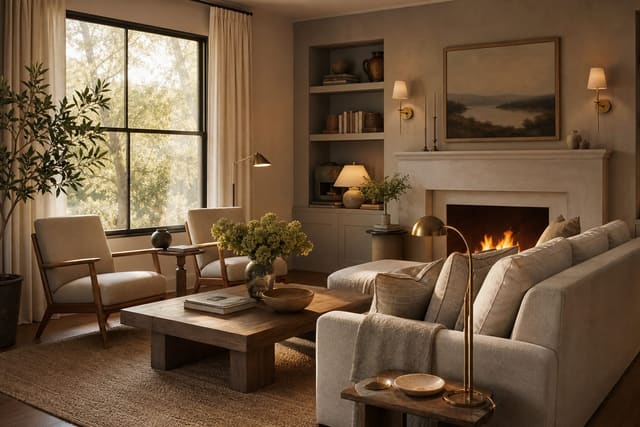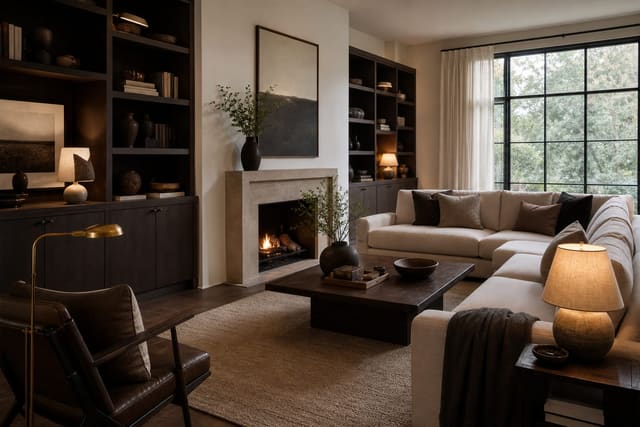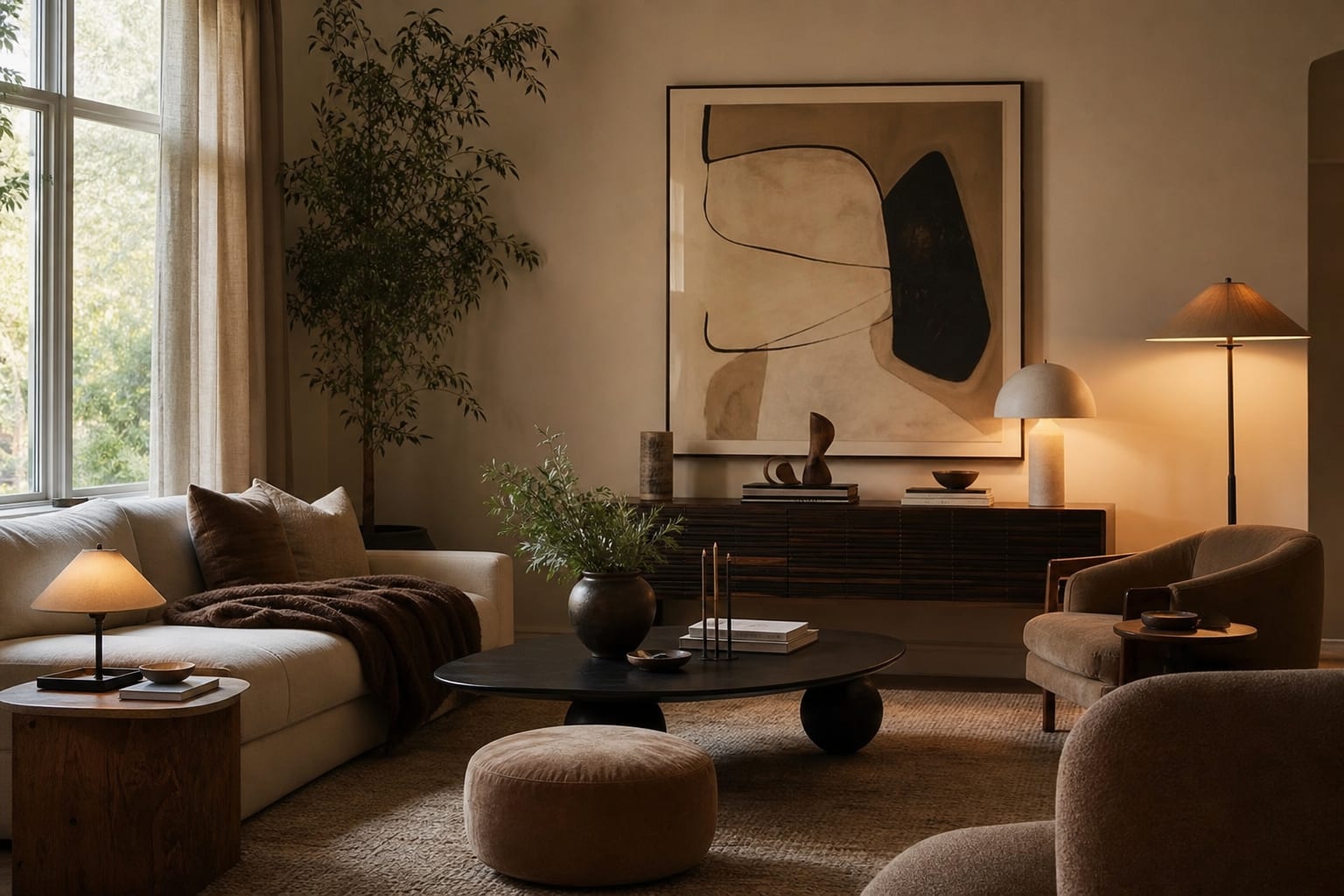
Builder beige walls update best by picking one route—warm white (Alabaster, White Dove), warm greige (Agreeable Gray, Edgecomb Gray), or a deep contrast accent wall—tested against your existing trim and floor before buying paint. Beige isn't ugly by default; it's usually undirected. Pick whether to cooperate with the undertone, cool it, or contrast it, and the room stops feeling like a default setting.
Which route fixes your builder beige walls?
Start by identifying the undertone. Hold a plain white sheet of paper against the wall in daylight; if it turns peach, yellow, green, or gray beside the paper, that's your family. Don't buy a rug, curtain, or sofa fabric until you know which direction the wall leans.
Check fixed finishes next: flooring, tile, countertops, and any sofa you won't replace. These outrank pillows because they occupy more visual space and cost more to change.
- Warm route — beige leans yellow, sand, or camel. Add ivory, oatmeal, cognac, olive, unlacquered brass, warm black, and keep bulbs at 2700K–3000K.
- Cool route — beige has a gray or pink cast. Bring in mushroom, taupe, slate blue, soft charcoal, and brushed nickel; avoid icy white trim, which can make beige look dirty by comparison.
- Contrast route — walls stay as-is. Use black frames, deep green, navy, or terracotta, repeated at least three times so it reads as design, not clutter.
If the room still feels flat, fix the light before judging color — see creating fake natural light in any room. Test your own room photo with ReDesign before committing, keeping walls, windows, furniture, and fixtures visible in the shot.
What changes make builder-grade paint look intentional?
The fastest wins are the surfaces that touch the wall visually: curtains, art, lighting, and one large textile.
- Hang curtains higher and wider — rod 6–8 inches above the casing, 8–12 inches past each side, panels finishing about 1/2 inch above the floor.
- Match art to the undertone — ivory, rust, olive, and black for warm beige; charcoal, muted blue, and stone for cool beige. Over a sofa, art should run roughly two-thirds the sofa width.
- Upgrade lampshades and bulbs — a 14–18 inch linen shade plus high-CRI bulbs softens the room's edges. A mirror only helps if it reflects a lamp, window, or pale surface — see using mirrors to amplify light.
- Address trim — warm white trim cleans up yellow beige; charcoal trim sharpens the contrast route. Renters can fake the edge with black curtain rods, framed art, and peel-and-stick molding.
Common beige wall mistakes that keep the room bland
- Sticking to mid-tones only. Beige wall, tan sofa, medium wood table, and oatmeal rug leave the eye nowhere to land; add one light large surface or a dark repeated accent for range.
- Choosing white that's too clean. Bright white or blue-white bedding can make warm beige look yellow by comparison; use ivory, flax, or warm white instead.
- Ignoring the floor. Beige walls next to beige carpet need a rug with real contrast and texture, even a flatweave with charcoal or rust lines.
- Spreading accents evenly instead of repeating one. Pick a single accent color and repeat it low (rug), middle (pillows), and high (art or lampshade).
- Treating open zones as separate. Beige often runs through halls and living rooms together; keep neighboring zones quieter and let one area carry the strongest accent — see a room with too many doorways.
Use AI design to test beige walls before paint
AI previews matter here because a swatch can look right and still fail across four walls. Photograph the room from a doorway or corner so at least two walls, the floor, and the main furniture are visible; open curtains and shoot again with lamps on for a nighttime check.
Request three focused versions with the same furniture kept constant: warmer (camel, olive, cream, black), cooler (taupe, slate, chalky white, charcoal), and contrast (dark frames, bolder rug, stronger art). This isolates the wall strategy instead of a full imaginary shopping spree.
Once a version works, test it cheaply first — pillow covers, a test curtain panel, taped-up art dimensions, or one new lampshade — before repainting the whole room.
Frequently Asked Questions
What is the problem with builder beige walls?
Mid-1990s through 2010s builder beige (Navajo White, Practical Beige) carries a pink-yellow undertone that clashes with cool-white trim and cool-toned floors. The mismatch reads dated regardless of furniture choice, which is why fixing the undertone pairing matters more than replacing decor.
What is the best replacement color for builder beige?
A warm white with the slightest beige cast (Alabaster, White Dove) or a true warm greige (Agreeable Gray, Edgecomb Gray) both read current without stripping the wall of warmth. Test either against your existing trim and floor before buying a full gallon.
Can I just paint over builder beige with cool white?
You can, but pure cool white (Chantilly Lace, Decorators White) against warm trim and warm-toned floors often reads sterile. Balance the white against your floor tone first, and use an AI preview to confirm the read before painting.
Should I do an accent wall instead of repainting everything?
An accent wall in deep green, navy, or warm brown updates the room without a full repaint. This works best when the existing beige is already at least one shade cleaner than 1990s Navajo White.
Does AI preview the wall color shift accurately?
Yes. Upload a room photo and AI previews replacement colors against your existing furniture and floor, so you can compare warm, cool, and contrast routes before opening any paint cans.
> Try this: Ready to see this on your own room? Open ReDesign and run the preview.
Three transformations to try
1. Warm white walls replacing builder beige 2. Greige walls with existing brown furniture 3. Deep green accent wall against builder beige