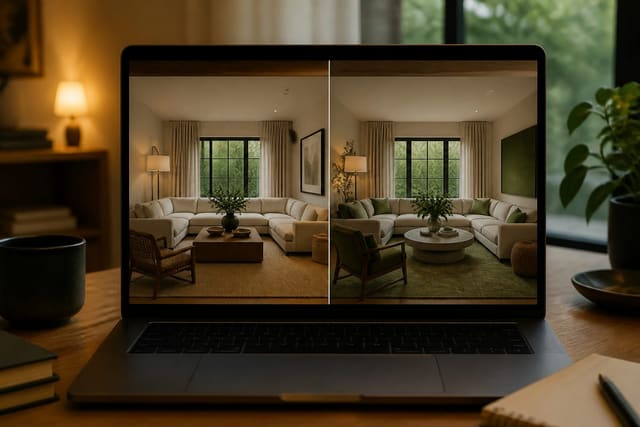
For most rooms, the answer isn't AI or a designer but AI first, then a designer where it counts. A subscription app that previews layouts costs less than one restaurant meal a month; a full-service designer for one room runs thousands. Use the cheap tool to settle easy decisions and the expensive professional only for problems software can't solve.
What are you actually paying for?
An AI tool sells speed and iteration. Upload a photo, swap a sofa or wall color, and see twenty versions of a room in an afternoon for a fee that often sits under $30, with capable free tiers available. There's no calendar to book and no minimum project size, so an app works for a single wall or a quick what-if.
A designer sells judgment and execution. The fee, commonly $2,000 to $12,000 for one room at full service, buys someone who reads the room in person, catches traffic-flow problems, sources furniture you can't find online, and coordinates the painter, electrician, and upholsterer so the project finishes. You're paying for accountability as much as taste.
Some designers charge a flat rate per room, others bill $100 to $300 hourly, and many take 20 to 35 percent of the furnishings budget. On top of the design fee you still pay for furniture, so a $4,000 design engagement can sit inside a $20,000 total project. An app skips the design fee entirely and hands the hours back to you: with software you spend time instead of money, and with a designer you spend money to reclaim time and reduce costly mistakes.
AI tools versus a designer, side by side
| Factor | AI design tool | Human interior designer |
|---|---|---|
| Cost | Free to about $30/month | About $2,000 to $12,000+ per room |
| Speed | Minutes per concept | Days to weeks per phase |
| Customization | Wide visual options, limited to presets | Bespoke, sourced to your exact space |
| Expertise | Pattern-based suggestions | Trained spatial and trade judgment |
| Execution | None; you manage the build | Coordinates trades and delivery |
A few rules follow from this: - Use AI when you have a clear room, a modest budget, and mostly need to see options before buying. - Hire a designer when the layout is genuinely hard, the budget is large, or you have no time to manage trades. - Combine them to get a polished result without a full-service fee, letting the app handle cheap exploration first.
See how leading apps compare before subscribing in Re-Design compared to competitors.
Where does AI fall short, and where does a designer earn the fee?
AI tools are strongest on the visible surface and weakest on everything behind it. They render a beautiful preview but don't measure your room, account for how afternoon light flattens a paint color, or know the radiator blocks the only sensible sofa wall. The honest limits of automation are unpacked in can AI replace an interior designer: software handles ideas well and execution not at all.
Lighting is the clearest gap. An app can place a floor lamp in an image, but it can't tell you the room needs three light sources at different heights to feel right at night, or specify the color temperature that keeps a space from reading cold. Scale in irregular rooms is another weak spot; a preset sofa dropped into an angled or open-plan space often looks fine on screen and wrong in person, and a designer catches this on a site visit.
Software also can't take responsibility. When a designer specifies a rug that arrives the wrong shade or a sofa that won't clear the stairwell, fixing it is part of the service you paid for; an app just shows you an image and the consequences are yours. That gap matters most on big-ticket purchases and structural changes, least on low-stakes choices like a paint color you can repaint for $60.
Let a free or cheap app, like the options in this roundup of free AI room design tools for 2026, handle exploration, then bring in a professional for the lighting plan, tricky measurements, and trade coordination software can't touch.
Preview both paths in Re-Design
Frequently Asked Questions
Is an AI design tool really cheaper than a designer?
Yes, by a wide margin. AI tools run free to about $30 per month, while a designer charges $2,000 to $12,000 or more for one room. The app only produces ideas and images; the designer also executes, sources, and manages the build.
Can AI replace a designer entirely for a simple room?
Often, yes. For a straightforward room with a modest budget, an app is enough to choose paint, furniture, and layout confidently. It falls short once the room has difficult lighting, awkward angles, or needs trades coordinated.
What is the best way to use both together?
Let the AI tool handle cheap, fast exploration to narrow your direction, then hire a designer only for the hard 20 percent: lighting, tricky scale, and execution. This usually costs far less than a full-service engagement from scratch.