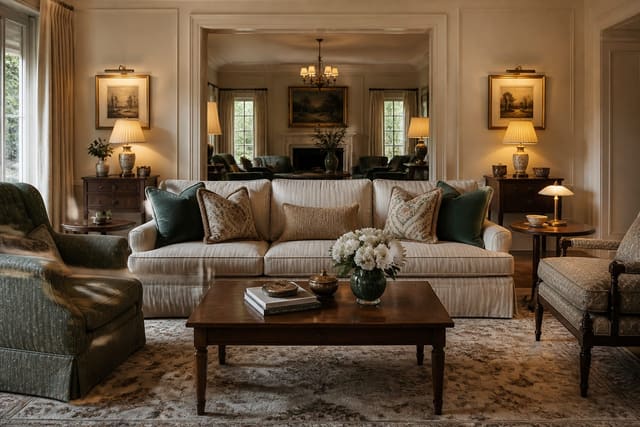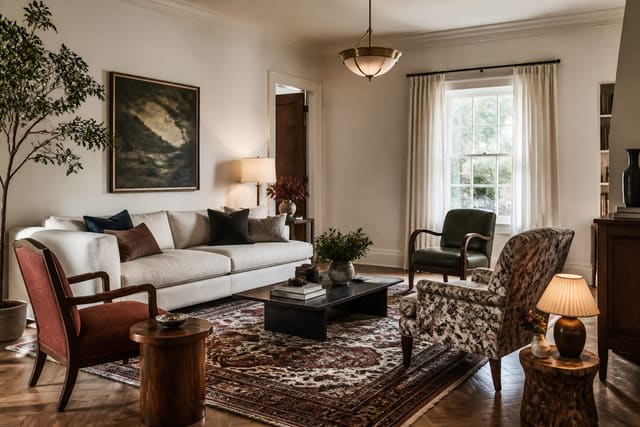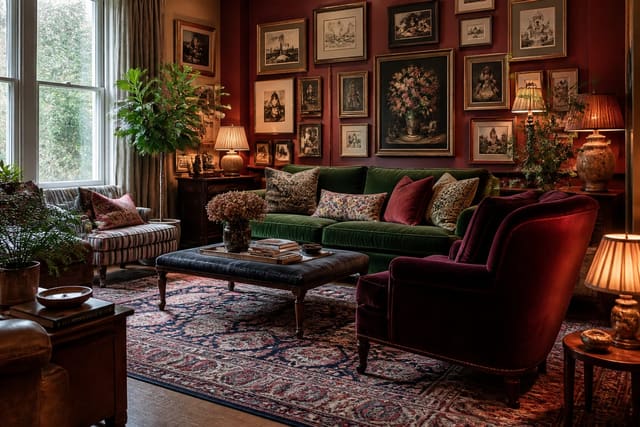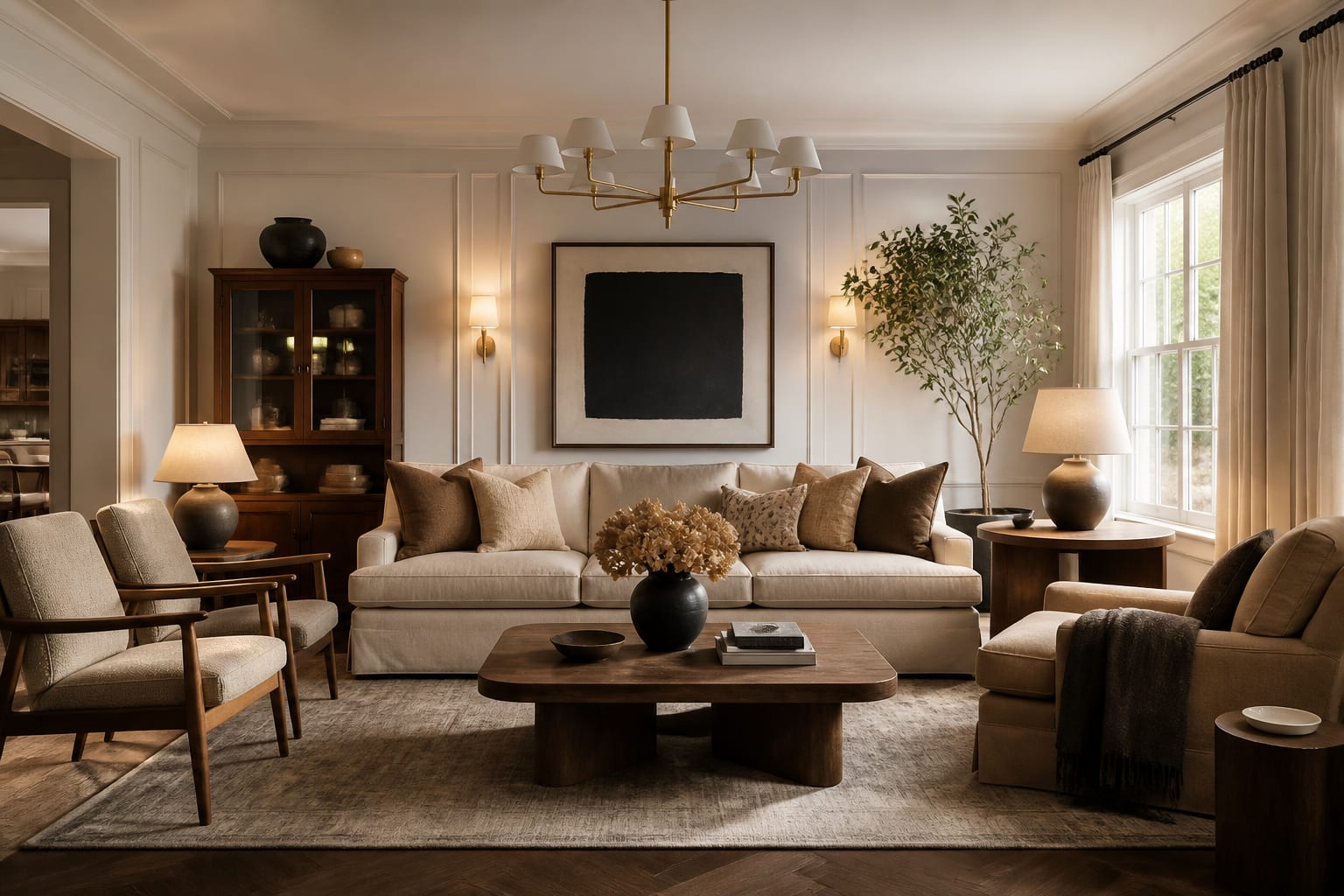
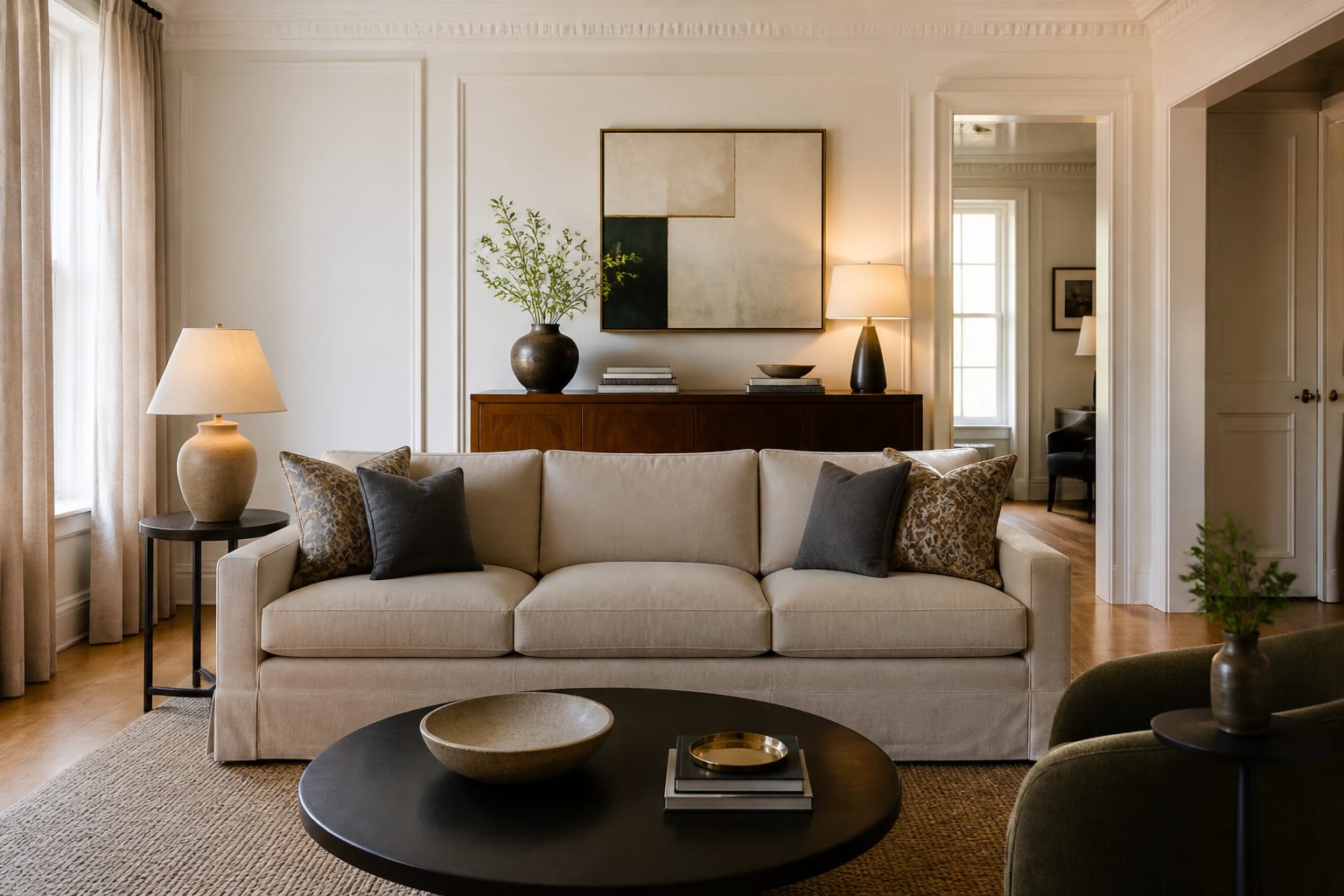
AI transitional interior design succeeds when you give it a precise classic-modern ratio instead of asking for something vague like "timeless." Specify exact pieces, wood tones, upholstery shapes, and lighting temperatures, and the tool can render a collected, editing-forward room. Skip those details and most AI previews default to a bland beige box with a pair of rolled-arm chairs.
How well does AI handle transitional design?
AI handles transitional design fairly well with a clear brief, but struggles with vague requests. The style is visually quiet compared to art deco or industrial, so the algorithm has fewer loud cues to grab and often flattens ingredients into safe beige.
A useful prompt reads like a design brief, not a style label: "Create a transitional living room using the existing oak floor and 8 foot ceiling, with an 86 inch clean-lined sofa, two traditional wood side tables, an 8 by 10 wool rug, cream linen curtains, warm 2700K lamps, black bronze accents, and no invented fireplace." That tells the tool exactly which side should feel classic and which should feel modern.
If a preview leans too formal, compare it with AI traditional interior design previews to see whether a more classic room actually suits you better. Transitional is edited; traditional tolerates more ornament, symmetry, and heavier detail.
Where do AI transitional previews go wrong?
Transitional previews collapse when the room has no tension. AI often defaults to cream sofa, cream rug, pale wood table, pale walls, and expensive-looking but forgettable lamps. That may photograph cleanly, but it skips the layered feel most people want from "transitional."
Check previews against these fixes:
- Keep one classic anchor - panel molding, a turned-leg table, a framed mirror, or a shaded lamp - so the room keeps a root.
- Add one modern silhouette, like a straight-arm sofa, slab coffee table, or a 16-18 inch deep media cabinet, so it doesn't drift formal.
- Control the palette by value, not just hue: pair ivory, taupe, or greige with walnut, charcoal, black bronze, or navy in at least one visible spot.
- Size the rug generously. An 8 by 10 rug is the minimum for most living rooms if front furniture legs can sit on it by 6 inches.
- Warm the lighting. Use 2700K in living rooms and bedrooms, and reserve 3000K for kitchens or work zones.
A good preview should still look right with shoes by the door or a laptop on the table. Transitional rooms are polished, not uninhabited.
Common mistakes compound this problem: accepting the first pretty neutral image after asking for "timeless," stripping out every ornament until the room reads as plain modern, mixing modern and traditional furniture with mismatched proportions, and letting AI invent bigger windows or built-ins that make the "win" about architecture rather than style. Regenerate with stricter wording - specific pieces, kept dimensions, preserved trim - rather than accepting the first polished result.
Transitional vs. traditional vs. eclectic: which is harder for AI?
Transitional is harder than traditional because its boundaries are subtler. Traditional gives AI obvious cues - rolled arms, carved wood, symmetry, drapery - and eclectic gives it built-in contrast. Transitional asks for editing, and editing is not the same as emptiness.
| Brief type | What AI usually understands | Where it fails | Better instruction |
|---|---|---|---|
| Traditional | Symmetry, classic upholstery, wood furniture, layered patterns | Too formal or heavy for daily life | "Keep classic shapes but lighten the palette and reduce ornament" |
| Transitional | Neutral color, tailored seating, mixed old and new pieces | Bland beige room with no point of view | "Use 65% modern lines and 35% classic detail with one dark anchor" |
| Eclectic | Mixed eras, art, pattern, collected pieces | Too many attention-seeking objects | "Use two style families and repeat one color across the room" |
| Modern | Clean lines, low clutter, simple furniture | Too cold or under-furnished | "Add warm wood, shaded lamps, and one traditional texture" |
If you want more visual friction, AI eclectic room design is a better reference; it tolerates a vintage cabinet beside a sculptural chair, while transitional softens those contrasts instead of exaggerating them. If you secretly want louder pattern and color, AI maximalist room design ideas may fit your instinct better than forcing a transitional brief to carry that energy.
How do you turn an AI preview into a real room?
Start from a doorway or main sightline photo showing the floor, ceiling, windows, trim, and current furniture - a cropped sofa shot won't teach the tool how the room works. Run three versions from that image: one leaning modern (cleaner sofa, simpler rug, fewer accessories), one leaning traditional (warmer wood, patterned rug, more symmetry), and one true transitional pass using the strongest move from each side.
Judge the previews by what stays consistent. If every good option includes warmer lamps, a darker wood piece, and a larger rug, those are the real decisions worth keeping. If one image only looks best because AI added taller windows or custom millwork, discard the fantasy and keep the mood.
Translate the winning image into five decisions before shopping: upholstery shape, wood tone, rug style, metal finish, and lighting temperature. Start with the largest soft piece - an 84-90 inch sofa or a 50-56 inch headboard - then add traditional warmth through wood, shaded lamps, or a rug with quiet pattern. Don't buy every "classic-modern" item from one collection; pair a modern sofa with a traditional side table, or a simple bed with pleated lampshades, so pieces feel related rather than matched.
Renters should stick to reversible moves: larger rugs, plug-in sconces, linen curtains, framed art, secondhand wood case goods, and warmer bulbs. Owners can consider deeper changes like paneling, built-ins, or refinished floors, but let the preview prove the direction first.
Frequently Asked Questions
What is transitional interior design?
Transitional design blends classic architectural detail with modern furniture lines, using a restrained neutral palette, warm wood tones, and tailored upholstery. It sits between traditional (more ornament, symmetry, heavier detail) and modern (minimal, cooler, low-clutter), aiming for a collected but current feel rather than a strict period look.
Why do AI transitional previews look bland or beige?
AI often over-edits transitional prompts, stripping contrast until the room becomes all-neutral with no anchor. Vague requests like "timeless" give the tool no scale or material rules to follow. Fixing this requires naming a dark anchor, a specific traditional detail, and a modern silhouette in the prompt instead of relying on mood words.
How is transitional different from traditional in an AI prompt?
Traditional prompts can rely on obvious cues - rolled arms, carved wood, symmetry - and AI renders them reliably. Transitional needs an explicit ratio, such as "65% modern lines and 35% classic detail," because the style's subtlety gives the algorithm fewer strong signals to latch onto without guidance.
What should a good transitional AI prompt include?
Include exact furniture sizes (an 86-90 inch sofa, 24-30 inch nightstands), an 8 by 10 rug, wood tone, one metal finish, a lighting temperature like 2700K, and any existing features to preserve, such as floor color or ceiling height. This level of detail keeps the tool from defaulting to generic beige decor.
Can renters achieve a transitional look from AI previews?
Yes, by focusing on reversible items the preview highlights: an oversized rug, plug-in sconces, linen curtains, framed art, secondhand wood case goods, and warmer bulbs. These changes can replicate most of what makes an AI transitional preview work without altering floors, trim, or built-ins.