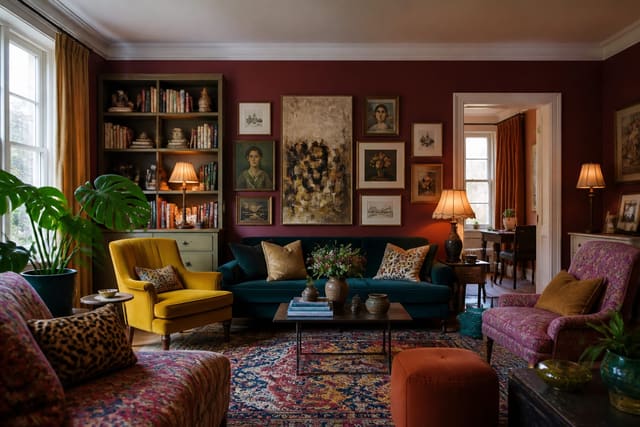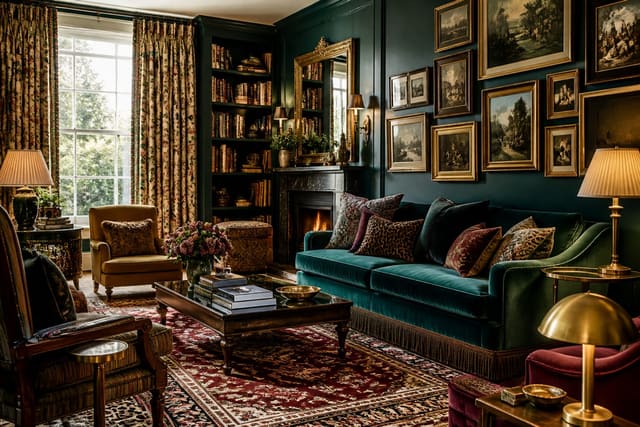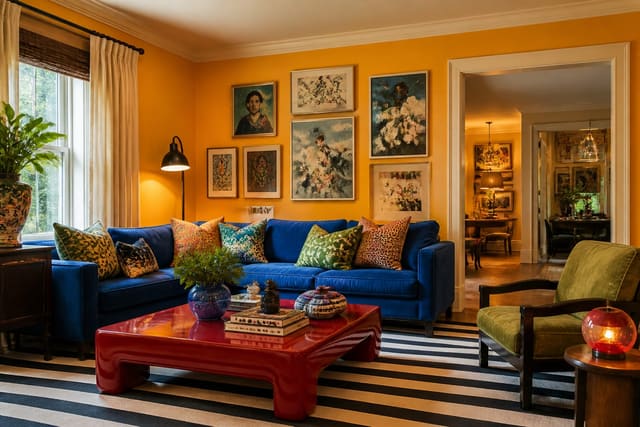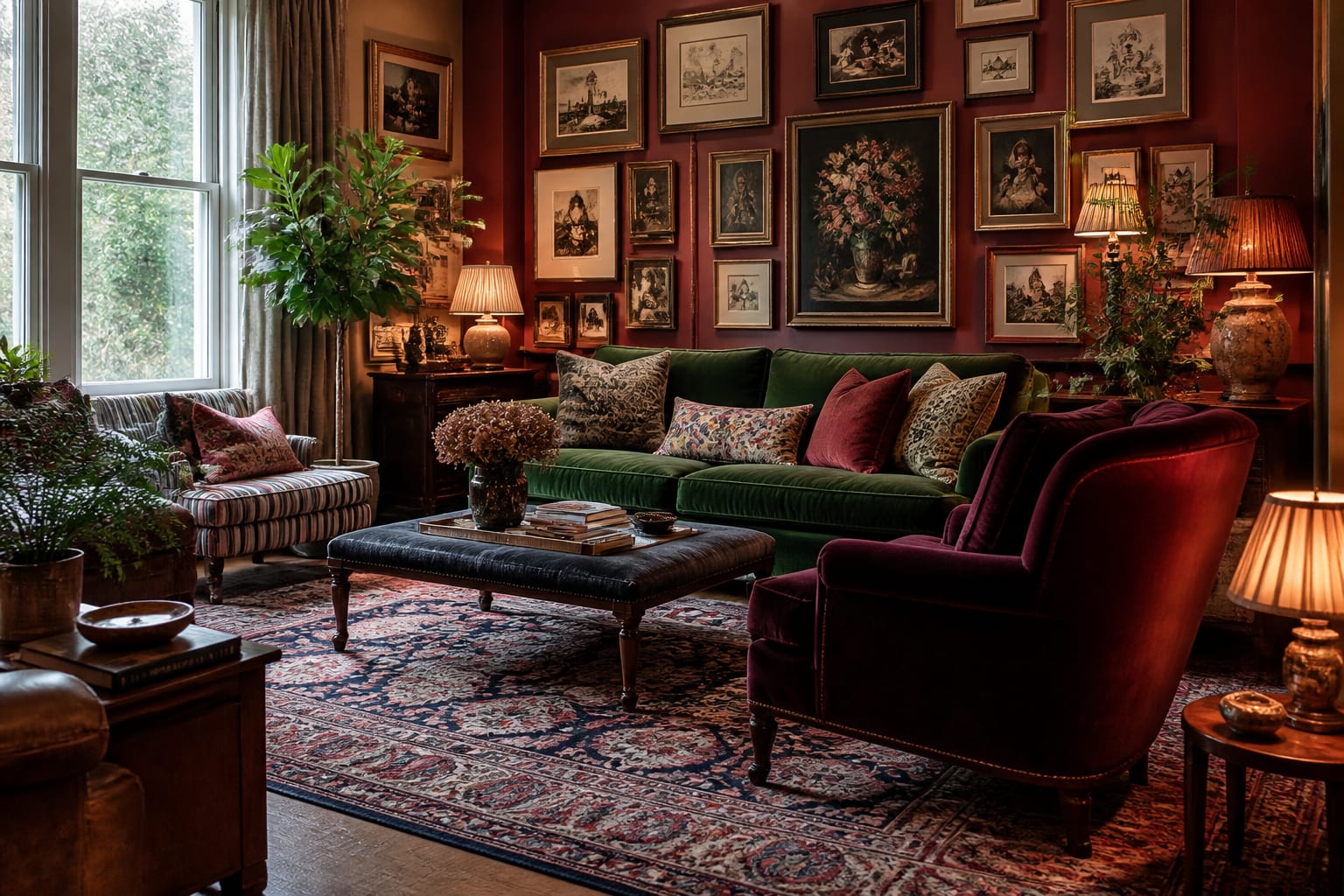
AI maximalist room design can go bold, but only when the prompt names the moves: saturated color, oversized pattern, layered art, dramatic lighting, and a clear focal hierarchy. Vague requests like "colorful but elegant" produce a neutral sofa with three bright pillows. Give the AI structure, and it will deliver rooms that feel deliberate, not decorated.
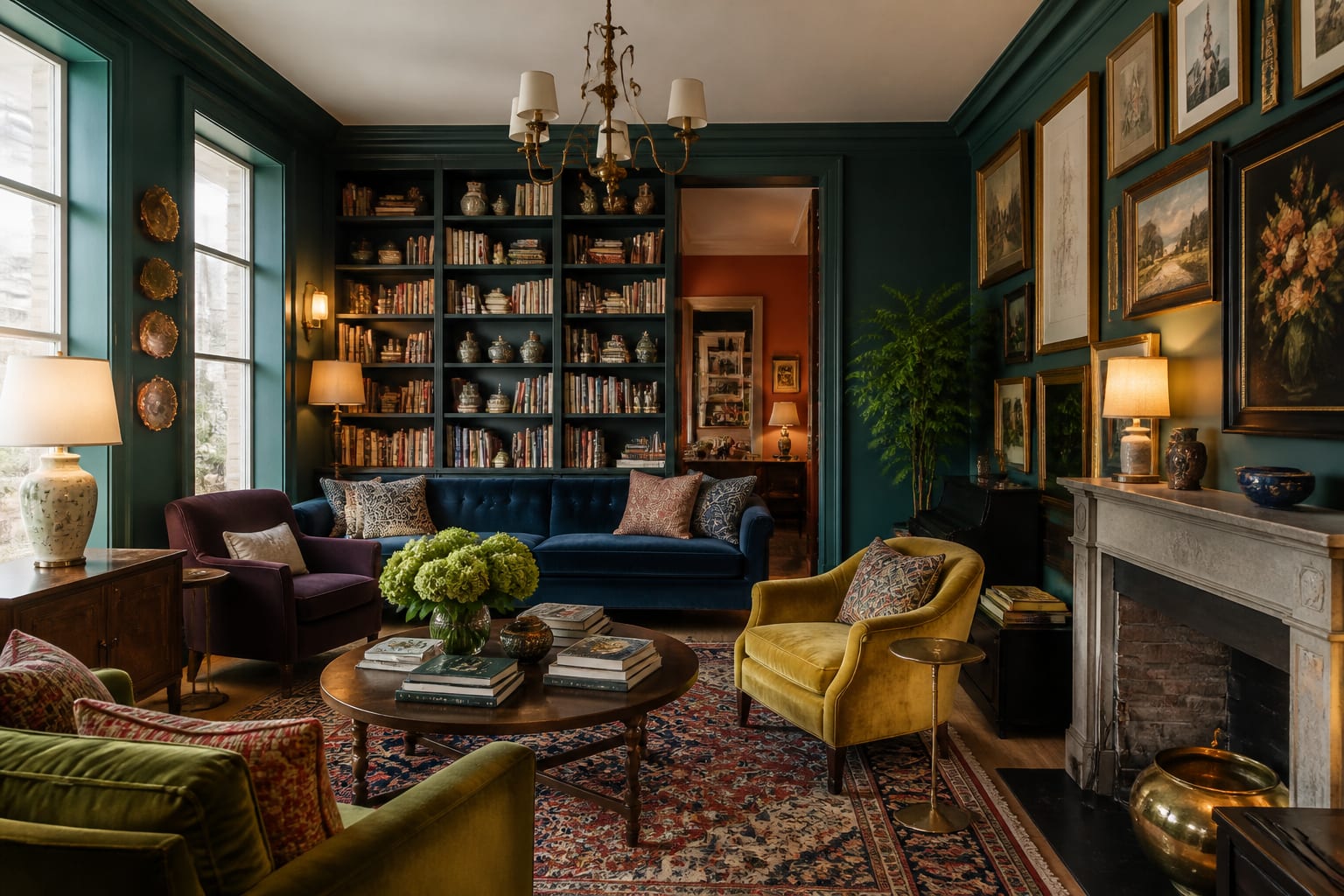
Can AI produce maximalist interior design results?
Yes, when the prompt asks for layered color, mixed pattern, oversized art, visible collections, dramatic lighting, and a clear focal hierarchy. It underperforms when the brief uses vague words like "bold," "fun," or "eclectic" without specifying what should lead the room.
Maximalism is not visual noise. A good bold room has rules: one dominant color family, one secondary color story, a controlled mix of pattern scales, and a few large gestures that anchor the eye. AI knows the symbols of maximalism — wallpaper, jewel tones, art walls, books, plants, patterned rugs, lacquer, velvet, brass, sculptural lamps — but needs pressure to use them with discipline.
If your first preview looks too quiet, push with stronger language: "saturated raspberry walls," "floor-to-ceiling art salon," "large botanical wallpaper," "8 by 10 patterned rug," "emerald velvet sofa," "three lighting layers," "visible collections arranged by color." For a brighter, punchier lane, compare with AI dopamine decor design ideas; dopamine decor tends to be bolder in color, while maximalism can be darker, stranger, and more collected.
Minimal prompt vs. maximalist brief: what changes?
The gap between a timid AI room and a real maximalist one is rarely a single color. It's the difference between asking for decor and asking for composition.
| Prompt approach | What AI usually gives you | Better maximalist instruction |
|---|---|---|
| "Make this room maximalist" | More pillows, more plants, a slightly busier wall | "Saturated aubergine wall, oversized art salon, 8 by 10 patterned rug, velvet seating, warm layered lamps" |
| "Add bold color" | One accent chair or bright throw | "Teal walls, oxblood accent, cream relief, black grounding line" |
| "Mix patterns" | Random pillows, unrelated prints | "One large botanical, one medium stripe, one small geometric — no more than 3 pattern families" |
| "Make it stylish and eclectic" | Polished room, scattered accessories | "Collected maximalist room with books, art, ceramics, patterned curtains, one dramatic focal wall" |
A better prompt gives AI permission to be bold and a way to stop. Without a stopping point, previews either retreat into beige or explode into wallpaper, striped chairs, floral curtains, and art on every wall.
Maximalism also differs from transitional style, which is built on edited contrast and calmer blending. If your previews keep softening into symmetrical, beige rooms, check them against AI transitional style design to see if the tool is pulling toward a safer classic-modern lane.
What makes a maximalist AI room feel intentional?
Accessories can't carry the style alone. The biggest decisions — walls, rug, lighting, main furniture — need to be strong enough to organize the smaller ones.
- Pick a dominant color family first. Try deep green with raspberry and brass, cobalt with tobacco and cream, aubergine with olive and black, or ochre with ink blue and walnut.
- Vary pattern scale. Pair a large floral wallpaper, a medium striped curtain, and a small geometric pillow rather than five similar busy motifs.
- Size the rug to the room. Start with an 8 by 10 rug and move to 9 by 12 once seating is wide enough for front legs to land on it by at least 6 inches.
- Give art a wall strategy. Anchor a salon wall with one piece at 24 to 36 inches wide, then vary smaller frames with a consistent 2 to 3 inch gap.
- Add at least three lighting sources. Use warm 2700K lamps for lounge areas, a shaded floor lamp near seating, and a picture light or sconce for evening richness.
- Keep one surface calm. A plain ceiling, simple sofa silhouette, or quiet media wall lets bolder pieces read as collected, not frantic.
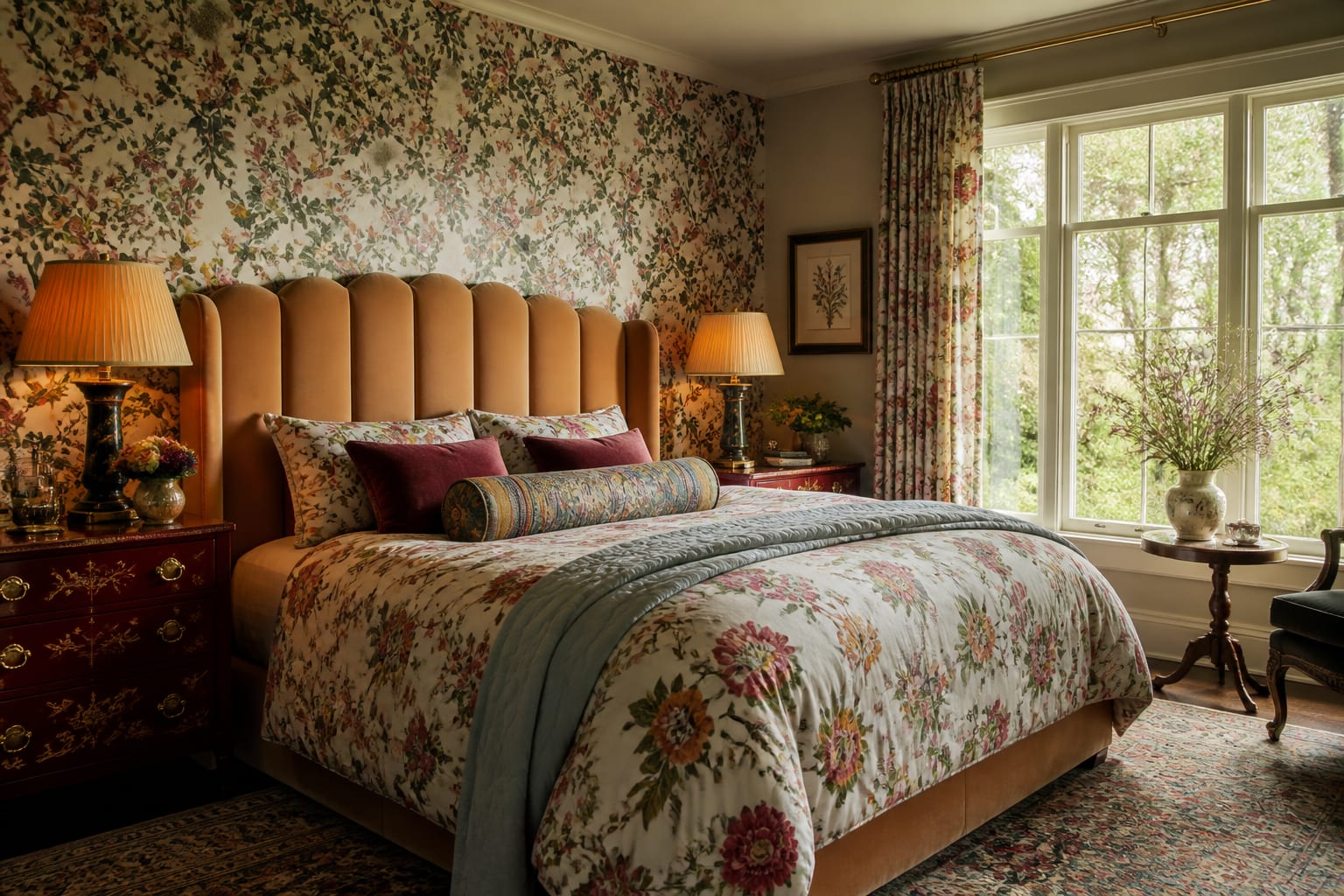
Think of maximalism as choreography: wallpaper leads, the rug answers, art complicates the story, and lighting decides whether the room feels lush or exhausting. AI can show that choreography fast, but your prompt has to assign the roles.
What mistakes make an AI maximalist room look messy?
Boldness without scale. AI may add twenty small objects instead of one large gesture. Replace scattered drama with bigger moves: 96-inch curtains, an 84-inch sofa in saturated fabric, a large patterned rug, or a full art wall.
Every surface competing. Patterned wallpaper, rug, sofa, curtains, and lampshades all at once usually reads as static. Keep one hero pattern, one supporting pattern, and one quiet texture like velvet, linen, or dark wood.
Confusing maximalist with traditional. Heavy symmetry, formal chairs, and restrained palettes may be beautiful, but that's classic layering, not maximalism. If AI keeps producing paired lamps and carved furniture, compare it with AI traditional interior design concepts before forcing the room louder.
Fake architecture. Renders love tall windows, built-ins, and moldings because they make bold rooms easier. If your room has an 8-foot ceiling or rental blinds, tell the tool to keep them and solve style through color, textiles, and lighting instead.
Ignoring daily mess. Maximalism absorbs books, pets, and collections better than minimalism, but still needs storage: closed cabinets 14 to 18 inches deep, lidded baskets, and one clear tabletop zone.
How do you use AI to preview a bold room before committing?
Photograph the room from the doorway or main sightline, with floor, ceiling, windows, trim, outlets, and current furniture visible. A cropped sofa photo won't show whether the space can survive wallpaper, dark paint, or a bigger rug.
Run three versions from the same image: one color-led with saturated walls, one pattern-led with wallpaper or rug as the main gesture, and one collection-led with art, books, and objects arranged into a system. Keep the camera angle consistent so you're comparing design decisions, not digital flattery.
Try a prompt like: "Create a maximalist living room while keeping the existing 8-foot ceiling, oak floor, window size, and current sofa. Add deep teal walls, an 8 by 10 patterned rug, floor-to-ceiling gallery wall, raspberry and olive accents, dark wood storage, velvet chair, layered 2700K lamps, and no invented fireplace."
For a bedroom: "Maximalist bedroom with existing window placement, botanical wallpaper behind the bed, 56-inch upholstered headboard, 28-inch lacquer nightstands, patterned bedding, curtains mounted 6 inches above the casing, shaded warm lamps, art above both nightstands, and no change to ceiling height."
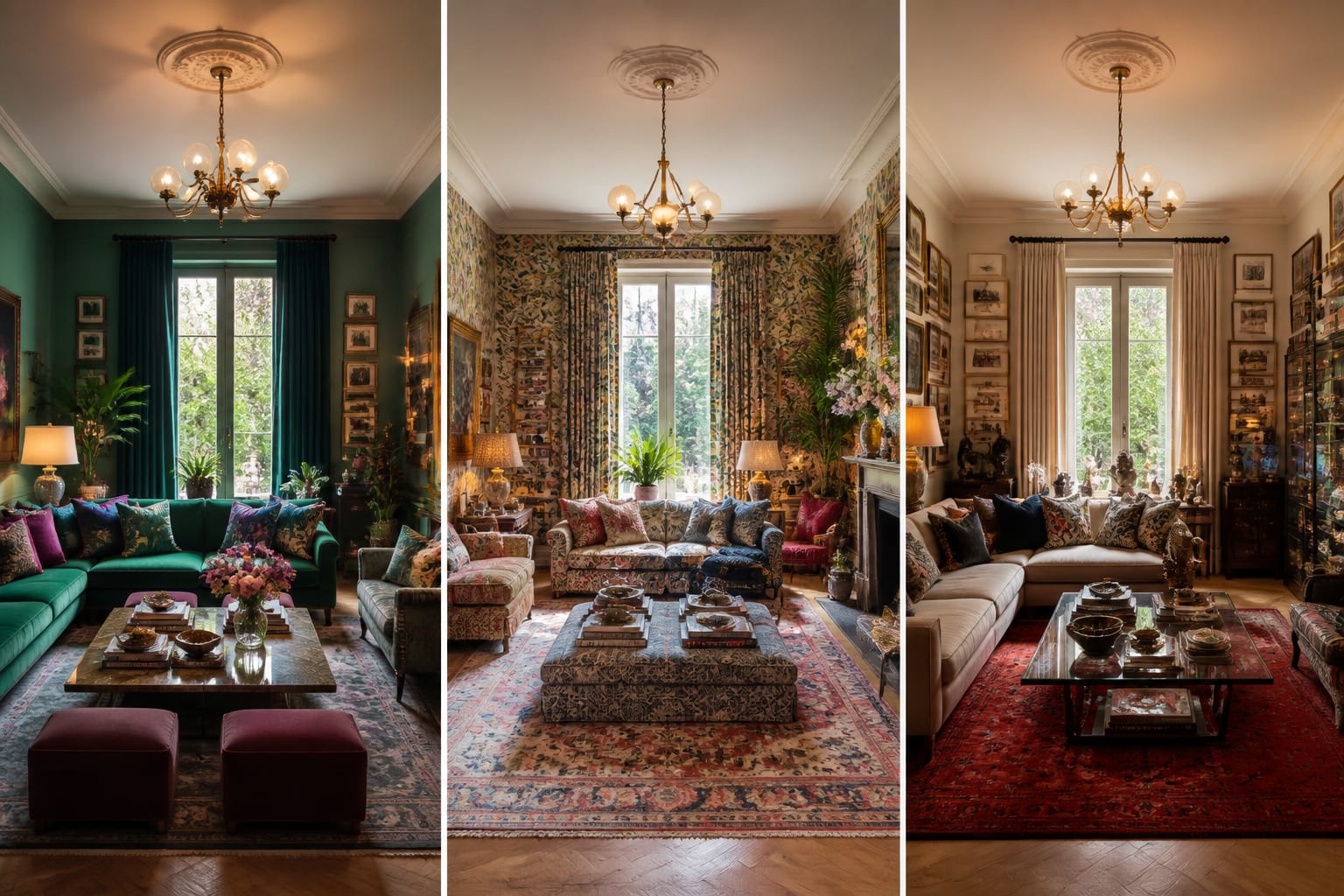
Judge previews by what stays believable. If the same wall color, rug scale, lamp placement, and art strategy keep working across versions, the idea has strength. If the best image only succeeds because the tool widened the room or invented built-ins, keep the atmosphere and rebuild the plan around your real architecture.
How do you turn the winning preview into a real room?
- Name the dominant color and repeat it on a large surface, a medium piece, and one small accent for rhythm.
- Choose one hero pattern first, then keep secondary patterns smaller or quieter.
- Decide whether the main risk is wall color, rug, sofa, art wall, or lighting — don't let every purchase compete.
- Keep rental moves reversible with large rugs, plug-in sconces, art, and painted furniture; owners can test built-ins, tile, or lacquer.
A strong maximalist room doesn't apologize for color, pattern, or stuff. AI is most useful here not as a taste authority, but as a fast visual lab for seeing how far your room can go before bold becomes cluttered.
Frequently Asked Questions
Does AI interior design go bold enough for maximalism?
Yes, but only with a detailed prompt. AI defaults to safe, resale-friendly interiors unless you specify saturated wall colors, large-scale pattern, layered art, and multiple lighting sources. Vague requests like "bold" or "eclectic" typically produce a neutral room with a few bright accents instead of true maximalist composition.
How many colors should a maximalist AI prompt use?
Stick to 2 to 3 main colors: a dominant wall or furniture color, a secondary accent, and a grounding neutral like cream or black. More than three main colors without a hierarchy usually reads as chaotic in AI renders rather than intentional and collected.
What's the difference between maximalism and dopamine decor?
Dopamine decor tends to be brighter and more energetic, built around cheerful, saturated color. Maximalism can be darker, stranger, and more layered, mixing pattern, collected objects, and dramatic lighting. Compare both moods directly using AI dopamine decor design ideas before choosing a direction.
Can a small room handle a maximalist AI design?
Yes, if pattern scale and rug size are adjusted to the footprint. Keep an 8 by 10 rug as the starting point, maintain a 30-inch walkway, and let one wall carry the boldest color or pattern while other surfaces stay quieter to avoid visual overload.
Why does my AI maximalist preview look like traditional style instead?
Heavy symmetry, carved furniture, and restrained palettes signal traditional design, not maximalism. If your prompts keep returning paired lamps and formal chairs, add explicit maximalist cues like collections, mixed pattern scales, and saturated color, and check results against AI traditional interior design concepts.