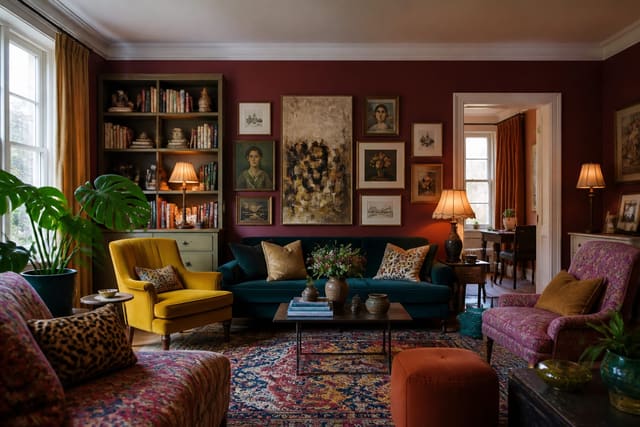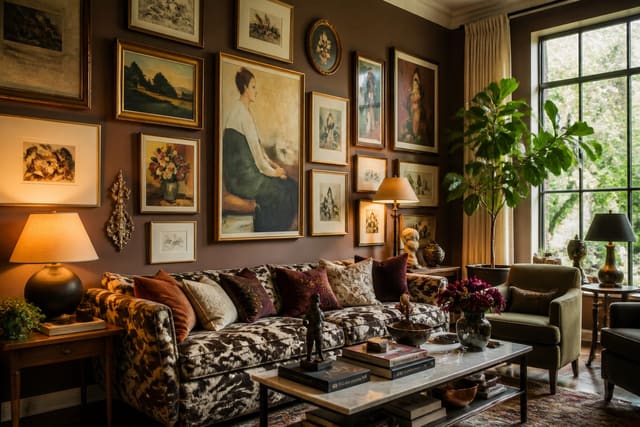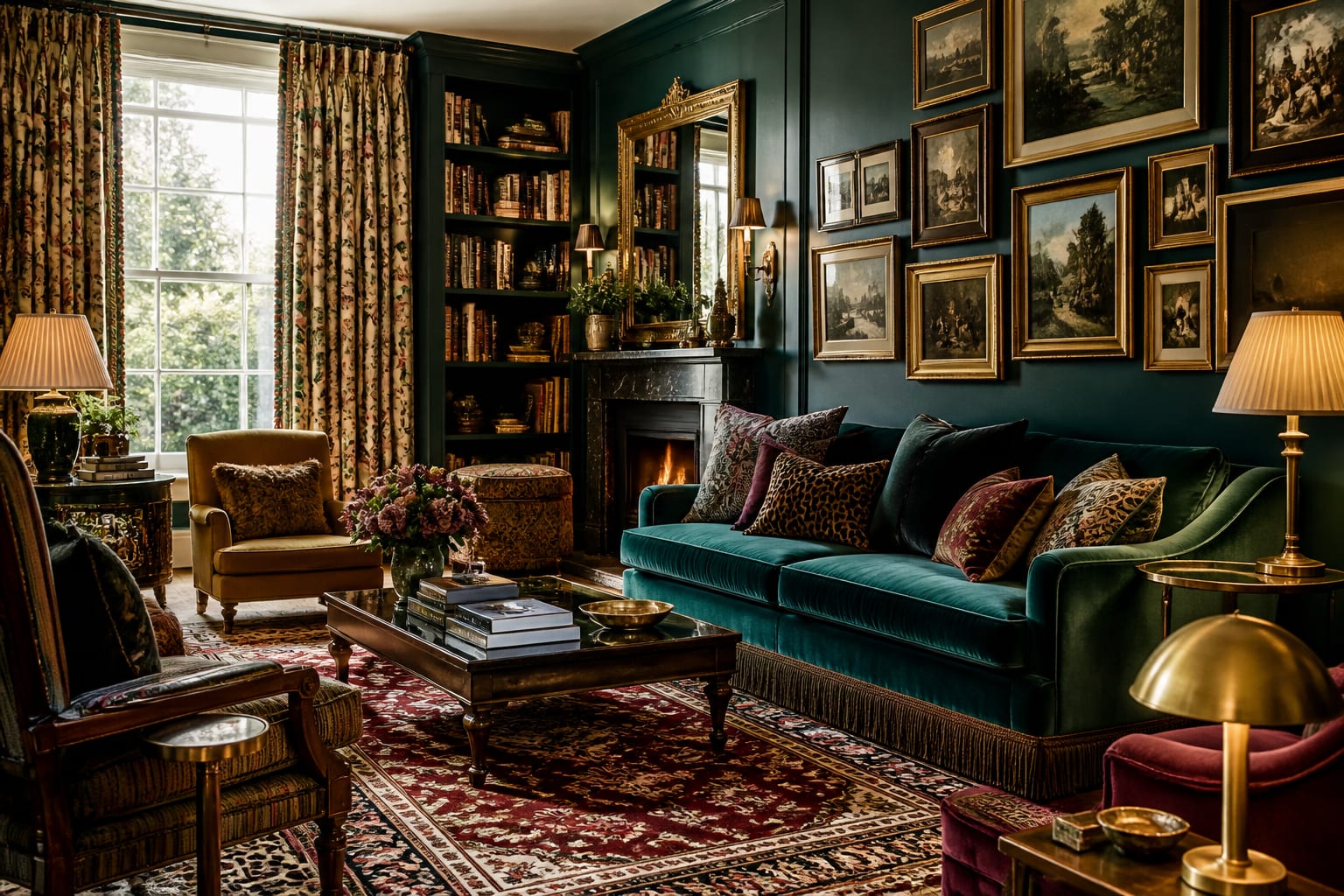
Maximalist living room ideas work when abundance has hierarchy: one or two dominant moves, several supporting layers, and enough color repetition to feel chosen rather than stuffed. The fix for a timid or half-finished room isn't one wild pillow, it's a stronger point of view carried through the whole space, built on scale, repetition, and lighting.
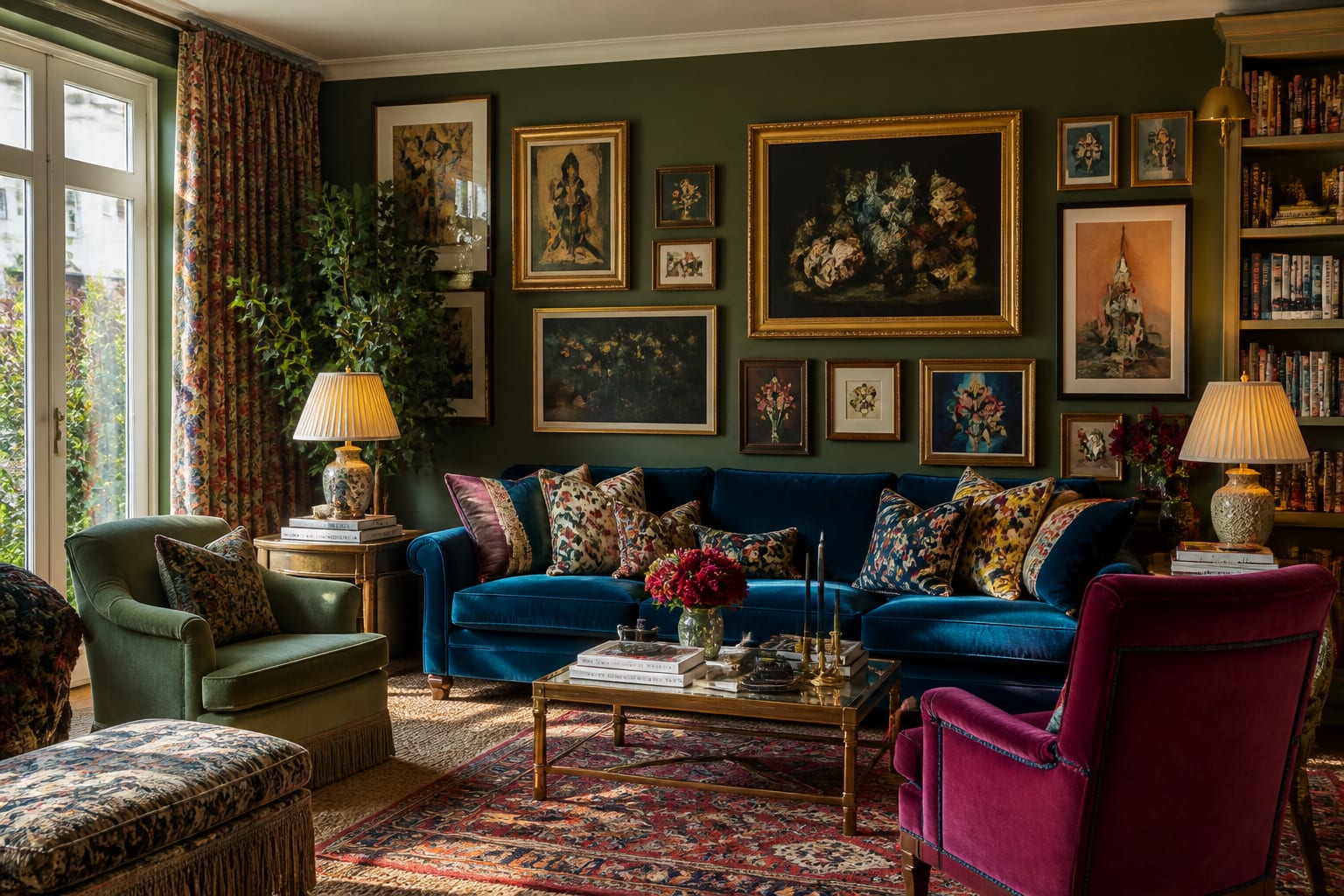
What makes a living room feel maximalist instead of messy?
Messy rooms show everything at the same volume. Maximalist rooms give the sofa, rug, wall color, or art wall the leading role, then let pillows, books, lamps, plants, and objects act as the chorus. If the walls are white, the sofa is gray, and the art is small, colorful accessories alone won't fix it.
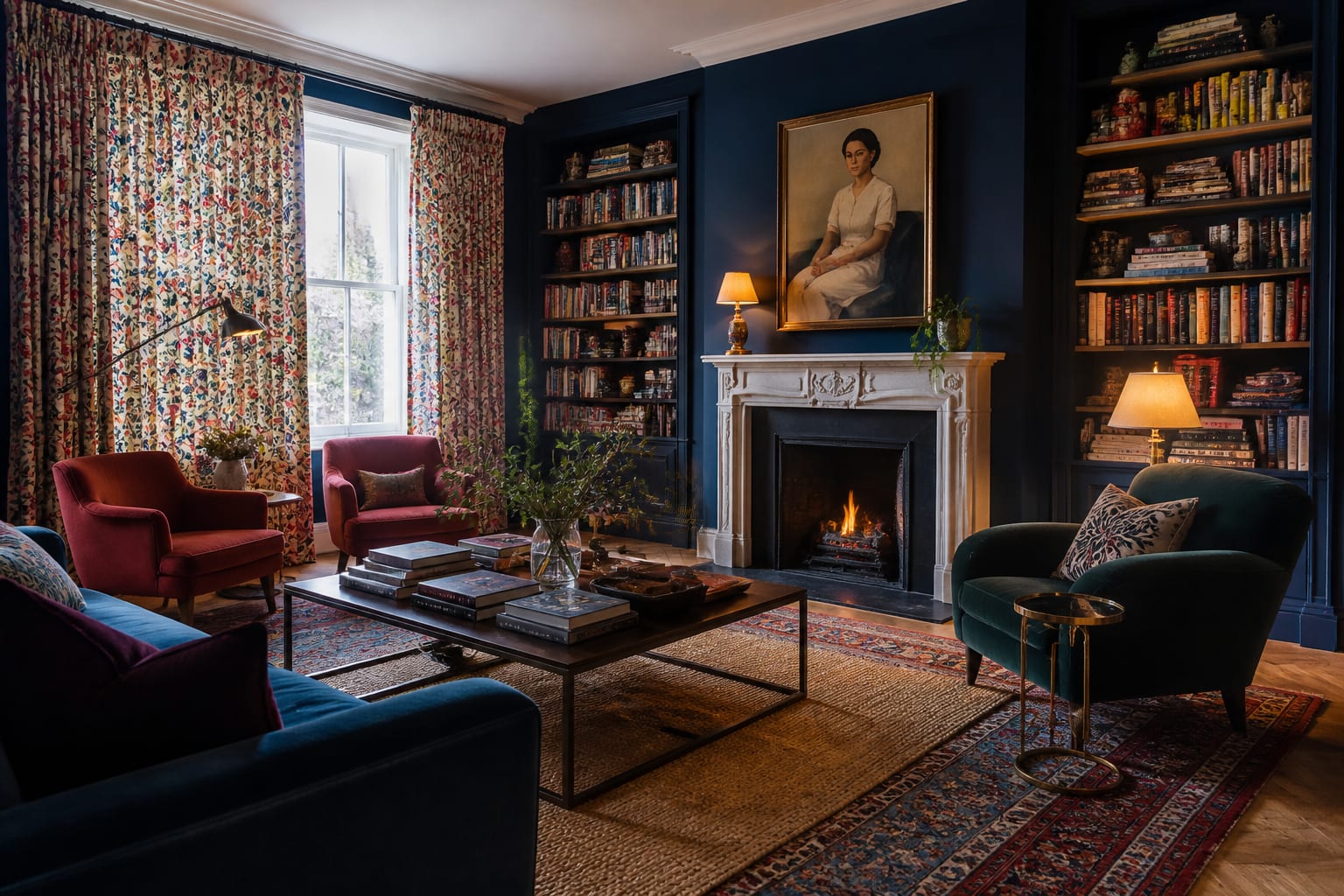
Start with the largest surfaces and pick one big declaration: emerald velvet sofa, oxblood walls, a saturated blue bookcase, or a floor-to-ceiling gallery wall. Then repeat two or three colors across the room so the eye connects the layers.
Scale keeps the look grown up. In a 12 ft x 16 ft room, a rug under 8 ft x 10 ft leaves furniture stranded; a 9 ft x 12 ft rug lets front legs sit on the pattern. Curtains should hit the floor, with rods mounted 6-10 in above the casing so busy fabric feels architectural, not fussy.
Which maximalist ideas actually carry the look?
Choose five or six of these based on your room and the pieces you already own:
- Paint walls a saturated color (deep teal, aubergine, olive, paprika, ink blue) and keep the ceiling lighter if the room is under 8 ft high.
- Build a gallery wall that covers a real zone: start 6-8 in above the sofa back, keep 2-3 in between frames, and repeat one frame color. See maximalist gallery wall ideas before hanging anything.
- Layer two rugs, a flat natural-fiber base under a smaller patterned rug, with the top rug set at least 12 in inside the base.
- Choose one statement sofa or chair pair in velvet, mohair, leather, or bold print; upholstery carries color better than tiny accents.
- Mount patterned drapery high and wide, extending the rod 8-12 in past each side of the window.
- Turn a bookshelf into a color-and-object wall, leaving about a third of each shelf empty and repeating one metal finish.
- Add one pattern (animal, floral, stripe, geometric) at real scale, a 24 in pillow, 5 ft x 8 ft rug, or full curtain panel, rather than ten tiny competing prints.
- Vary lamp heights: a 58-64 in floor lamp, 24-30 in table lamp, and a low picture light layer glow across the room.
How do color, pattern, and layout work together?
Pick a dominant palette of three to five hues and let depth vary, not the count of colors. Emerald, mustard, raspberry, tobacco, and cream can coexist if they repeat across rug, art, upholstery, and lampshades. The room struggles when every object introduces a color that never reappears.
Mix pattern scales: one large, one medium, one small, such as a large botanical curtain, a medium Persian-style rug, and small striped pillows. Same-scale patterns fight from across the room; shared color lets them disagree productively instead.
Keep 30-36 in of walking clearance and 14-18 in between sofa and coffee table so the room stays usable. For a darker, metal-forward version of bold, compare industrial living room ideas before committing to heavy black fixtures.
What are the most common maximalist mistakes?
| Mistake | Fix |
|---|---|
| Only buying small colorful decor | Anchor with a rug, sofa, wall color, or 36 in x 48 in art |
| Mixing patterns with no shared color | Repeat one hue in three spots: rug, pillows, art |
| Skipping plain texture | Add velvet, linen, leather, rattan, wood, or wool solids |
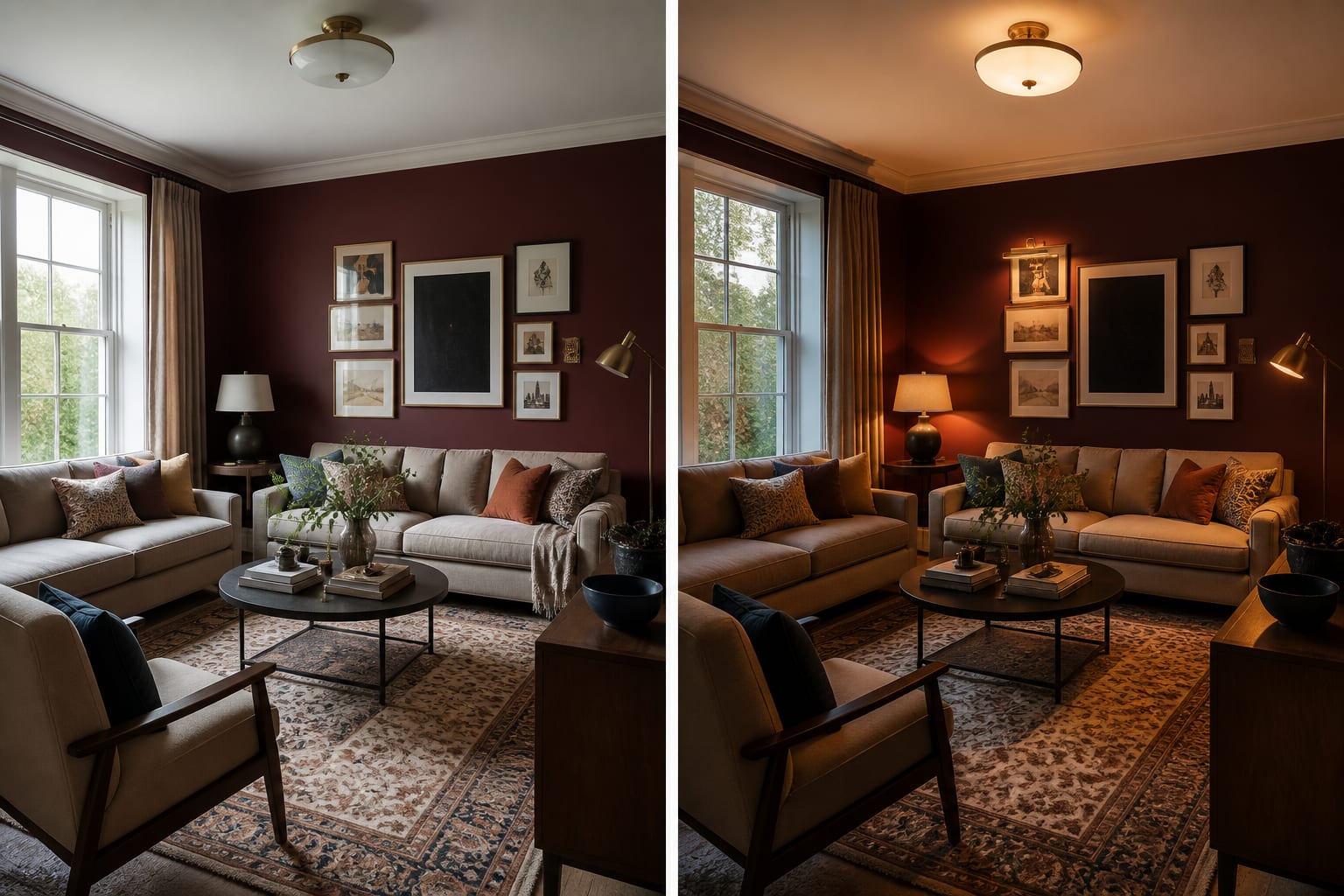
| Cold overhead lighting | Swap to warm white (~2700K) bulbs plus shaded lamps |
| Filling every surface | Leave one table, shelf, or mantel section quiet |
Avoid over-theming too: if you love florals, don't repeat them on curtains, pillows, art, lampshades, and wallpaper at equal intensity. Let one floral lead, supported by stripes, checks, solid velvet, and wood. For a softer, romantic version of abundance, see cottagecore living room ideas.
How can you preview a maximalist room before buying?
A maximalist room is risky to buy piece by piece because relationships matter more than individual objects, the sofa has to work with the rug, the rug with the art, the art with the wall color, and the wall color with your actual daylight.
Upload a photo of your living room to Re-Design and test full directions before ordering expensive pieces: bold walls with calmer furniture, a patterned sofa with neutral walls, or drama concentrated in art and curtains. Keep your real fireplace, windows, ceiling height, and floor visible so the preview answers your actual question.
This matters most in rentals, north-facing rooms, or spaces with a sectional you must keep. A preview shows whether a dark wall feels glamorous or cramped, whether a gallery wall balances a TV, and whether a patterned rug clashes with the existing floor.
What finishing details make the room feel personal?
Add books you actually open, art you'd keep past a trend cycle, a tray for remotes, a reading lamp, and objects with weight: ceramic, stone, brass, lacquer, wood, or vintage metal. Hang standalone art at 57-60 in on center, or align a gallery wall to the furniture below rather than chasing symmetry.
Use pillows in fewer, stronger sizes, 22 in squares on a deep sofa plus one lumbar, and add plants only where light actually supports them. Stand at the doorway and name the room's dominant move in three seconds; if you can't, edit one layer back. More is more only when the room knows what the more is doing.
Frequently Asked Questions
How do I start a maximalist living room without it looking messy?
Start with one large anchor, a bold sofa, saturated wall color, big rug, or full gallery wall, before adding smaller decor. Repeat two or three colors across fabrics, art, and rugs so the layers read as connected. Scale and repetition, not quantity of objects, are what separate maximalist from cluttered.
How many patterns can I mix in one living room?
Three works reliably: one large-scale pattern, one medium, and one small, ideally sharing at least one color. Same-scale patterns compete for attention, while patterns at different scales with a shared hue feel intentional rather than chaotic.
What size rug does a maximalist living room need?
In a typical 12 ft x 16 ft room, use at least a 9 ft x 12 ft rug so front furniture legs sit on it. Smaller rugs make furniture look stranded and undercut the layered, grounded look maximalism depends on.
What lighting works best for maximalist decor?
Warm light around 2700K, layered across floor lamps (58-64 in), table lamps (24-30 in), and picture lights. A single cold overhead fixture flattens rich color and pattern, making the room feel harsh instead of cozy.
Can I try maximalist colors before painting or buying furniture?
Yes. Upload a photo of your living room to Re-Design and preview options like bold walls with calm furniture, or a patterned sofa against neutral walls, using your real fireplace, windows, and floor as the backdrop before making purchases.