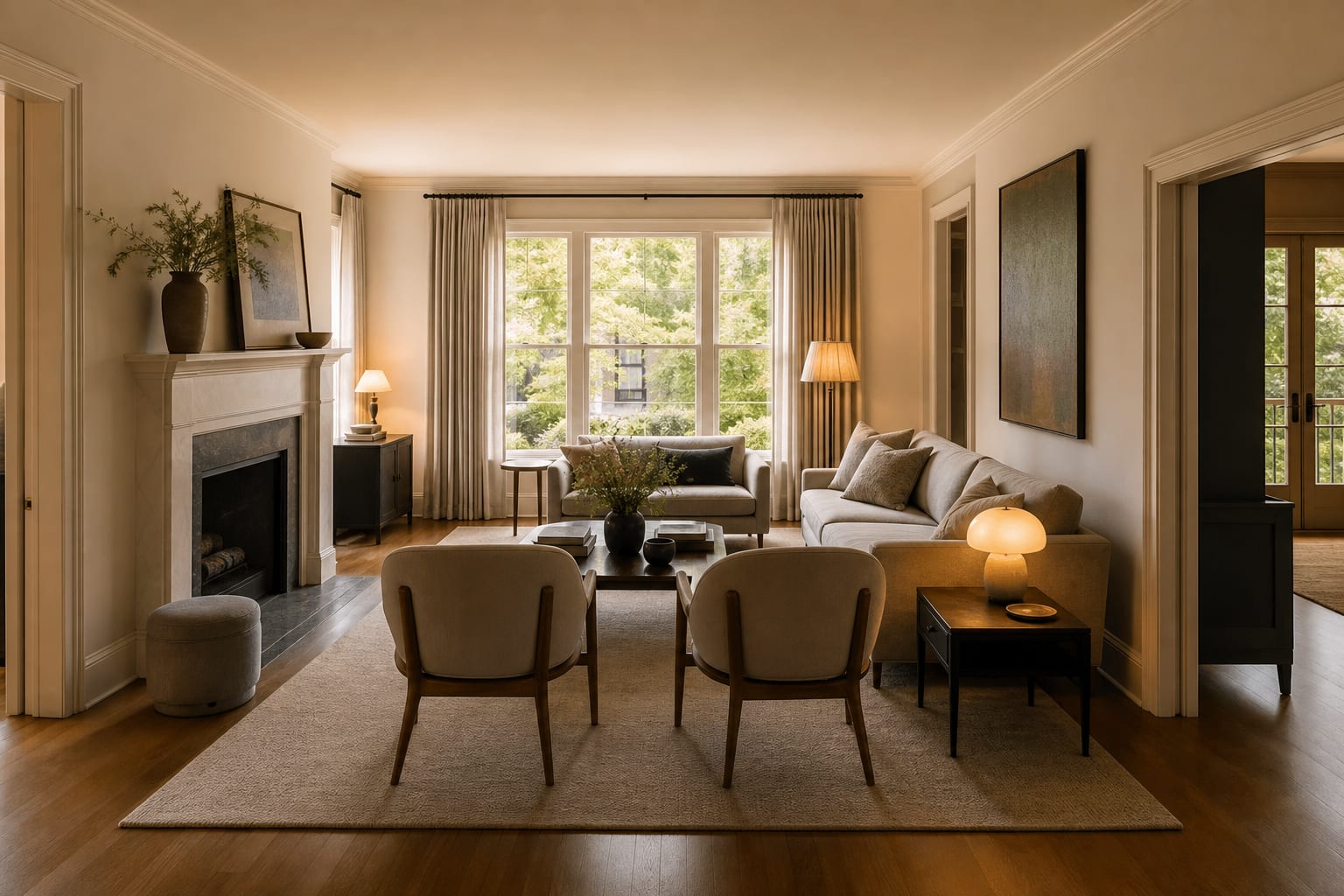
Area rugs go wrong in three predictable ways: too small for the seating, wrong shape for the room, and misaligned with the furniture's focal point. This area rug size guide fixes all three with one rule: the rug must reach the furniture's front legs, not just fill open floor. Use 8'x10' for standard living rooms, 9'x12' for larger ones, and pull bedroom rugs 18-24 inches past the bed.
What size rug should you use in a living room or bedroom?
Use 8'x10' for a sofa with two chairs, 9'x12' for a full-size sofa or larger room, and 10'x14' in open-plan spaces. In bedrooms, put an 8'x10' rug under a queen and a 9'x12' under a king, extending past the bed on three sides.
The living room rule: front legs of the sofa and chairs must sit on the rug, ideally by 6-10 inches, so the seating group reads as one zone. Leave 14-18 inches between sofa and coffee table so knees and trays still work.
Bedrooms need the same logic softened. A queen with an 8'x10' rug placed perpendicular usually leaves 18-24 inches of rug on each side. In narrow rooms, use two runners (2'6" x 8' or 3' x 8') instead of forcing a full rug into the baseboards.
Keep 8-18 inches of exposed floor between rug edge and wall in most rooms; small rooms can go to 6 inches. Check pile height and pad thickness if a door swings over the rug, since a thick rug plus a thin pad becomes a daily scrape.
Which rug layout fits each room type?
Start with the furniture footprint, not the pattern, then pick the largest rug that fits without blocking doors or vents.
- Living rooms: 8'x10' for a sofa with two chairs, 9'x12' for a longer sofa or sectional, 10'x14' for open-plan seating. Size up if front legs miss the rug.
- Bedrooms: pull the rug past the nightstands, extending 18-24 inches beyond the sides and foot of the bed.
- Dining rooms: add 24 inches beyond each side of the tabletop so chairs stay on the rug when pulled back. A 72-inch table often needs 8'x10'; larger tables need 9'x12' or more.
- Entries and hallways: leave 3-5 inches from an inward-swinging door, and keep runners centered with floor visible on both sides. See circulation tips for rooms with too many doorways when a rug needs to clarify the path.
Color affects perceived size too. A dark rug in a dim room can feel heavier than its measurements, while a pale, low-contrast rug can widen a small space. Pair rug color choices with ways to fake natural light in any room before committing to charcoal or navy.
Test rug sizes against your own room photo with ReDesign and keep doorways, walls, windows, and main furniture visible so the preview solves the actual room.
What are the most common area rug sizing mistakes?
Buying the cheaper 5'x7' for a living room is the top mistake. That size works beside a bed or under a small table, but under a full sofa and chairs it makes furniture look stranded.
Centering the rug on the room instead of the furniture is another. A rug centered between four walls can still leave a chair on bare floor if the sofa sits off-center, so center on the seating, bed, or table instead.
Skipping the rug pad causes problems too: an undersized pad creates a raised lip, an oversized one catches doors. Cut the pad about 1 inch shorter than the rug on all sides, and use low-profile felt or rubber in high-traffic zones.
Ignoring light is a fourth mistake. Glossy floors and bright windows can wash out a pale rug, while a dark rug can absorb the only light a north-facing room gets. See how mirrors amplify light for pairing rug tone with reflected light.
Matching every rug in an open plan is the last mistake. Coordinate with one shared element, such as wool, border color, or a neutral undertone, and size each rug for its own furniture instead of matching wrong proportions.
How does AI design help you size a rug before buying?
A folded rug sample shows color and texture, not whether a 9'x12' will crowd a balcony door or an 8'x10' will crowd the sofa. Upload a straight photo of the room and test both.
For a living room, preview a sofa with front legs on a 9'x12' wool rug, two chairs sharing the rug, a 16-inch gap to the coffee table, and a 30-inch walking path. Run the same layout with an 8'x10' and compare the borders and traffic lane.
For a bedroom, test an 8'x10' under a queen pulled below the nightstands, then two 3'x8' runners. The preview shows whether a full rug grounds the bed or runners solve the same comfort problem in a tighter room.
Use the preview as a proportion tool, then tape the rug corners on the actual floor and walk the main paths before ordering.
What final checks make the rug feel right?
Check the room from the entry: if the rug looks tied only to the coffee table, it is too small; if it slices through a walkway, size down or rotate the layout.
Measure furniture, not just floor: sofa length, chair depth, bed width, nightstand width, table size, door swing, and rug-to-wall distance. In living rooms the rug should be at least as wide as the sofa, usually 12-24 inches wider.
Round rugs work under round tables or in nurseries, but rarely fix a rectangular sofa plan. A larger rectangle usually calms a chopped-up room faster than a novelty shape.
Frequently Asked Questions
How do I know if my rug is too small for the room?
If the rug only touches the front legs of the sofa or floats island-like in the center of the room, it is too small. The rug should anchor at least the front legs of every primary seating piece so the group reads as one zone.
What is the standard rug size for a living room?
For most living rooms, 8'x10' works as a minimum, 9'x12' for medium rooms, and 10'x14' for large rooms. The rug width should match the sofa length within 12 inches on either side.
Should the rug be wider than the sofa or shorter?
Wider. The rug should extend 6-12 inches past the sofa on each end so it visually carries the seating group; shorter rugs make the sofa look stranded on bare floor.
How far from the wall should an area rug stop?
Leave 12-18 inches of bare floor between the rug edge and the wall in an average room. Less than 6 inches reads as a wall-to-wall miss, and more than 24 inches reads as a small rug in a big space.
Does AI help me size an area rug?
Yes. AI previews rug sizes overlaid on a photo of the room so you can compare 8'x10', 9'x12', and 10'x14' against the actual sofa, coffee table, and chairs before buying.
> Try this: Ready to see this on your own room? Open ReDesign and run the preview.
Three transformations to try
1. 8x10 rug with front legs of sofa on it 2. 9x12 rug with all sofa legs on it 3. 10x14 rug with sofa + chairs + coffee table on it


