Bamboo gets sold as the eco-friendly hardwood substitute, and that framing does it a disservice. My read is that bamboo is its own material with its own strengths, not a cheaper stand-in for oak. Is bamboo good for interior design? Yes, when you buy the right grade and use it where its hardness and warmth pay off, bamboo is an excellent, genuinely sustainable interior material that holds up to daily life and brings a calm, organic tone to a room.
The catch is that bamboo quality varies wildly, and a bad strand-woven knockoff will sour you on the whole material. So this guide is less cheerleading and more about what to actually look for, where bamboo belongs, and the specific mistakes that lead to dented floors and warped furniture.
The sustainability story is what gets bamboo in the door for most people, and it holds up. A bamboo stalk regenerates from its own root system after cutting, so harvesting does not kill the plant the way felling a hardwood does, and a managed grove can be cut on a rolling cycle for decades. Mature plants also pull carbon and release oxygen at a high rate while they grow. The one caveat is shipping, since most bamboo comes from Asia, so a low-VOC, responsibly milled product is the version that actually lives up to the eco label.
Is bamboo good for interior design?
The direct answer is yes, with conditions. Strand-woven bamboo is one of the hardest flooring materials you can buy, often outscoring oak on the Janka scale, which means it resists dents and scratches in real households. It carries a light, even grain that reads modern and biophilic at once, and it suits everything from a minimalist apartment to a warm Scandinavian scheme.
Where bamboo stumbles is in cheap construction. Horizontal and vertical bamboo are softer than strand-woven and dent more easily, and bargain products often hide weak adhesives and poor moisture sealing. So the material is genuinely good, but the grade you choose decides whether you love it in five years. Buy strand-woven for floors that take traffic, and you get a surface that competes with hardwood at a lower environmental cost.
It helps to understand the three construction types, because the labels are not obvious on a showroom floor. Horizontal bamboo shows the classic knuckle-and-node pattern and is the softest. Vertical bamboo stacks thin strips on edge for a cleaner, more uniform line, slightly harder. Strand-woven shreds the fibers and compresses them under heat and resin, which is what pushes its Janka rating to 3000 to 5000 and makes it the only grade I recommend for busy households. If a product does not say strand-woven, assume it is one of the softer two.
Where bamboo works best in a home
Bamboo earns its place in more rooms than people expect, and not only as flooring. These are the applications I trust:
- Strand-woven flooring in living rooms, bedrooms, and hallways where hardness matters.
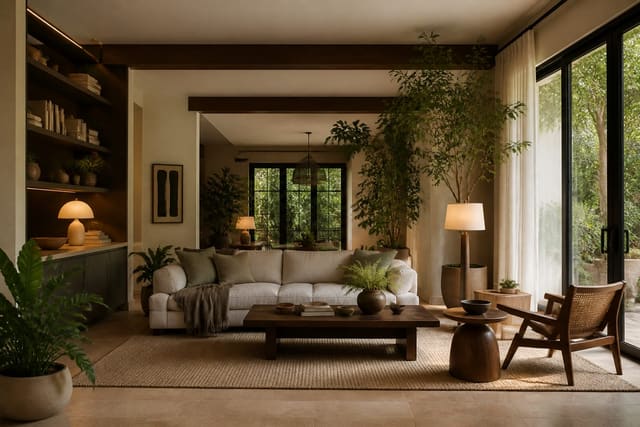
- Bamboo furniture frames, which are light, strong, and pair well with indoor plant styling for a fuller biophilic look.
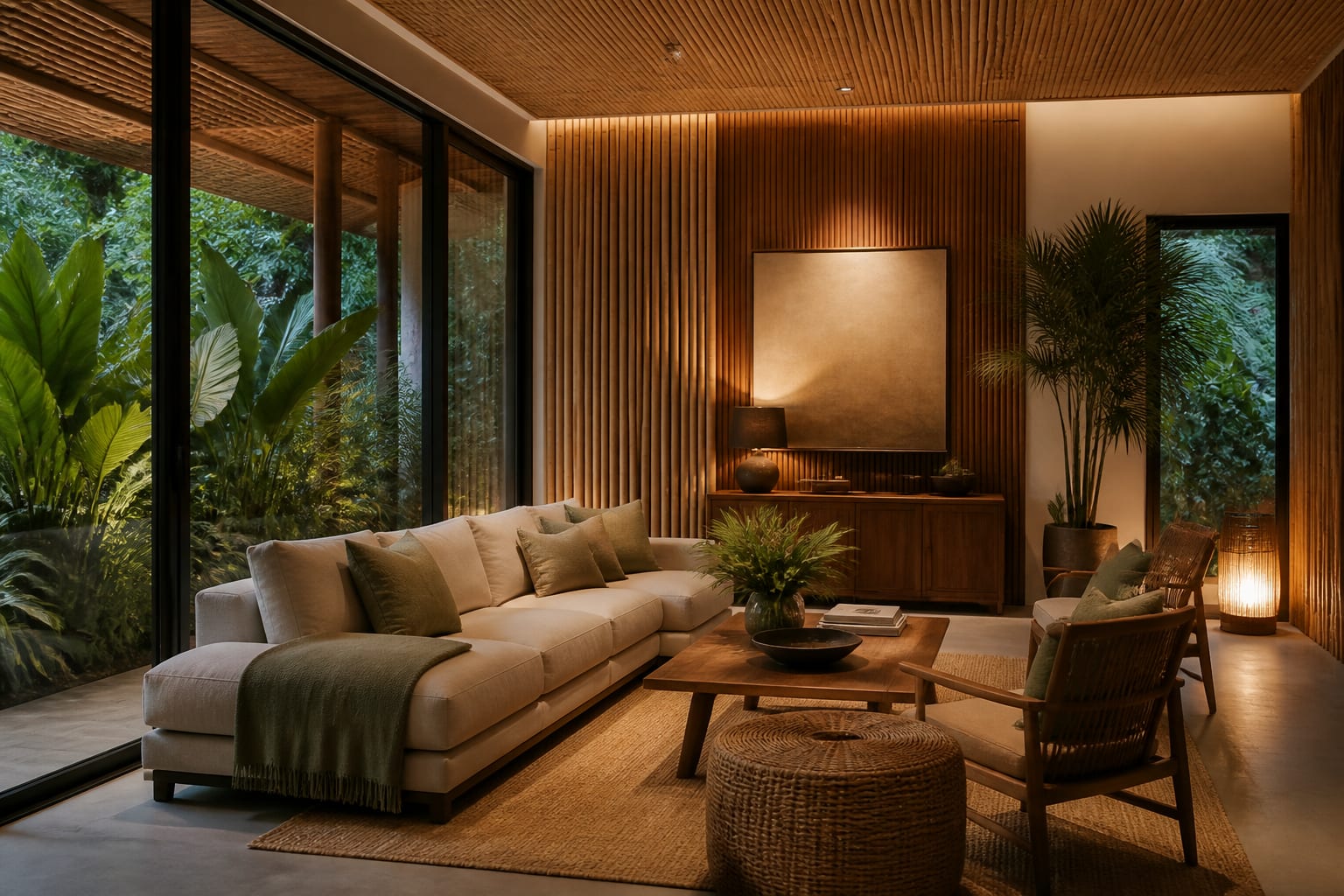
- Woven bamboo wall panels or screens that add warm texture without heavy construction.
- Window shades and blinds in bamboo, an easy, low-commitment way to bring the material in.
- Bamboo cabinetry and shelving, which take a clean finish and resist humidity better than many softwoods.
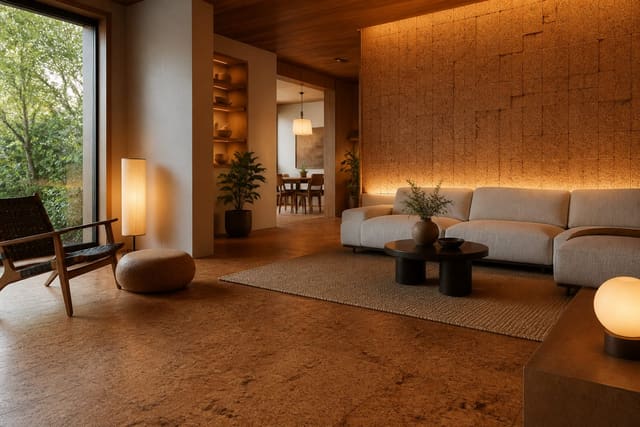
Bamboo also plays nicely with other sustainable materials. It sits comfortably next to cork underfoot, and the soft acoustics of cork material interior design complement bamboo's harder surfaces in an open-plan space. For a living, textural wall, bamboo screens read beautifully alongside a moss wall, giving you two natural materials at different scales.
Color is a real decision with bamboo. Natural bamboo is pale and blond, close to maple, which keeps a room bright and airy. Carbonized bamboo is heat-treated to a deeper caramel or amber, and that warmth comes at a cost: the carbonizing process softens the fibers slightly, so a carbonized strand-woven floor is a touch less hard than its natural sibling. If you want the dark tone and the durability both, look for a stained natural bamboo rather than a carbonized one. It is a small detail that saves people from a softer floor than they bargained for.
On floors, a quality strand-woven bamboo plank runs about 1/2 inch thick and shrugs off daily traffic, and most rooms land near $5 per square foot for the material before labor.
Caring for bamboo so it lasts
Bamboo is durable, but it is not indestructible, and it rewards a little discipline. Keep indoor humidity in the 40% to 60% range, because bamboo expands and contracts with moisture more than many hardwoods, and big swings cause gapping or cupping. Wipe spills quickly, use felt pads under furniture, and skip steam mops, which drive moisture into the seams.
For finish, a factory-applied aluminum oxide coating holds up far better than a site-applied finish on bamboo. If a board does scratch deeply, strand-woven bamboo can usually be lightly sanded and refinished once or twice over its life, though thinner engineered planks cannot. Treat it well and a quality bamboo floor lasts 20 to 25 years.
Installation method affects longevity as much as care. Floating click-lock bamboo handles minor humidity movement well and is forgiving for DIY, while glue-down installs feel more solid underfoot but demand a flatter subfloor and a moisture barrier over concrete. In a basement or over a slab, I always specify a vapor barrier, because trapped moisture from below is the quiet killer of bamboo floors. Get the substrate right and the surface takes care of itself.
Common mistakes to avoid
The most common mistake is buying on price alone and ending up with soft horizontal-grain bamboo where strand-woven was needed. The cheap board dents under chair legs within a year, and people blame bamboo when they really bought the wrong grade. A second common mistake is ignoring the adhesive and formaldehyde rating, since low-end imports can off-gas; insist on E1-rated or better.
The other anti-pattern I see is installing bamboo in a bathroom or unsealed basement. Bamboo tolerates normal humidity but not standing water or constant damp, so a wet room will warp it regardless of grade. And do not skip the acclimation step: leave the planks in the room for 48 to 72 hours before installation so they adjust to your home's humidity, or the floor will move after it is laid.
Use AI design to preview bamboo before you commit
Bamboo's color and grain shift a lot between products, from pale natural to deep carbonized amber, and a small sample plank cannot show you how a whole floor or wall of it will feel. AI design solves that. Upload a photo of your room to Re-Design and it re-renders the space with bamboo flooring, paneling, or furniture in the exact tone you are weighing, so you judge the warmth and grain at full room scale.
The part I find most useful is testing tone against your existing walls and light. Carbonized bamboo can read either rich or muddy depending on the room, and previewing it beats betting on a swatch. Upload one shot, compare natural against carbonized bamboo in the same frame, and you choose the finish that actually flatters the space.