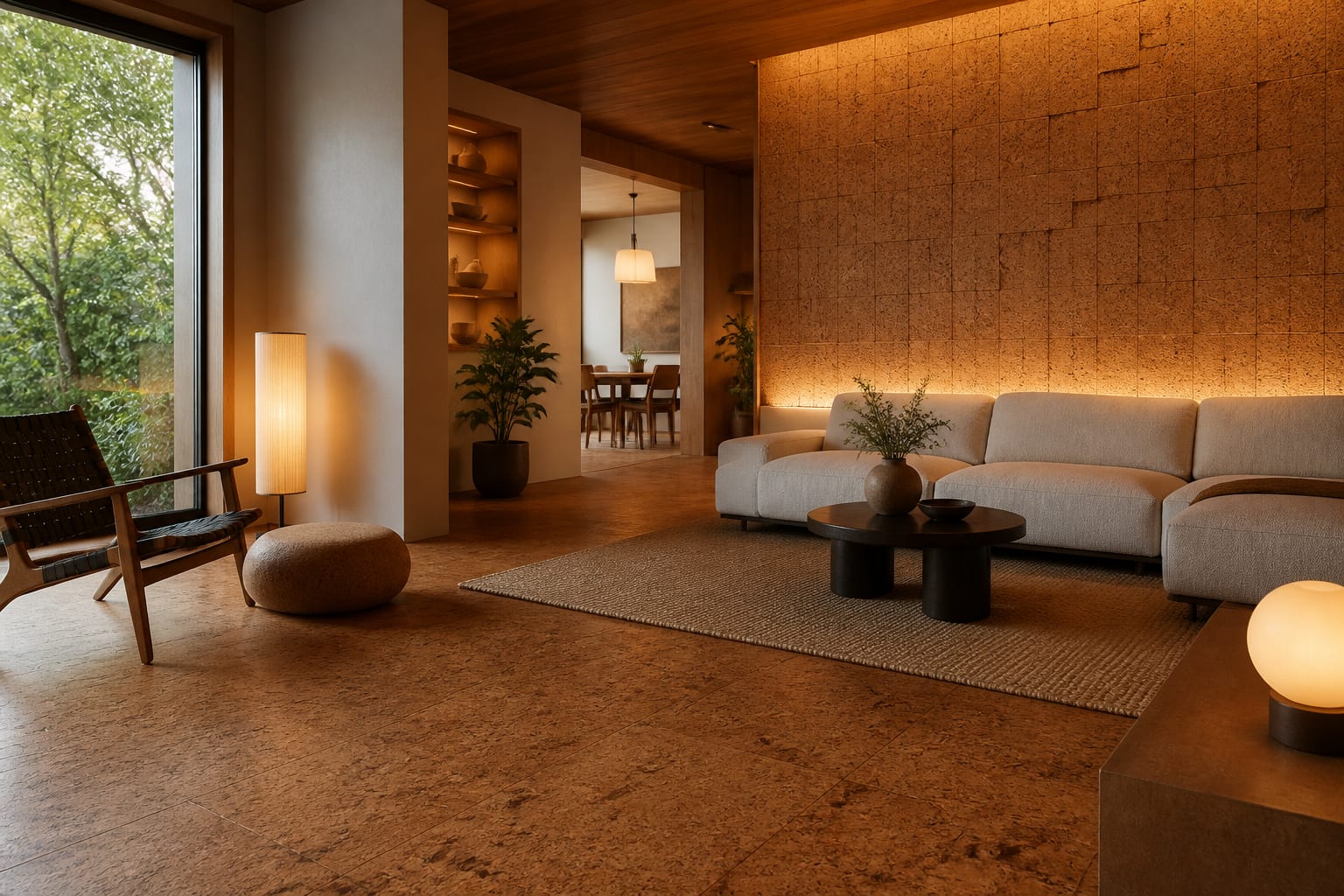
Cork is the material people forget exists until they stand on it barefoot in a friend's kitchen and wonder why the floor feels so good. My read is that cork is one of the most underrated surfaces in interior design, and the only reason it is not everywhere is a dated 1970s reputation. Is cork flooring a good choice? For most homes, yes: cork is warm, quiet, soft underfoot, and genuinely renewable, and modern finishes have fixed the durability worries that scared people off decades ago.
What makes cork special is structural. It is harvested from the bark of cork oak trees without felling them, the bark grows back, and the same tree gets harvested every 9 years for over a century. That gives you a material with real sustainability credentials and a cushioned, insulating feel no hardwood can match.
Most people meet cork as flooring, but the material reaches further than that, and treating it as a one-room product sells it short. The same warmth and sound absorption that work underfoot also make cork a smart wall covering, a quiet underlayment beneath other floors, and a soft, tactile surface for a study or a nursery. Once you understand what cork does well, you start seeing places for it that a harder, colder material would never suit.
Is cork flooring a good choice?
For comfort, sound, and warmth, cork is hard to beat, so the answer for most living spaces is a clear yes. The cellular structure that makes cork roughly half air also makes it springy underfoot, easy on joints, and quiet to walk on, which is why it shows up in libraries and recording spaces. It holds warmth too, so a cork floor never has the cold shock of tile in winter.
The honest caveats are about hardness and light. Cork dents under heavy point loads like stiletto heels or an unprotected sofa leg, though the material's elasticity means many shallow dents recover over time. Unsealed cork can also fade in strong direct sun. Choose a urethane-finished or vinyl-topped cork product for wet-prone rooms, keep furniture on felt pads, and these limits stop mattering for daily life.
There is a comfort angle that hard floors simply cannot match, and it is the reason I keep recommending cork. Because the material is roughly half air by volume, it gives slightly underfoot, which is easier on knees and backs during long stretches of standing, and it softens the sound of footsteps and dropped objects. Cork also holds warmth, so it sits around 4 to 8 degrees warmer to the touch than tile in the same room. In a kitchen where you cook for an hour, those two qualities add up to a floor you actually enjoy standing on.
Cork flooring ideas worth stealing
Cork is more versatile than its beige-tile stereotype suggests. These are the applications I reach for:
- Floating cork plank floors in kitchens and home offices, where the cushion reduces standing fatigue.
- Stained or printed cork that mimics wood grain, giving you the comfort with a more current look.
- Cork wall tiles as a pinboard-meets-acoustic-panel in a study or kids' room.
- A cork accent wall to soften echo in an open-plan space, pairing well with the living texture of a moss wall.
- Cork underlayment beneath other floors purely for the sound and thermal benefit.
Cork also sits naturally in a biophilic, natural-material scheme. It pairs especially well with bamboo, and the harder surface of bamboo interior design balances cork's softness when you mix the two across an open floor plan. Add greenery and the room reads cohesive; the styling logic in these indoor plant styling ideas ties cork's earthy tone to living elements.
The format you buy changes the look and the install. Cork comes as glue-down tiles, floating click-lock planks, and rolls for underlayment, and each suits a different project. Glue-down tiles give the most seamless, custom field and the best moisture resistance when sealed properly, while floating planks go down fast over an existing floor and pull up cleanly if you rent. For walls I reach for thin cork tiles or sheets, which weigh almost nothing and cut with a utility knife, so a feature wall is a weekend project rather than a contractor job.
Cork planks and tiles usually come in thicknesses from 6 mm to 12 mm, and installed cost tends to sit around $8 per square foot, which lands between vinyl and engineered wood.
How cork wears and what care it needs
Cork is more durable than its soft feel suggests, but the finish does the heavy lifting. A factory urethane or aluminum-oxide coating protects against scuffs and moisture, and it can usually be refreshed rather than fully replaced. Sweep grit regularly, since trapped sand abrades the finish, and wipe spills before they sit, because raw cork seams can absorb standing water.
Use felt pads under furniture and consider area rugs under rolling chairs to spread the load. Keep direct sun off unfinished cork or expect gradual fading. With a sealed product and that light maintenance, a cork floor comfortably reaches 25 years and often well beyond, which makes its mid-range price look like a bargain over its lifespan.
There is a resilience to cork that surprises people who expect it to be fragile. Because the cell walls compress and rebound, a cork floor recovers from a lot of the dents that would permanently mark hardwood, and a chair leg impression often eases out over a few days. It is also naturally resistant to mold and fairly antimicrobial, which is part of why it shows up in kitchens and kids' rooms. None of that means it is indestructible, but it ages more gracefully than its soft reputation suggests.
Common mistakes to avoid
The most common mistake is installing unsealed or cheaply finished cork in a high-moisture room like a full bathroom. Cork tolerates humidity but not standing water through open seams, so a poorly sealed floor swells and lifts. Specify a waterproof-core or vinyl-topped cork for those rooms instead of a basic glue-down tile.
Another common mistake is skipping the subfloor prep. Cork is thin and conforming, so it telegraphs every bump and ridge underneath, and an uneven subfloor shows through within months. A frequent anti-pattern is dragging heavy furniture across cork without protection, which gouges the surface in a way that does not bounce back. Move heavy pieces on sliders and put broad glides under any leg carrying real weight.
Use AI design to preview cork before you commit
Cork's color range surprises people, running from pale honey to dark espresso and even printed wood looks, and a single tile sample cannot show how a whole floor will read in your light. AI design fixes that gap. Upload a photo of your room to Re-Design and it re-renders the space with cork flooring or wall tiles in the shade you are considering, so you see the warmth and pattern across the entire surface, not a two-inch chip.
What I find most helpful is comparing cork against the floor you have now. Drop a light natural cork next to a darker stained version in the same room and the right call usually becomes obvious. Upload one photo, test a couple of cork tones side by side, and you commit to the finish that genuinely suits the room.