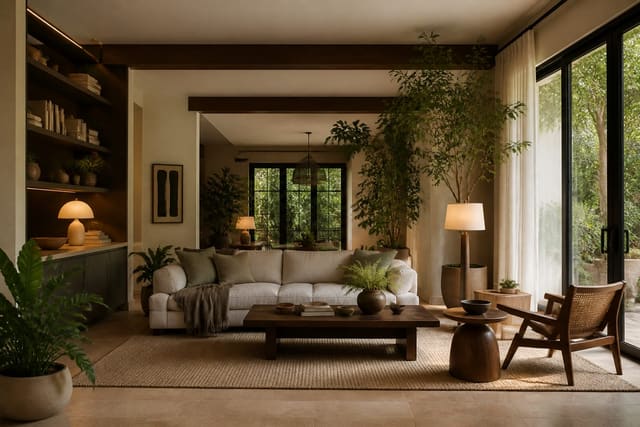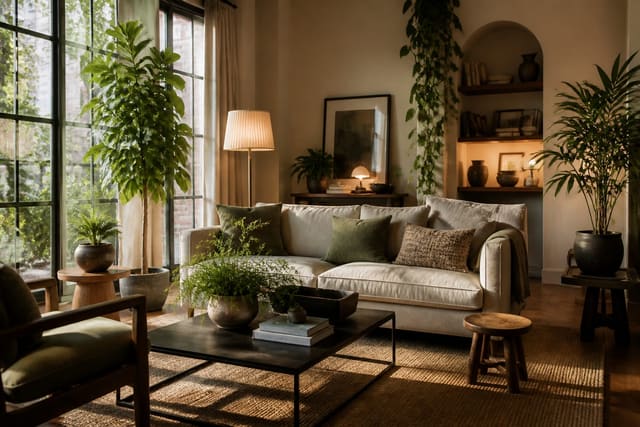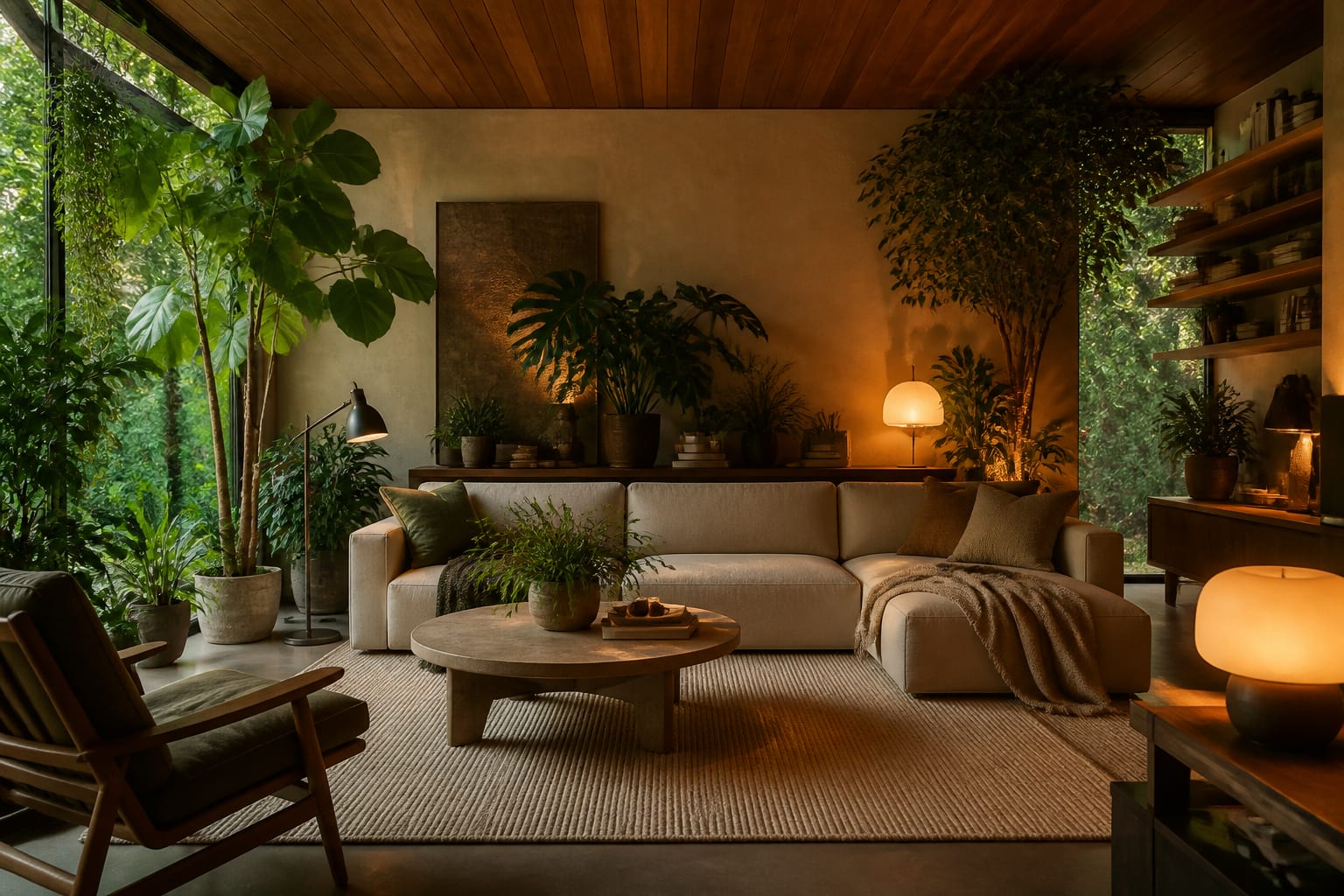
Biophilic living room ideas work best when nature feels woven into the room, not staged on top of it. The strongest version treats plants, daylight, and raw materials as structural choices rather than decoration. Start by pulling furniture toward your largest window, then build outward with timber, linen, and clay tones. A living room designed this way reads calmer the moment you walk in, because your eye lands on greenery and grain instead of glossy synthetics. Below are specific moves that make the look feel rooted and lived-in.
Build the Room Around Real Daylight
A biophilic living room starts with light, so treat your windows as the most valuable feature in the space and design outward from them. Pull the sofa off the back wall and angle seating toward the glass, giving everyone a sightline to whatever greenery sits outside. Swap heavy blackout drapes for sheer linen panels that diffuse sun without blocking it, keeping the room bright through the afternoon. If your window faces a wall or alley, lean on mirrors placed perpendicular to the glass to bounce daylight deeper into the room. Light also shapes how plants behave, so group your leafiest specimens where morning sun lands and tuck shade-tolerant varieties into dim corners. The goal is a room that tracks the day, brightening at dawn and softening at dusk, the way a clearing in a forest does. Avoid overhead fixtures as your only source, because flat ceiling light flattens texture and kills the natural depth biophilic rooms depend on. Instead, layer a floor lamp near the plants and a low table lamp by the sofa, both with warm bulbs that mimic late-day sun. Reflective surfaces help too, so a pale rug or a sandy plaster wall will carry borrowed light across the floor and walls. When daylight becomes the organizing principle, every other natural material in the room reads richer, and the whole space feels connected to the world outside rather than sealed away from it. The shift is immediate and worth the rearranging. If you can position seating to catch both a morning glow and a softer afternoon angle, the room will feel different at each visit, which is exactly the living, changeable quality a biophilic living room should have throughout the day.
See also our guide to Cottagecore Living Room Ideas for more on biophilic living room ideas.
Layer Plants in Tiers, Not Singles
One potted plant on a shelf reads as an afterthought, but a biophilic living room earns its name through tiers of greenery at different heights and densities. Start with a tall floor specimen like a fiddle-leaf fig or a kentia palm to give the room a vertical anchor near a corner. Build a middle layer with snake plants, rubber plants, or a ZZ on a side table and a low stool, filling the visual gap between floor and eye level. Finish with trailing greenery such as pothos or string-of-hearts spilling from a high shelf or the top of a bookcase, softening hard edges and drawing the eye upward. Clustering matters more than scattering, so group three or five pots together in odd numbers where they read as a small thicket rather than lonely accents. Vary the pot materials too, mixing terracotta, glazed stoneware, and woven baskets so the containers feel collected over time instead of bought in one trip. Keep care realistic by matching species to your actual light, since a struggling plant undermines the calm you are chasing. If your room runs dark, lean on cast-iron plants, snake plants, and pothos that tolerate low light without sulking. The payoff is a room that feels populated by living things at every level, which is the entire point of the style. Greenery layered this way also improves the air and adds the gentle movement that flat decor can never deliver. Rotate a few pots every couple of weeks so each plant gets its turn near the light, and the whole arrangement stays healthy and full rather than thinning out on the darker side of the room.
For a related angle on biophilic living room ideas, read Maximalist Living Room Ideas.
Choose Materials That Came From Somewhere
Biophilic living rooms rely on materials that show their origin, so favor wood with visible grain, stone with real veining, and textiles spun from plant or animal fibers. Trade a high-gloss lacquer coffee table for solid oak or a slab of walnut where you can still read the tree it came from. Bring in a jute or wool rug underfoot, because natural fibers carry subtle color variation and texture that synthetic carpet flattens out entirely. Rattan and cane work hard here, whether in a lounge chair, a pendant shade, or a cabinet front, adding handmade warmth and a pattern that catches light. Stone earns its place through a travertine side table, a slate hearth, or a bowl of river rocks that ground the room with something quarried rather than molded. Keep upholstery in linen, hemp, or boucle so the seating feels tactile and a little imperfect, the way nature rarely arrives in straight lines. Even small swaps register, so replace plastic switch plates and shiny chrome hardware with brushed brass, aged copper, or carved wood pulls. The aim is a room where almost everything you touch has texture and a story, which is what separates a genuinely biophilic space from a green-painted imitation. Layering these materials also gives the eye somewhere to rest, since grain and weave hold attention the way a blank surface never could. Over time the natural finishes patina and improve, making the room feel more rooted each year. A scratch in oak or a worn edge on a rattan chair only deepens the character, which is the opposite of how synthetic surfaces age and start to look tired and cheap.
Set a Palette Drawn From Outside
Color decides whether a biophilic living room feels intentional or merely cluttered with houseplants, so pull your palette straight from a landscape you love. Anchor the walls in warm whites, soft clay, sage, or oatmeal, tones that recede and let living greenery become the brightest thing in the room. Treat green as your accent rather than your base, because painting every surface green competes with the plants and muddies the effect. Layer earthy neutrals through the larger pieces, then introduce deeper grounding shades like terracotta, ochre, or a muted forest tone in cushions, throws, and art. Keep contrast gentle so the room feels like a continuous natural scene instead of a set of clashing zones. Texture carries much of the interest here, which means you can stay tonal and still avoid a flat, monotonous result. Bring in flickers of warmth through wood and woven materials, and let metallic accents stay matte and aged so nothing reads as cold or industrial. Natural light shifts these colors through the day, so test swatches against your actual window before committing, since a sage that glows at noon can turn gray by evening. Avoid stark black-and-white pairings or saturated primaries, both of which fight the organic mood you want. When the palette mirrors a forest floor, a coastline, or a desert at dusk, the plants and materials finally read as one cohesive habitat rather than scattered decorations, and the living room feels genuinely restful instead of merely on-trend. Pull one accent shade from a single plant or a piece of natural stone in the room, and repeat it sparingly so the palette feels gathered from the space itself rather than imposed on it.
- Cluster three to five plants in odd numbers for a natural thicket effect
- Angle your sofa toward the brightest window instead of a wall
- Swap glossy coffee tables for solid oak or walnut with visible grain
- Hang trailing pothos high to soften shelf and bookcase edges
- Mix terracotta, stoneware, and woven baskets across your plant pots
- Replace chrome hardware with brushed brass or carved wood pulls
- Bounce daylight deeper with a mirror placed perpendicular to glass
Bring the look home with Re-Design
Want to see these biophilic living room ideas in your own space before buying a single plant? Open Re-Design, upload a photo of your living room, and preview the style applied to your actual walls, windows, and furniture. You can test sage versus oatmeal walls, swap a glossy table for warm oak, and judge where a tall floor plant belongs without moving anything physical. Seeing the layered greenery and natural materials rendered on your real room makes the leap from idea to plan far easier and faster.
Frequently Asked Questions
What plants work best for a biophilic living room?
Layer tall anchors like fiddle-leaf figs or kentia palms with mid-height snake or rubber plants, then add trailing pothos. Match every species to your real light levels, leaning on cast-iron plants and ZZ plants if your room stays dim through most of the day.
Can I create a biophilic living room without many windows?
Yes. Use mirrors to bounce available daylight, add warm-toned lamps to mimic natural light, and choose low-light plants like pothos and snake plants. Natural wood, stone, and woven textures still deliver the grounded, nature-connected feeling even when daylight is limited.
What colors define a biophilic living room?
Warm whites, clay, sage, oatmeal, and earthy neutrals form the base, letting living greenery stand out as the brightest element. Use terracotta, ochre, or muted forest tones as accents, and keep contrast soft so the room reads like a continuous natural scene.