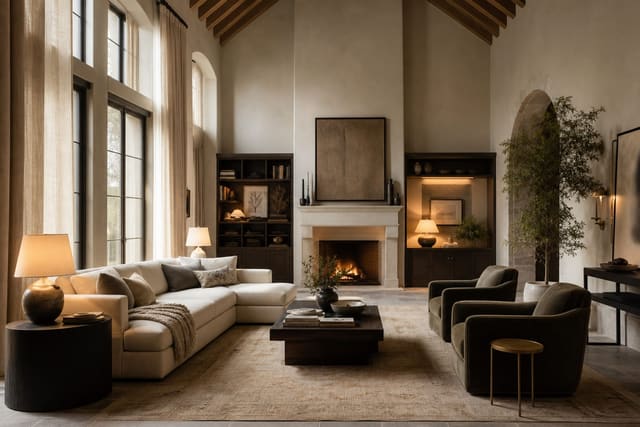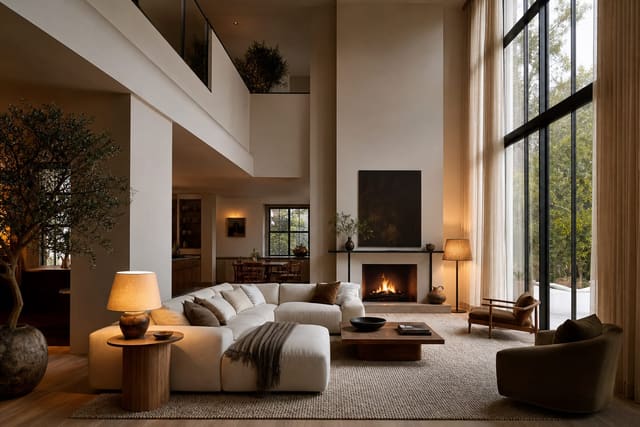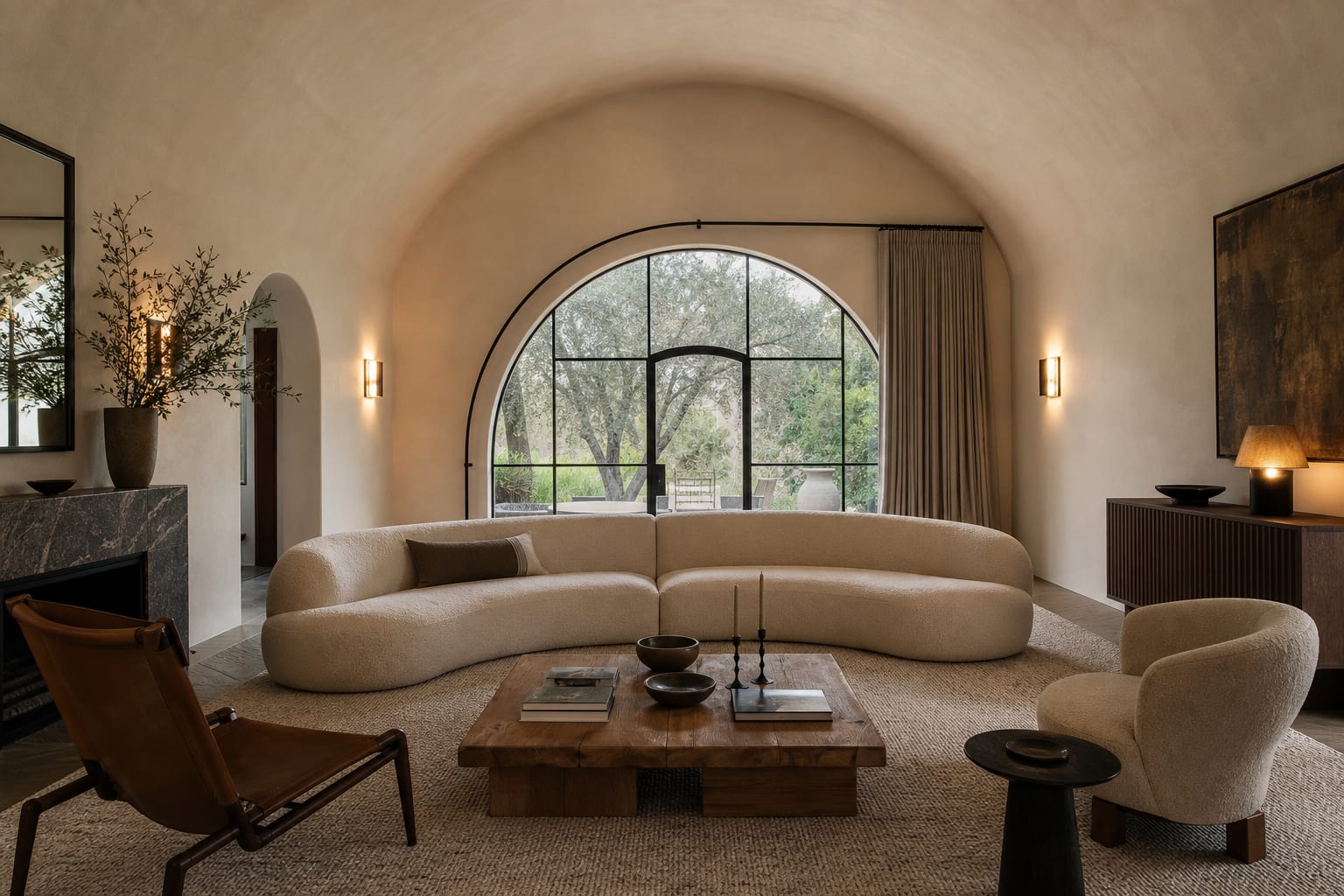
Barrel vault ceilings ground best when furniture picks up the curve: an oversized sofa, a rug sized up from normal, and one fixture hung at chord height rather than the apex. Center the main seating or bed under the arch, keep tall pieces on flat end walls, and let low, broad furniture make the ceiling feel intentional instead of top-heavy. Preview the layout on your own room photo before buying anything large.
How do you furnish a room with a barrel vault ceiling?
Center the main furniture zone under the curve, keep the tallest pieces on flatter walls, and use low, broad furniture so the arch feels planned rather than accidental. The ceiling already dominates the room, so the furniture's job is to build a calm horizontal base beneath it.
Start with the vault's centerline. In a 12-16 foot wide room, leave 30-36 inches for circulation and place the sofa, bed, dining table, or desk in the middle third of the floor, parallel to that line. This keeps the curve from reading as a hallway and gives the eye a clear landing point.
Keep silhouettes low near the center: a sofa back around 30-34 inches, lounge chairs 28-32 inches wide, and a coffee table 14-18 inches high. Tall wing chairs, canopy beds, and towering cabinets compete with the curve and can make the vault feel compressed.
Size the rug generously — go one size up from what a flat-ceiling room would need. Use 8'x10' for a compact seating group, 9'x12' for a full sofa and two chairs, or 10'x14' in a wide room, with at least the front legs of every main seat on the rug by 6-10 inches. A small rug reads as an island under a tall, curved volume.
If the vault is also tall, borrow grounding logic from high ceiling room decorating: build a strong human-height room first, then let the volume above become atmosphere.
Which furniture shapes flatter the arch?
Good furniture repeats the ceiling's sweep without turning every piece into a gimmick. You don't need a crescent sofa, a round bed, and arched cabinets — one or two softer shapes balanced by straight lines is enough.
A curved sofa works in a generous room; leave at least 30 inches around it so the curve feels gracious, not trapped. In a smaller room, choose an oversized straight sofa (92-108 inches, 38-42 inch seat depth) with rounded arms, an oval coffee table, and two barrel-back chairs — smaller sofas float visually in a curved volume.
Dining tables should follow the long axis, centered under the highest point with 36 inches of chair clearance. A racetrack or oval table echoes the ceiling better than sharp corners in a narrow vaulted room.
For bedrooms, anchor the headboard on the most stable wall, usually a flat end wall. A 48-60 inch headboard is often enough; a 72-inch version needs a wide wall where the arch starts well above it. Keep nightstands 20-28 inches wide and mount sconces 56-64 inches up so lighting stays in the human zone.
Storage should stay low and horizontal — a 12-18 inch deep console or long low cabinet beats a tall case piece interrupting the curve. If you need height, put it on a flat end wall in a finish close to the wall color.
Test this on your own room photo with ReDesign before buying; keep the doorway, windows, main furniture, lighting, and any fixed features visible so the preview solves your actual room.
How should lighting, rugs, and walls support the vault?
A single pendant hung from the high point can turn the room into a tunnel with a necklace. Hang fixtures at chord height — the imaginary horizontal line where the curve begins — not at the apex, so light reaches the seating or table zone instead of stranding itself overhead.
In a dining room, hang the fixture 30-36 inches above the tabletop. In a living room, avoid a dangling light in the walking route unless there's at least 7 feet of clearance underneath. Slim linear pendants, shallow chandeliers, and wall sconces usually behave better than one dramatic drop.
Side lighting matters most. Use table lamps, plug-in sconces on flat walls, picture lights, and bulbs around 2700-3000K. A barrel vault can turn cool overhead light into a gray wash on stone, plaster, or pale paint; for dim rooms, the layered-lamp and mirror tactics in faking natural light in any room help.
Use one continuous wall-and-ceiling color, or a ceiling only one step lighter than the walls — hard contrast at the spring line slices the room in half. Soft warm white, clay, mushroom, and pale greige support the architecture better than stark white against dark walls.
Keep art at eye level (center around 57-60 inches from the floor) rather than chasing the crown. Over a sofa, stack art vertically up to chord height or use one oversized piece — 48-72 inches wide, or 60+ inches for a focal wall — instead of scattering small frames up the curve.
Common barrel vault design mistakes
The biggest mistake is treating the room like a rectangle with a decorative lid. A vault changes perceived width, height, and direction, so a standard furniture plan can feel slightly off even when pieces technically fit. Center the main zone under the arch first.
Other recurring issues:
- Too many arched motifs. Arched mirrors, arched cabinets, half-moon tables, and a curved sofa together turn architecture into a theme party — repeat the curve once or twice, then go straight.
- Tall furniture on the curved wall. A 78-inch bookcase or armoire looks squeezed; move height to the flat end wall instead.
- Undersized rugs. A 5'x7' rug under a coffee table looks temporary beneath dramatic architecture; size the rug to the seating group.
- Skipped window treatments. Mount drapery 4-8 inches above the casing and extend rods 6-10 inches past each side so fabric stacks off the glass, not the wall.
If the room also has a steep roofline or mixed ceiling shapes, vaulted ceiling room decorating covers where the eye should land.
Use AI design to preview the vault before you commit
A sofa that looks normal online can seem squat under an arch, while a fixture that looks oversized in a showroom can disappear once it hangs in the curve. Upload a straight photo from the room entry and test the layout before moving furniture or ordering custom pieces.
Prompt with the actual architecture: "room with a barrel vault ceiling, main seating centered under the arch, low linen sofa, two rounded chairs, 9'x12' wool rug, oval coffee table, warm wall sconces, continuous soft white walls and ceiling." Then run a second version with the sofa rotated, a rectangular coffee table, or a lower console on the end wall.
Judge scale, not styling: does the furniture sit confidently under the vault or look lost? Does the fixture connect to the seating area or float? Renters can preview removable changes — plug-in sconces, rugs, freestanding cabinets, no-drill curtains — while owners can test built-ins, plaster finishes, and new lighting before the project gets expensive.
What final checks make the room feel designed?
Stand at the entry and name the first thing you see. If it's empty curve, a lonely pendant, or timid edge furniture, the room needs a stronger center; if you see the seating group, bed, or art wall first and the arch second, the balance is working.
Measure the vault width, apex height, spring line height, rug size, sofa back height, table clearance, and fixture drop — the curve makes objects feel taller, shorter, or narrower than they are, so guessing is risky. A 34-inch sofa back, 18-inch coffee table, 30-inch walkway, and 9'x12' rug are ordinary numbers that make unusual architecture livable.
The best barrel vault ceiling room design doesn't compete with the architecture. It gives the arch a grounded room beneath it: low furniture, generous rugs, warm side lighting, restrained walls, and one repeated curve that shows the ceiling was considered.
Frequently Asked Questions
Why does normal-sized furniture look small under a barrel vault?
Barrel vaults add 2-4 feet of effective vertical volume, which makes standard 30-inch sofas and 18-inch coffee tables read miniature. The eye scales the room against the ceiling apex, not the wall height, so furniture needs to be sized up to match.
What sofa size works under a barrel vault?
Go oversized: a 92-108 inch sofa with a 38-42 inch seat depth holds the room visually. Smaller sofas tend to float in the curved volume instead of anchoring the seating area.
How low should pendants hang in a barrel vault room?
Hang pendants at chord height — the horizontal line where the curve begins — rather than at the apex. That brings light down to the seating or dining zone instead of leaving it stranded in the dome above.
Should a rug be larger than usual in a barrel vault room?
Yes, size up one notch, such as 10'x14' instead of 9'x12', so the rug grounds the seating arrangement against the curve. Small rugs read as an island in a tall, curved volume.
Does art on the wall help anchor a barrel vault room?
Yes. Stack art vertically up to chord height, or use one oversized piece of 60 inches or more on the focal wall, to pull the eye to the wall plane and balance the ceiling's volume.
> Try this: Ready to see this on your own room? Open ReDesign and run the preview.
Three transformations to try
1. Oversized 108-inch sofa with 10x14 rug 2. Chord-height pendant over seating zone 3. Vertical art stack to chord height