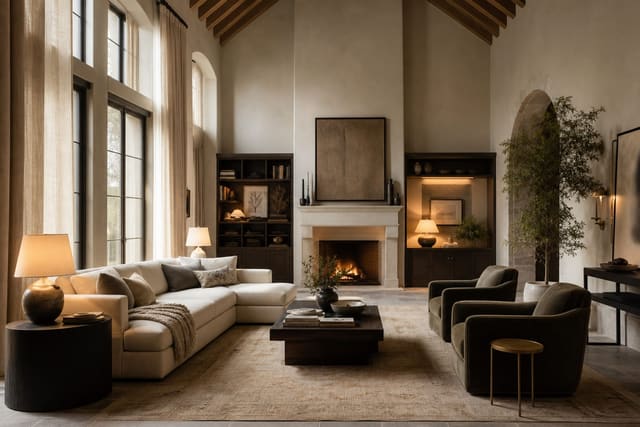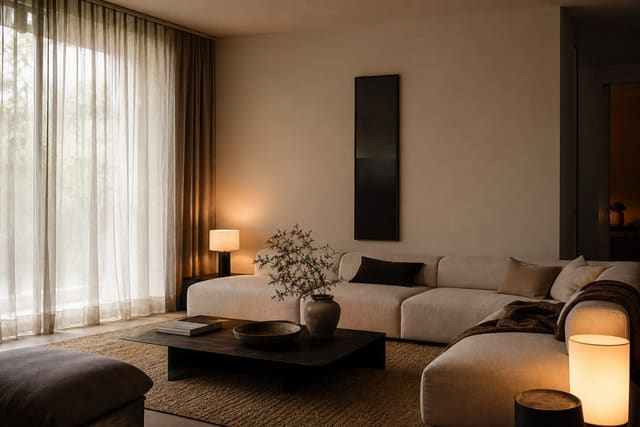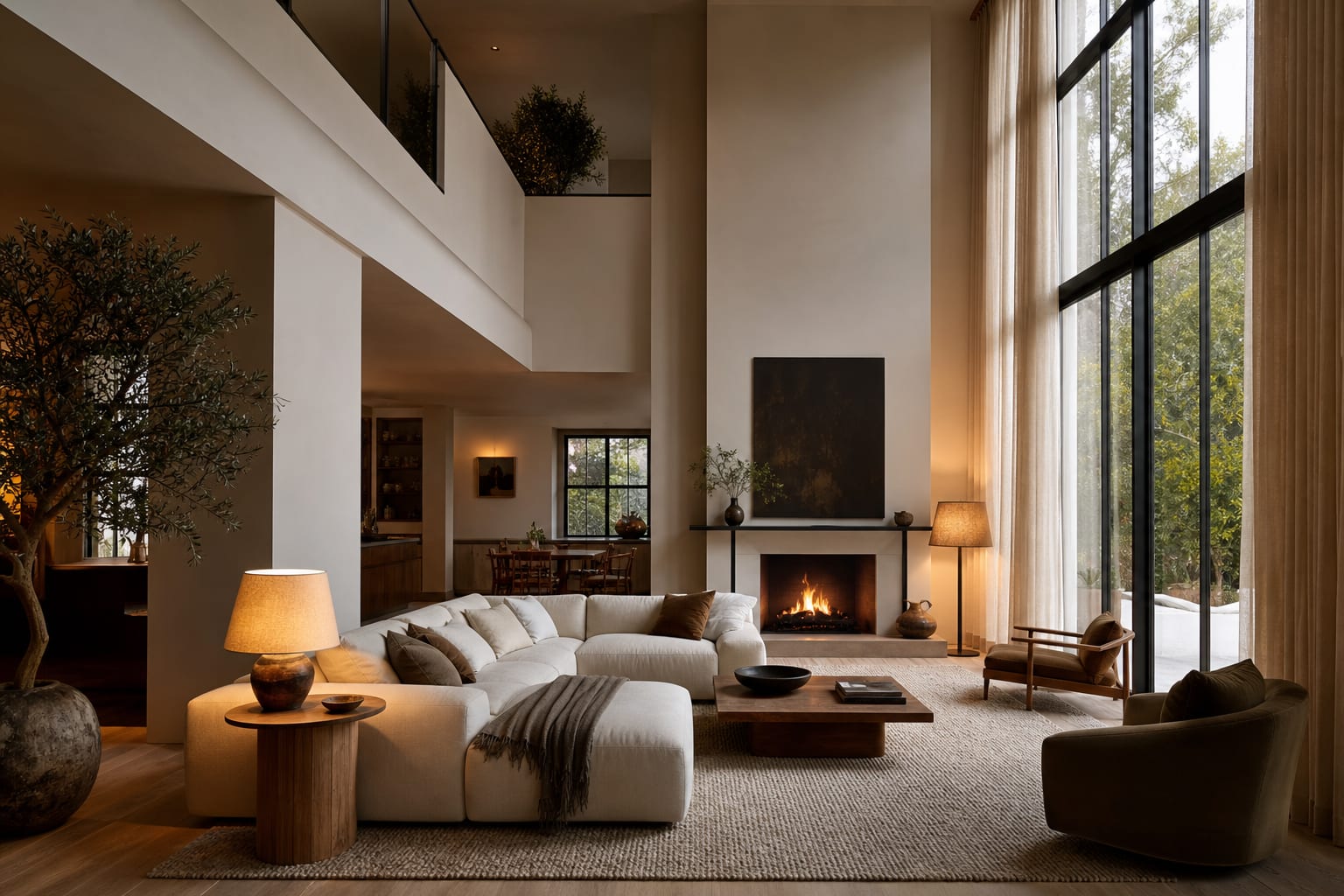
High-ceiling rooms feel grounded when oversized art or paneling fills the upper third of the walls, pendants drop to seating height, rugs run one size larger than normal, and a tall storage piece anchors a primary wall. High ceiling room decor ideas work by adding weight at multiple heights — a strong human-scale floor plan, then a single confident vertical move — instead of chasing the roofline.
What makes a high ceiling room feel grounded instead of hollow?
Start with the floor, because an empty floor makes tall walls feel even taller. A 9' x 12' rug is often the minimum for a sofa and two chairs; go 10' x 14' when furniture floats in a large open room. Let front legs of every main seat sit on the rug by 6–10 inches, with 14–18 inches between sofa and coffee table.
Furniture needs width, depth, and texture, not just height. A sofa back around 30–36 inches works in many tall rooms, paired with a deep sectional, upholstered chairs, a long console, or a broad coffee table. Tiny furniture under a 12-foot ceiling looks apologetic.
Vaulted ceilings follow the same grounding logic, but the slope shifts where weight belongs — see vaulted ceiling decorating strategies when the highest point sits off-center.
Which walls and windows should carry the height?
A tall wall needs one clear vertical decision, not a dozen small decorations climbing upward. Give the first wall people see from the entry a single job: tall drapery, a large artwork, a fireplace treatment, built-ins, limewash, paneling, or a plant-and-lighting composition.
Curtains are the easiest non-construction move. Mount the rod 4–8 inches above the casing, or 2–4 inches below the ceiling if the window is already tall, and extend it 8–12 inches beyond each side so panels stack off the glass. Let fabric skim the floor with about 1/2 inch of clearance. Linen, cotton, and wool blends soften echo better than shiny synthetics.
Art should serve people, not the roofline. Keep the center of a primary piece around 57–60 inches from the floor and size it generously — a 60–84 inch wide artwork over a sofa reads calmer than a gallery wall climbing toward the ceiling. On a huge wall, use a diptych or one oversized canvas instead of scattering small frames.
Built-ins help only when scaled to the architecture; a bookcase stopping at 7 feet on a 14-foot wall needs art or sconces above it to avoid looking stranded. A cheaper fix is a 30–34 inch credenza with tall lamps, large art, and a plant reaching 7–9 feet without touching the ceiling.
Test grounding moves on your own room photo before committing — keep the doorway, windows, main furniture, and any fixed features visible in the shot.
How should lighting fix the echo and empty feeling?
A dramatic ceiling does not excuse one cold fixture floating twelve feet overhead. Light needs three heights: overhead for architecture, mid-height for walls, and low light for people.
Use chandeliers and pendants only when they relate to the furniture below. Over a dining table, hang the fixture 30–36 inches above the tabletop; in open living areas, keep at least 7 feet of clearance under anything people walk beneath.
Wall lights matter as much as the ceiling fixture. Sconces mounted 60–66 inches from the floor add human-scale glow on tall walls, and picture lights make large art feel intentional at night. Table lamps should carry shades around 14–18 inches wide so they hold their own against wall height.
Use 2700K bulbs in living rooms and bedrooms for warmth; 3000K suits kitchens and tall entries needing cleaner task light. Install dimmers where possible — a double-height room often needs a bright cleaning mode and a softer evening mode.
If height is paired with poor daylight, don't add more overhead brightness. Instead use the layered approach from faking natural light in any room: pale matte surfaces, warm lamps, and mirrors placed to catch real window light.
Common high ceiling room decor mistakes
- Buying tall objects just because the ceiling is tall. A faux tree or spindly floor lamp fills a corner in inches while doing nothing for comfort; use height where it has a job.
- Undersizing the rug. A 5' x 7' rug under a coffee table in a large tall room makes seating feel temporary; size the rug to the conversation area, not the empty floor.
- Hanging everything too high. Art, sconces, and mirrors should serve people standing and sitting — a mirror centered around 60 inches usually beats one near the top of a fireplace wall.
- Making every surface hard. Bare floors, glass, and thin upholstery amplify echo; add wool rugs, lined curtains, books, canvas art, and fabric lampshades for absorption.
- Ignoring the lower third of the walls. Tall architecture exposes skinny consoles and bare baseboards; a long cabinet, paneled lower wall, or darker upholstery adds weight without cluttering the upper air.
Use AI design to preview the room before you commit
Scale is hard to judge from a shopping cart. A sofa that looks generous online can shrink under a 13-foot ceiling, and a bold showroom chandelier can disappear once suspended in real volume.
Upload a straight photo from the main entry, then a second from the seating area facing the tallest wall. Name the height and grounding moves in the prompt: "living room with 13-foot ceiling, 10' x 14' wool rug, low deep sectional, tall linen curtains mounted near the ceiling, oversized art above a 72-inch console, warm sconces, and layered 2700K lamps."
Run a second version with darker lower-wall paint, a larger rug, or a different chandelier shape, then compare for proportion: does your eye land on the seating group first, or shoot into empty space? Renters can preview floor-length curtains, plug-in sconces, and oversized rugs before buying pieces that are hard to return; owners can test built-ins, limewash, or chandelier drops before committing budget. If lighting is the weak spot, borrow the approach in layered living room lighting and test several sources instead of one fixture.
What final checks keep a tall room comfortable every day?
Measure ceiling height, main wall width, window height, sofa back, rug footprint, curtain rod location, and chandelier drop before ordering — a 10-foot ceiling and a 16-foot ceiling don't need the same fixture or curtain height.
Stand at the doorway and name the first thing your eye sees. Empty drywall or a lonely pendant means the room needs stronger grounding; seeing the seating area or art wall first, with height noticed after, means the balance is working.
Test the room at night with only lamps, sconces, and picture lights on. If it suddenly feels warmer and less echoey, lighting hierarchy — not architecture — was the problem.
Build from the floor up: bigger rug, stronger seating, taller fabric, warmer side light, quieter walls, and one confident vertical move. When the lower half settles, the ceiling becomes space you enjoy rather than space you're trying to fill.
Frequently Asked Questions
Why does a high-ceiling room feel cavernous?
When all visual weight — furniture, rugs, art — sits on the floor plane and upper walls stay bare, the eye reads empty volume above. Grounding fixes the imbalance by adding weight at the upper third: oversized art, paneling, or a tall focal treatment.
What art size works in a high-ceiling room?
Go oversized: single pieces 60+ inches wide, or a gallery wall that climbs into the upper third of the wall. Standard 30-inch art floats in the volume and reads small against tall walls.
How low should a pendant hang in a tall room?
Hang it 30–36 inches above the seating or dining surface, not at the ceiling apex. Bringing light down to human scale lights the zone people actually use and breaks up the empty volume overhead.
What rug size grounds a high-ceiling room?
Go one tier larger than the standard rule — if you'd normally choose 9' x 12', pick 10' x 14' or 12' x 15'. The larger footprint visually claims more floor and balances tall walls.
Does AI preview grounding moves before I buy?
Yes. Upload a photo of the tall room and describe the rug size, curtain height, and pendant drop you're considering; the preview shows how those choices sit against your existing ceiling height before you spend money.
> Try this: Ready to see this on your own room? Open ReDesign and run the preview.
Three transformations to try
1. Oversized art on tall focal wall 2. Pendant dropped to seating height 3. 10x14 rug grounding under sofa group