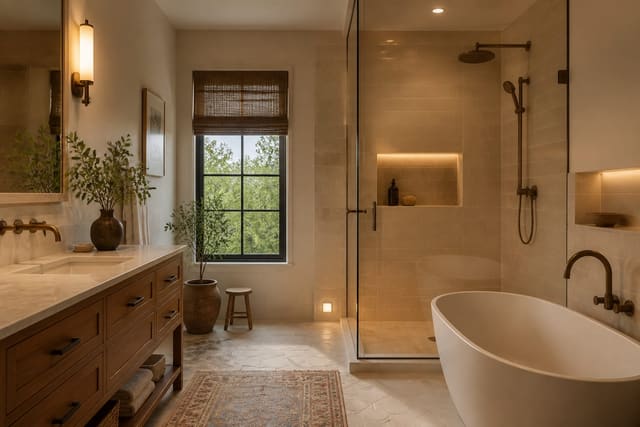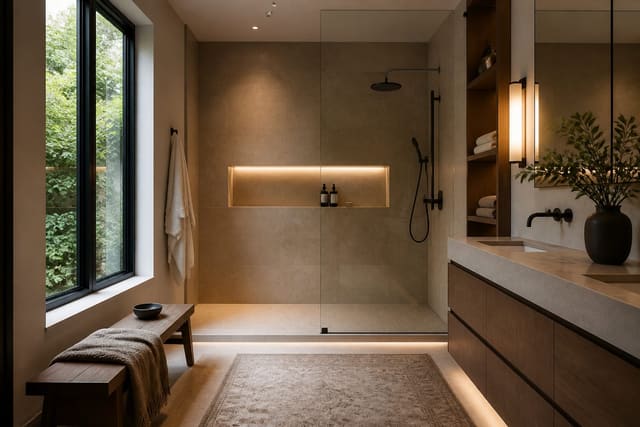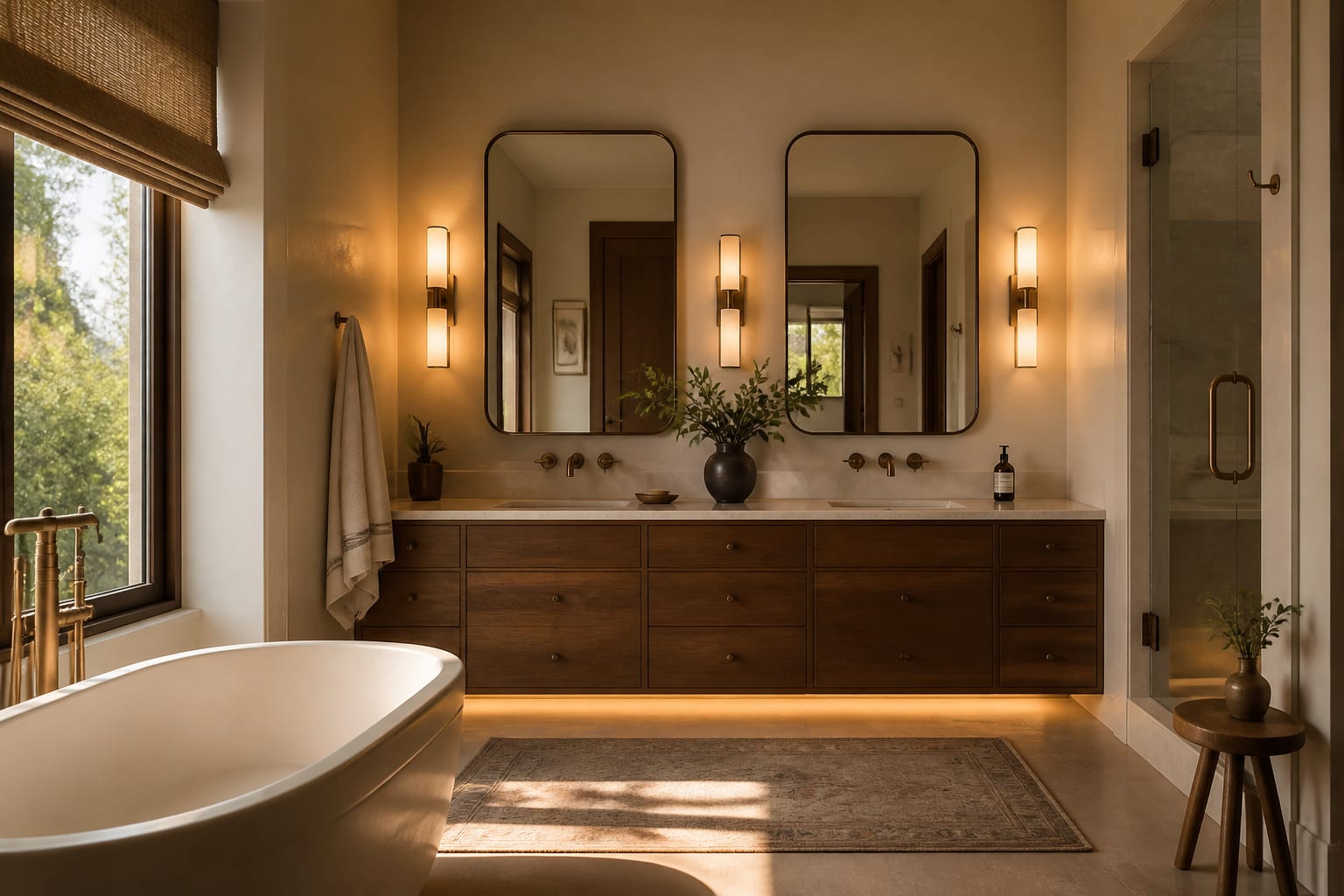
A mirror is the one fixture everyone in the bathroom looks at directly, so getting its size, height, and light right matters more than its frame. The most common mistake is hanging a mirror that floats awkwardly above the sink or stretches wider than the vanity it sits on. Get the proportions correct and the rest is preference: a warm wood frame, a clean frameless edge, a soft round shape, or a backlit LED that glows. The smartest choice anchors the mirror to the vanity below it, lights your face evenly, and matches the scale of the wall it hangs on.
How wide should a bathroom mirror be?
Size the mirror to the vanity, not to the wall. The reliable rule is to keep the mirror a few inches narrower than the sink base or vanity cabinet beneath it, which visually ties the two pieces together and keeps the mirror from looking like it is spilling past its support. On a 36-inch vanity, a mirror around 30 to 32 inches wide reads balanced; on a 48-inch single, aim for roughly 42 to 44 inches.
Going wider than the vanity is the error people regret most, because the mirror then floats untethered and the proportions feel off. A touch narrower always looks intentional.
Height is more forgiving and depends on the look you want. A tall mirror that climbs toward the ceiling makes a low room feel taller and gives more people room to see themselves. A shorter mirror centered over the sink keeps things tidy and leaves wall space for sconces. Whatever the dimensions, the mirror should feel like it belongs to the vanity it shares a wall with, echoing its width rather than competing with it.
See also our guide to Bathroom Tile Ideas for more on bathroom mirror ideas.
What height should you hang a bathroom mirror?
Hanging height is where good intentions go wrong. The dependable target is to set the bottom edge of the mirror about 5 to 10 inches above the faucet or the top of the backsplash. That gap clears the spout, keeps water splashes off the glass edge, and stops the mirror from sitting so high that shorter users lose the top of their reflection.
From there, center the mirror roughly on the eye level of the household, not on a rigid number. A mirror centered around 60 to 65 inches from the floor works for most adults, with the bottom edge landing in that 5 to 10-inch zone above the faucet.
In a shared bathroom, favor a taller mirror so people of different heights all get a full view. If a backsplash runs up the wall, measure from its top rather than the counter so the mirror clears it. The single biggest improvement most people can make is simply lowering a mirror that was hung too high, since dropping it a few inches instantly brings faces back into frame.
For a related angle on bathroom mirror ideas, read Walk In Shower Ideas.
Framed, frameless, round, or rectangular?
Shape and frame set the personality of the wall. A frameless mirror with a polished edge feels modern and nearly vanishes, letting the vanity and tile carry the design. It is also the easiest to clean, with no frame lip where dust and water spots gather. A framed mirror, by contrast, introduces color and material, so a matte black or warm brass border can pull the whole palette together.
Round mirrors soften a bathroom full of straight tile lines and rectangular cabinetry, adding a friendly curve that breaks up the boxes. They suit a single sink especially well. Rectangular mirrors maximize usable reflective surface and pair naturally with a wide vanity, giving more people a clear view.
Match the shape to the room's geometry. A small bathroom dominated by square subway tile often relaxes with a round mirror, while a long double vanity reads cleaner with rectangles. Frame finish should echo something already in the room, such as the faucet metal or a cabinet pull, so the mirror feels chosen rather than random. There is no single right answer, only a fit with the surfaces around it.
Are backlit LED and double mirrors worth it?
Backlit LED mirrors solve the oldest bathroom-lighting problem: shadows on your face. A perimeter of light behind the glass wraps illumination around your features evenly, which is exactly what makeup and shaving need. Many models include a defogger pad so the center stays clear after a hot shower, and a warm-to-cool color toggle lets you match daylight or evening light. They cost more and need a power connection in the wall, so plan the wiring during a renovation rather than after.
Over a double vanity, the choice between one wide mirror and two separate mirrors shapes the whole wall. Two matched mirrors, each centered on its own sink, give every user a dedicated reflection and let you hang a sconce between them. This usually looks more deliberate than a single long sheet that leaves people staring at the gap between basins.
If budget or simplicity rules, a single long mirror still works above a double sink, especially when you flank it with two sconces for even light. But for symmetry and personal space, two mirrors paired with centered sconces is the layout most people end up happiest with.
- Size the mirror a few inches narrower than the sink base so it visually anchors to the vanity.
- Hang the bottom edge 5 to 10 inches above the faucet to clear the spout and backsplash.
- Choose a frameless polished-edge mirror for a modern look that wipes clean with no frame lip.
- Add a matte black or brass frame to tie the mirror to the faucet metal and cabinet pulls.
- Soften a square-tile bathroom with a round mirror over a single sink.
- Install a backlit LED mirror with a defogger pad for shadow-free, even face lighting.
- Hang two matched mirrors centered on each basin over a double vanity for symmetry.
- Lower a mirror that was hung too high so shorter users see the top of their reflection.
Bring the look home with Re-Design
Mirror proportions are tough to judge from a product page, since the same mirror can look perfect over one vanity and oversized over another. With Re-design you upload a photo of your bathroom and preview a round mirror, a frameless rectangle, or a glowing backlit LED hung right above your real sink. Compare a single wide mirror against two matched ones over a double vanity, and nudge the size until it sits a few inches narrower than the base. Seeing the fit in your own room beats guessing from measurements alone.
Frequently Asked Questions
What size mirror goes over a 36-inch vanity?
Aim for a mirror around 30 to 32 inches wide over a 36-inch vanity, keeping it a few inches narrower than the cabinet below. That slight inset ties the mirror to its base and avoids the overhung look of a mirror wider than its support. Height is flexible, so size it to the wall and your eye level.
How high above the faucet should a mirror hang?
Set the bottom edge of the mirror about 5 to 10 inches above the faucet or the top of the backsplash. That clearance keeps splashes off the glass edge and prevents the spout from cutting into your reflection. If a tall backsplash runs up the wall, measure from its top rather than from the counter surface.
Are backlit LED mirrors worth the extra cost?
For anyone who does makeup or shaves, yes. The perimeter glow wraps even light around your face and erases the shadows a single overhead fixture casts. Many include a defogger pad and a warm-to-cool toggle. The catch is wiring, since they need a power connection in the wall, so plan it during a renovation.
One mirror or two over a double vanity?
Two matched mirrors, each centered on its own sink, usually look more intentional and give every user a dedicated reflection plus room for a sconce between them. A single long mirror still works if you flank it with two sconces for even light, but the paired layout tends to win on symmetry and personal space.