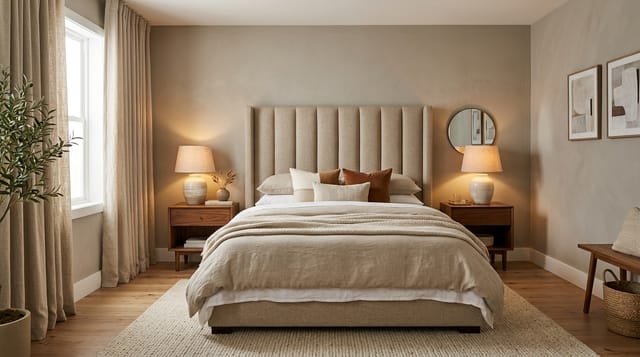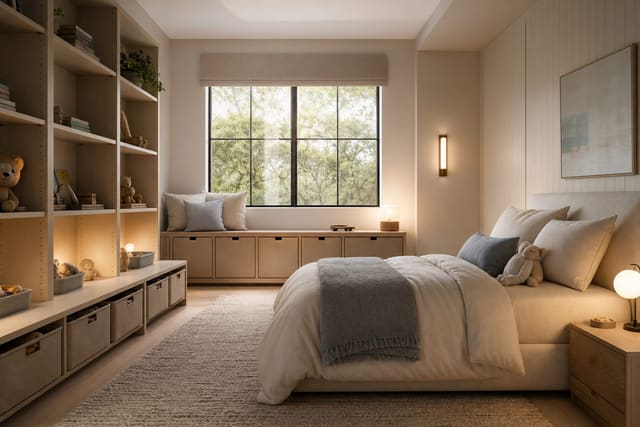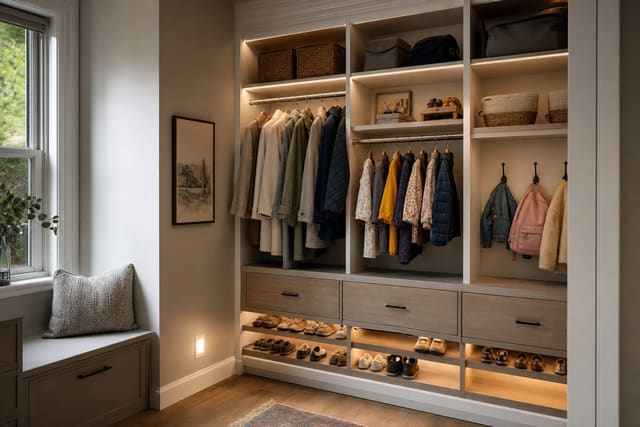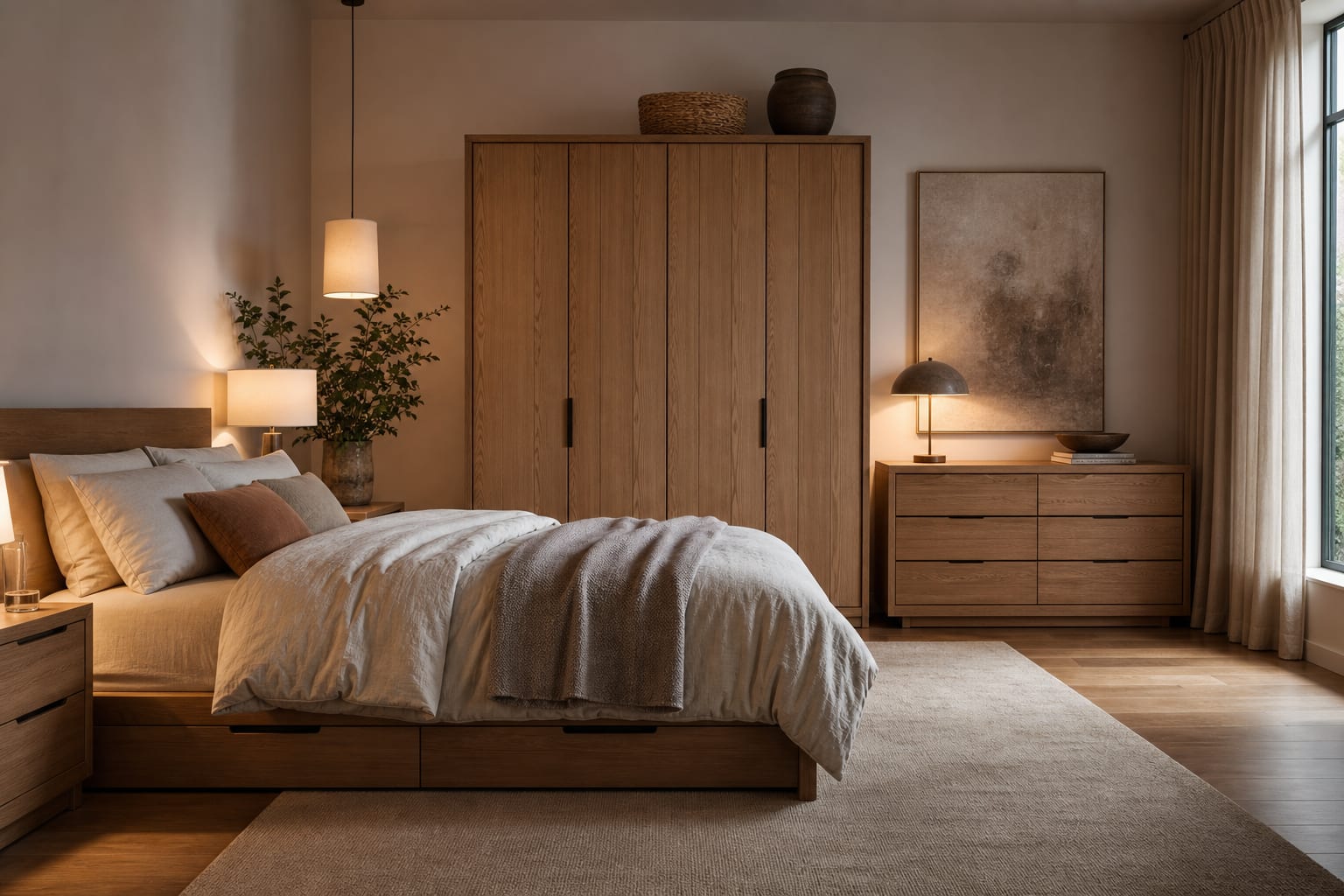
A bedroom without a closet needs a freestanding wardrobe (6 to 7ft tall, 30 to 40in deep) for hanging clothes, a 6-drawer dresser sized to the longest wall for folded items, and one open garment rack for in-rotation pieces. Spreading storage across these three furniture types beats one oversized wardrobe that swallows the room and still doesn't solve the daily reset.
What do you do first when a bedroom has no closet?
Use a freestanding wardrobe or armoire for hanging clothes, add a dresser for folded items, create one controlled open rail, and reserve under-bed storage for off-season overflow. A closet-free bedroom needs a hierarchy, not random bins scattered around the room.
Choose the wall that will act like the closet wall: opposite the bed, beside the door, or the longest uninterrupted wall without the only window. Keep at least 30 inches of walking clearance between the bed and the storage piece; 36 inches is better for two people.
Most closet-free bedrooms need one tall piece and one low piece. The tall piece handles hanging clothes, coats, and dresses. The low piece holds folded clothes and gives the top a restrained surface for a tray or lamp. If the room is too narrow for a standard dresser, see these dresser alternatives for a small bedroom before forcing a bulky six-drawer chest into a tight path.
Treat the first purchase as architecture. A 72-inch to 84-inch wardrobe reshapes the room more than a rolling rack ever will. Choose a finish close to the wall or floor tone so a visually heavy piece settles in rather than dominating the corner.
Which wardrobe alternatives actually behave like a closet?
The best alternative hides the mess you create most often. Jackets, button-downs, and dresses need enclosed hanging space first; mostly knits and T-shirts means drawers and shelves matter more than a rod.
| Option | Best for | Key spec |
|---|---|---|
| Freestanding wardrobe | Mixed hanging + folded clothes | 20-24in deep, 30-48in wide, adjustable shelves |
| Armoire | Charm plus closed storage | Often shallower; check hanger depth before buying |
| Garment rack | Curated, current-season display | Limit to 24-36in run, matching hangers |
A freestanding wardrobe is the cleanest substitute for a real closet. Mirrored doors can brighten a small room, but only if they reflect a window or calm bedding rather than a laundry pile. An armoire adds charm but is often shallower, so confirm doors close around your hangers before buying.
A garment rack should function as display, not total storage. Packed end to end, it turns the room into a backstage changing area instead of a bedroom.
Renters can still build a convincing closet zone without permanent installs. The principles in a renter-friendly closet system apply here: use freestanding towers, tension components only where floor and ceiling can handle pressure, and reuse existing holes instead of creating new ones.
Test this on your own room photo with ReDesign before committing; keep the doorway, walls, windows, main furniture, and awkward fixed features visible so the preview solves the room you actually have.
How do you keep closet-free storage from taking over the room?
A no-closet bedroom looks worse when every storage piece has a different height, finish, and personality. Pick one primary finish for the storage wall, one textile finish for the bed, and one metal finish for hardware.
- Reserve under-bed space for overflow, not daily clothes. Use drawers or zippered bins under 8 inches high for off-season sweaters and spare bedding, labeled on the short side.
- Add two to four hooks near the door or wardrobe. Mount at 60-66 inches for adults or 42 inches for kids to catch tomorrow's outfit before it hits the floor.
- Light the wardrobe corner at 2700K-3000K. Dim storage walls get messy faster; if the room has one window, a single-window bedroom lighting plan keeps that wall from going dark after sunset.
- Keep nightstands to 18-24 inches wide. If both nightstands become mini dressers, the wardrobe wall isn't carrying enough weight.
undefined
Common mistakes that make a no-closet bedroom feel chaotic
- Buying an open rack before closed storage. Rails look great with twelve linen shirts and punishing with winter coats and mismatched hangers; use a closed wardrobe for bulk clothing and save the rail for what actually looks good exposed.
- Scattering storage into every corner. A basket by the bed, a rack behind the door, and a dresser near the hallway never add up to one calm answer; consolidate onto a single main wall.
- Ignoring door swings and drawer clearance. A dresser needs about 36 inches in front to open comfortably; wardrobe doors need clearance from the bed or radiator, or sliding doors to save space (at the cost of hiding half the contents at once).
- Using under-bed storage for daily clothes. Kneeling and unzipping every morning fails by Thursday; keep everyday items at hand height in drawers or behind wardrobe doors.
- Letting laundry become part of the design. A lidded hamper (14-18in wide for one person, wider or dual bins for two) in the same finish family keeps sorting off the floor.
Use AI to preview your closet-free bedroom before you buy storage
AI design previews matter here because storage pieces are large, expensive, and easy to oversize. A wardrobe that looks reasonable on a product page can block a window or trap the walkway.
Photograph the room from the doorway with the bed, window, radiator, outlets, door swing, and target wall visible. Leave laundry baskets or clothing piles in frame if those are real problems you want solved.
Test three versions: a closed wardrobe plus low dresser, a wardrobe with a small open rail, and a dresser-heavy plan with under-bed bins and wall hooks. Keep bed size, window placement, and floor color unchanged so the comparison judges storage, not a fantasy renovation.
Check the dull details: whether the wardrobe should be 30, 36, or 48 inches wide, whether drawers can actually open, whether a 30-inch bed path survives, and whether the finish makes the room feel heavier or calmer. The winning preview becomes a shopping brief with dimensions, finishes, clearances, and the exact categories each piece must hold.
Frequently Asked Questions
What is the best alternative to a closet?
A freestanding wardrobe at 6 to 7ft tall and 30 to 40in deep holds roughly what a standard 24-square-foot closet holds and reads as furniture. Built-ins along one wall are the next tier up when budget allows.
How do I hide a clothing rack in the bedroom?
Place the rack in a corner behind a folding screen, or use a canvas-curtained wardrobe-style rack so clothes don't dominate the room. An exposed rack only reads as boutique-style when curated to about 20-30 pieces total.
Can I fit a dresser plus wardrobe in a small bedroom?
Yes. A 6-drawer dresser (about 60in long, 18in deep) on one wall plus a 30in wardrobe on the perpendicular wall fits in a 10x10ft bedroom while leaving 30 inches of clearance along the bed.
What about under-bed storage in a closet-less room?
Use storage drawers on rollers or a bed with built-in drawers; under-bed space can hold 30 to 50 percent of folded clothing in a closet-less plan. Bed risers add clearance if the frame sits too low.
Is a built-in wall of closets worth the cost?
An 8 to 10ft wall of built-ins runs $3,000 to $8,000 and adds resale value where closet-less bedrooms are penalized. In rentals or short-term homes, a freestanding wardrobe is the better fit.
> Try this: Ready to see this on your own room? Open ReDesign and run the preview.
Three transformations to try
1. Freestanding wardrobe plus dresser in small bedroom 2. Wall of built-in closets along long wall 3. Wardrobe plus open rack with curtain divider