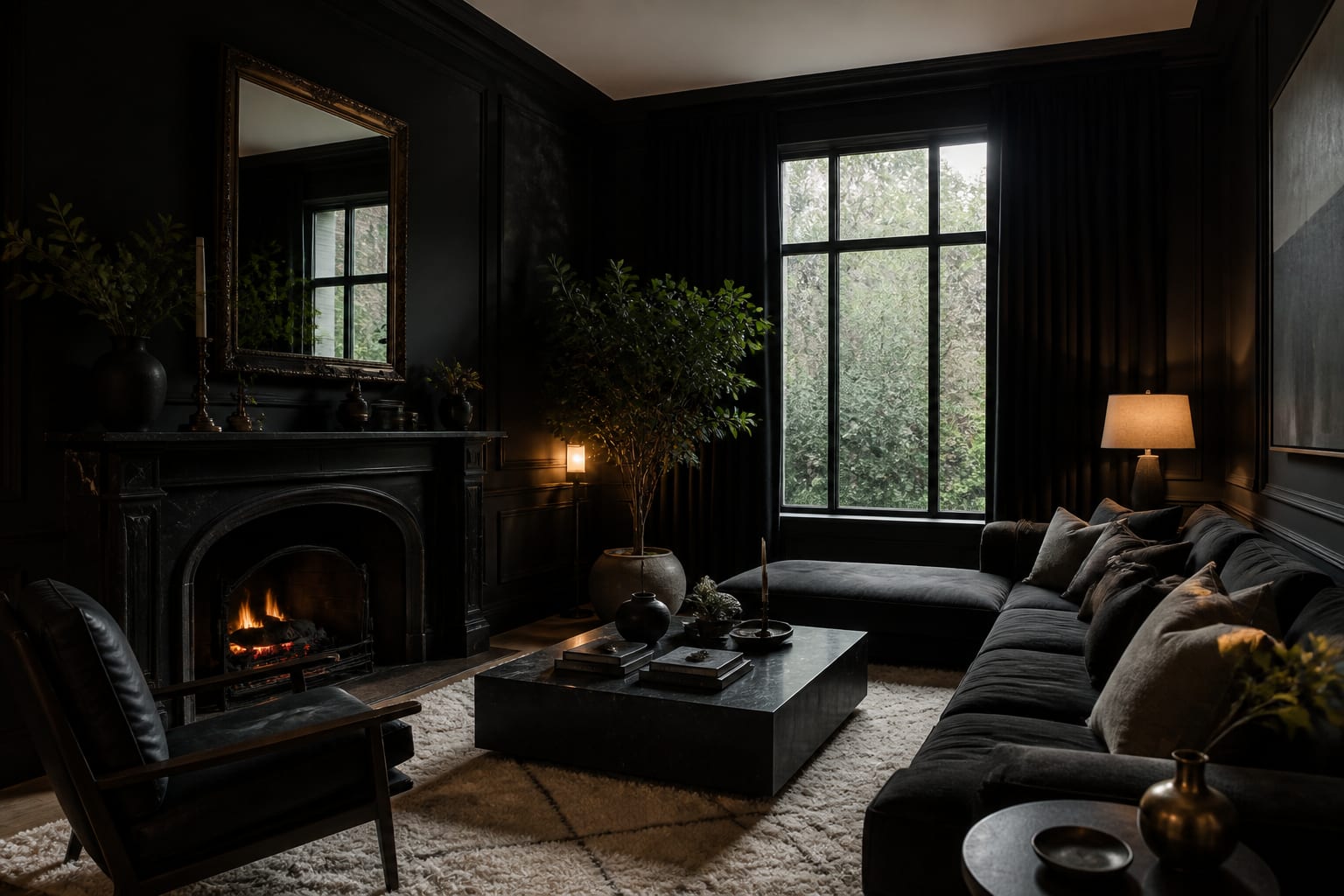
A black room fails when it reads as a dark void and succeeds when it reads as a deliberate, enveloping backdrop. The mistake most people make is painting four walls flat black and stopping there, which kills every shadow and flattens the space into a cave. The better move is to treat black as a stage: layer in texture, push light onto the surfaces you want seen, and let warm wood, brass, and a single bright object do the talking. Done with intent, a black room feels calm and expensive rather than gloomy, and it flatters almost everything you place against it.
Which black should you actually pick?
There is no single black, and the version you choose sets the entire mood. A near-pure carbon black is dramatic but can feel hard and graphic, which suits a powder room or a media den more than a bedroom. The blacks designers reach for most often carry a quiet undertone: a green-black softens to charcoal in daylight, a blue-black cools the room and pairs beautifully with brass, and a brown-black warms a north-facing space that never gets direct sun. Buy three sample pints, paint 24-inch by 24-inch swatches on two different walls, and watch them across a full day before you commit a single gallon.
Sheen matters as much as color. On walls, stay low, a 2 to 5 percent matte or dead-flat, so the surface absorbs light and hides drywall imperfections that gloss would broadcast. On trim, doors, and built-ins, jump to a 25 to 40 percent satin or semi-gloss. That contrast in finish is what gives a black room dimension: the matte field recedes while the crisper trim catches a highlight and draws the eye along the architecture. A quality interior paint runs roughly $50 to $75 per gallon, and a single coat of true black rarely covers, so budget two coats plus a tinted gray primer underneath. Skipping that gray primer is the most common reason a black wall ends up patchy, since the deep pigment needs an even base to read solid rather than streaky in raking light.
How do you keep a black room from feeling like a cave?
Light is the whole game. A black surface can swallow 90 percent or more of the light that hits it, so you need more fixtures than a white room and you need them placed to graze the surfaces you want seen. Skip the lone ceiling fixture as your only source. Instead, build three to five pools of warm 2700K light: a pair of table lamps, a floor lamp in a reading corner, and a wall sconce or two angled to wash texture. Picture lights over art and LED tape tucked under a floating shelf give the black walls something to do besides disappear.
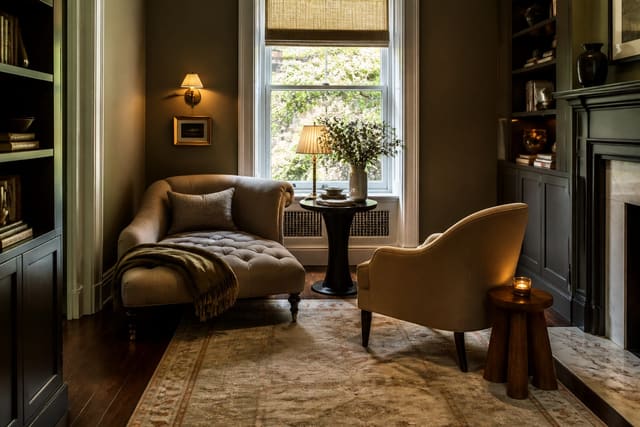
Texture rescues the rest. A black room painted flat and furnished flat is the cave everyone fears. Layer a chunky wool rug, a leather chair, linen drapes, and a fluted wood console so light catches differently on each. Matte velvet drinks light and goes nearly invisible against a dark wall, while a glossy ceramic lamp or a mirror throws it back, and that push and pull is what gives a dark room depth. A cozy reading nook carved into a black room becomes the warmest corner in the house once you add a deep chair, a 2700K lamp, and a soft throw. The contrast between the moody walls and the inviting seat is exactly the tension that makes the room work, and it is far easier to achieve than a beginner expects.
Where does black work best, room by room?
Black is most forgiving in spaces you pass through or use at night, and most demanding in rooms you sit in for hours under bright daylight. A small powder room is the easiest win: there is no furniture to fight the walls, and the jewel-box effect of black walls with a brass faucet and a backlit mirror feels intentional in a space you only occupy briefly. A dining room painted black turns dinner into an event, since candlelight and warm bulbs make the dark walls recede and the table glow.
Bedrooms reward black if you commit to the cocoon. Black behind the bed, warm lamps on each side, and pale bedding for contrast reads restful rather than heavy. Ceilings are the sleeper move: a black ceiling over white or mid-tone walls lowers the visual height in a good way and makes a tall, cold room feel intimate. If you want to go further, a full statement ceiling in a green-black with a brass pendant turns an overlooked plane into the best part of the room. Living rooms can carry black too, but plan more light and more contrast there since you use the space across every hour of the day.
Black room ideas to try
- Paint a single chimney breast or alcove black to frame a fireplace or a run of shelves without committing the whole room.
- Run black walls behind floating wood shelves and light them with 2700K LED tape so the wood and objects glow.
- Wrap a powder room in dead-flat black with a brass faucet, a backlit mirror, and one piece of bright art.
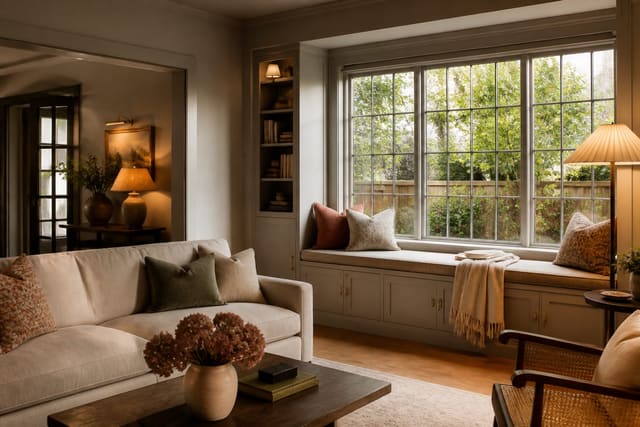
- Build a black-painted window seat with a pale linen cushion so the bright seat reads against the dark surround.
- Use black as a gallery-wall backdrop and hang white-matted frames so the art floats off the dark plane.
- Lay a high-pile cream rug over dark floors in a black room to bounce light back up and warm the whole floor plane.
- Paint trim and doors a satin black against mid-gray walls for a graphic, tailored look without going fully dark.
- Add a single brass or amber-glass lamp as the one warm focal point every black room needs after dusk.
See it first in Re-Design
Committing to black is a leap, and a sample swatch only tells you so much. Upload a photo of the room you are considering into Re-Design and re-design it in a green-black, a blue-black, and a soft charcoal to see how each undertone behaves against your floors, your light, and your existing furniture. You can preview the same wall with matte paint, with a black ceiling instead of black walls, or with one accent alcove blacked out, all in seconds, so you walk into the paint store knowing exactly which black and how much of it your room can carry.
Frequently Asked Questions
Does a black room make the space look smaller?
Not necessarily. Black blurs the corners where walls meet, which can actually make boundaries harder to read and the room feel more open and infinite at night. What black does reliably is lower the perceived ceiling height and make a space feel more intimate, which is an advantage in a tall, cold room and a drawback only if your room is already cramped and dark.
What sheen should I use on black walls?
Keep walls low, a dead-flat or 2 to 5 percent matte, so the surface absorbs light and hides imperfections. Save the higher 25 to 40 percent satin or semi-gloss for trim, doors, and built-ins. That difference in finish is what gives the room depth instead of letting it flatten into one solid plane.
How many light sources does a black room need?
Plan for at least three, and ideally four or five, warm 2700K sources spread around the room. Because black absorbs most of the light that reaches it, a single overhead fixture leaves the space gloomy. Table lamps, a floor lamp, sconces, and picture lights build the pools of light that make a dark room feel layered.
Can I use black in a north-facing room with little sun?
Yes, but lean toward a brown-black or a warm charcoal rather than a cool blue-black, since the cooler tones can feel flat and dreary in weak northern light. Add plenty of warm 2700K lamps and reflective metallics to bounce what light you have, and the room will feel cozy rather than cold.