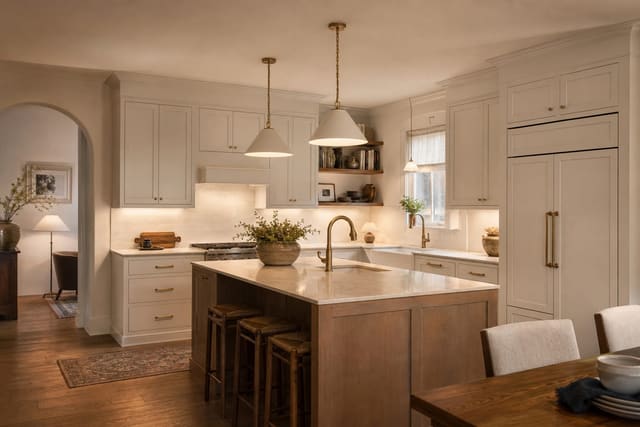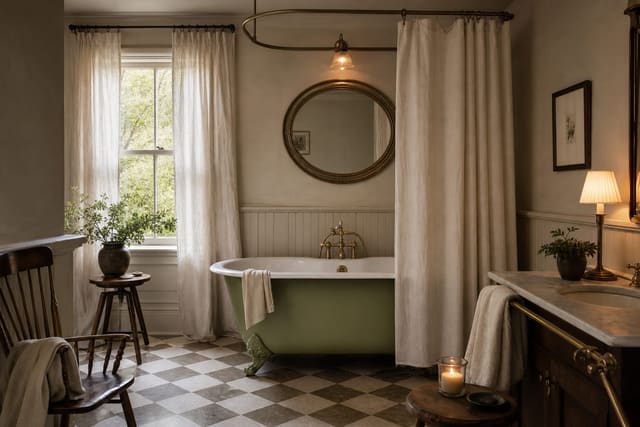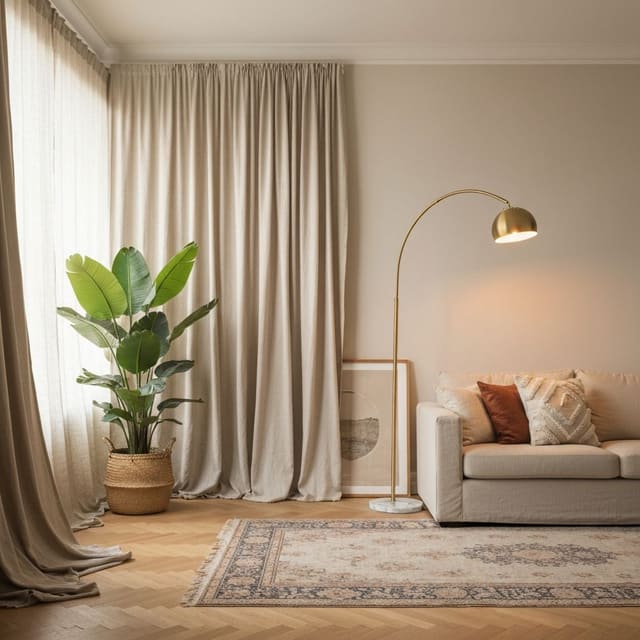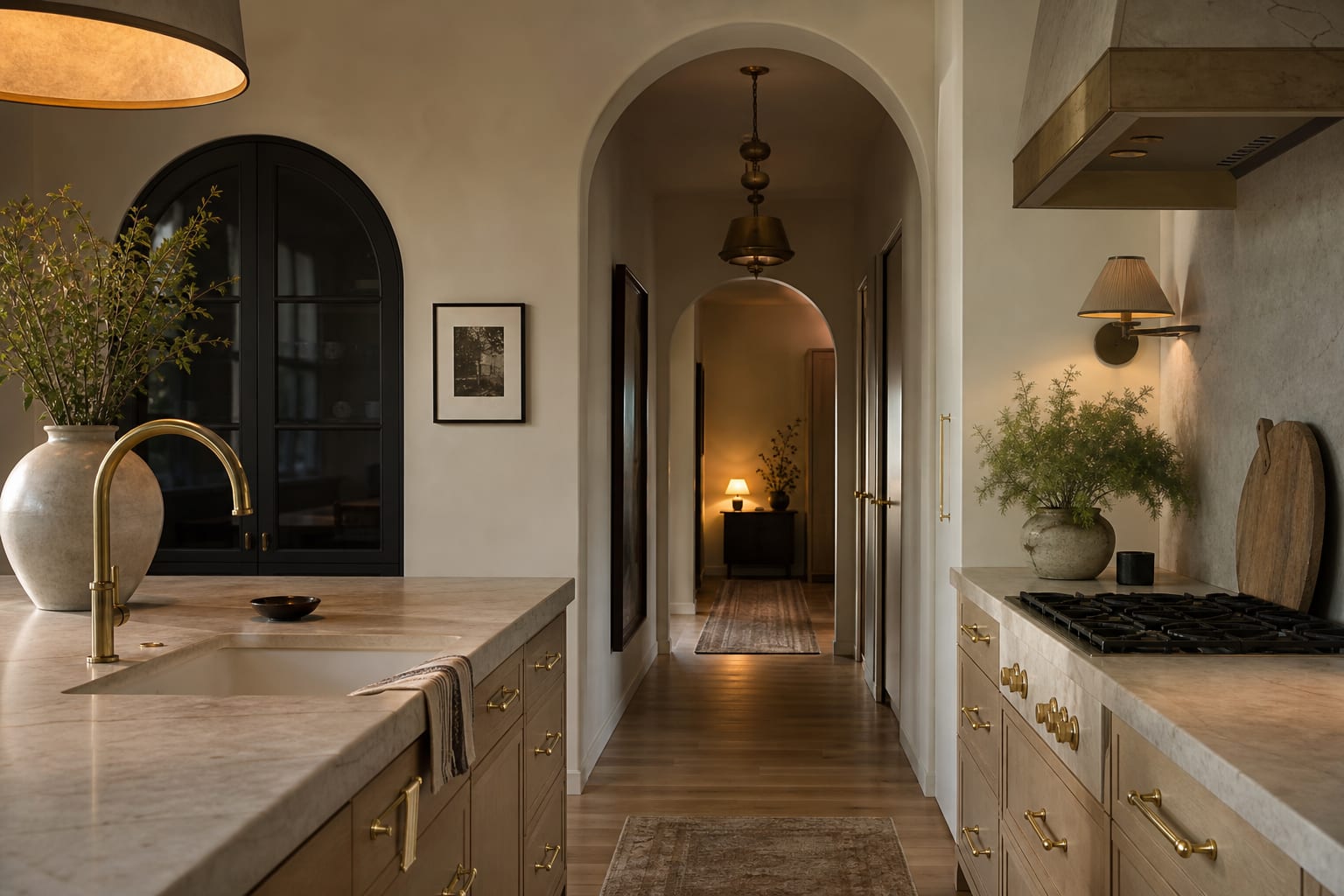
Update a brass-heavy home by keeping the best brass (simple shapes, soft aged tone), removing the shiniest yellow pieces, adding one cooler supporting metal like matte black or nickel, and repeating each finish deliberately room to room so the brass reads as a choice, not a builder-grade holdover.
How do you update a home with too much brass hardware?
Sort existing brass into three groups: good brass, loud brass, and background brass. Good brass has a simple shape, a warm aged tone, or high-touch placement, like daily-use cabinet pulls. Loud brass is usually high-gloss yellow, oversized, or curvy, and often attached to a dated light fixture. Background brass — hinges, strike plates, tiny knobs — only becomes a problem in huge numbers.
Don't judge by finish alone. A clean 5-inch satin brass pull can look current on painted cabinets, while a tiny shiny mushroom knob reads cheap in the same kitchen. Measure existing screw spacing before replacing pulls; common centers are 3 inches, 96mm, and 128mm, and keeping them saves drilling.
If the kitchen also feels dim, brass looks harsher under weak bulbs. Before swapping hardware, check the lighting fixes in making a dark kitchen feel brighter, especially with brown cabinets or one lonely ceiling fixture.
Which brass pieces should stay, and which should go?
Keep brass with simple shapes, soft tones, and enough scale to look intentional. Change brass that's fussy, mirror-yellow, or sitting at eye level dating the whole room.
- Cabinet hardware: Keep if scale is right — 4 to 6 inches on standard drawers, 8 to 12 inches on pot drawers. If pulls are the right size but too shiny, test one sample in satin brass, antique brass, or dark bronze first.
- Light fixtures: A brass pendant with a clean cone, globe, or drum shape can stay. A shiny scroll chandelier or undersized flush mount should go first. Island pendants typically hang 30 to 36 inches above the counter.
- Door hardware: Leave simple brass knobs and hinges alone; update only the pieces people notice most — entry set, powder room knob, vanity hardware, and visible lighting.
- Faucets: A brass faucet can be beautiful alone, but if pulls, pendants, and stools are already brass, it may push the kitchen over the line.
Test this on your own room photo with ReDesign — keep the doorway, walls, windows, main furniture, and lighting visible so the preview solves the room you actually have.
How should you mix metals so brass looks intentional?
Most homes handle two visible metal finishes per view: brass plus black, brass plus polished nickel, or brass plus stainless. Three can work in a layered old house; in a builder-grade kitchen it usually looks like every upgrade happened in a different month.
Use brass where warmth helps — cabinet pulls, picture lights, small lamps, mirror frames. Use the supporting metal where structure helps — long lines, appliances, hinges, curtain rods, shower trim. Repeat each finish at least twice within the same view; a lone brass faucet looks accidental, but brass faucet plus brass pulls plus a small picture light looks planned.
| Appliance finish | Easiest brass pairing |
|---|---|
| Stainless steel | Polished nickel, chrome, black, or aged brass |
| Black appliances | Black, dark bronze, or warmer brass |
| White appliances | Softer hand needed; too much yellow brass can feel rental-grade |
Lighting temperature matters too. Use 2700K to 3000K bulbs at 90+ CRI in kitchens, halls, and baths so brass and paint read accurately. For placement of new pendants or vanity lights, see kitchen task lighting layout.
What mistakes make brass look dated?
- Replacing everything in one new finish. A house with satin brass on every surface can feel as formulaic as the glossy brass it replaced. Pick a lead finish and a supporting finish, and let some background metal stay quiet.
- Mixing brass tones without a plan. Bright yellow, pink champagne, aged, and unlacquered brass don't automatically belong together. Pieces within 6 feet should match closely or be separated by shape and material.
- Ignoring scale. Tiny knobs on tall pantry doors or delicate handles on heavy vanities look cheap in any finish. Tape a sample pull on for a day; if it looks lost from the doorway, size up.
- Ignoring color temperature. Brass beside orange oak, beige tile, and yellow bulbs can turn a room entirely golden. Add contrast with cream, olive, stone, or dark bronze.
Small kitchens need extra restraint since every metal line sits close to every other. The editing logic in micro kitchen design for small spaces applies: fewer finishes, cleaner profiles.
How can AI design preview the brass edit before you buy?
Metal finishes are relational — the same brass pull looks warm beside cream cabinets and flashy beside gray laminate. Upload a straight photo of the actual room, keeping cabinet color, counters, flooring, and layout in place, and test variations.
Photograph the room from the main doorway in daylight and again at night with your usual bulbs; brass can look restrained at noon and loud after dinner. Run focused versions: brass hardware kept with black lighting, brass pulls with a nickel faucet, or just the fussy brass lights removed. Look for the version that needs the fewest permanent changes — keeping the brass hinges and pulls while swapping two pendants and a faucet beats ordering eighty new pieces over one annoying sconce.
What should you change first this weekend?
Start with the brass most visible from the doorway — usually kitchen pendants, cabinet pulls, an entry light, or vanity hardware. Buy one sample pull, one sample knob, and one supporting-metal item before ordering a whole-house set, and check them in both morning light and at night.
If budget is tight, change bulbs first, then one eye-level fixture, then the most-touched hardware. A dated brass chandelier can make every cabinet pull look guilty by association; fixing it first often calms the room before a single knob changes. Let brass handle smaller warm moments (pulls, lamp, mirror) and let the supporting metal handle the longest lines (curtain rods, faucet, appliances) so the repetition feels obvious without being nameable.
Stop when the brass looks edited, not erased — a home stripped of all warm metal can feel colder than the dated version it replaced.
Frequently Asked Questions
Is brass hardware dated?
Polished, lacquered brass from the 1990s reads dated. Unlacquered, brushed, or matte brass reads current and remains the dominant warm metal finish in modern interiors.
Can brass mix with chrome or nickel?
Yes. Mixed metals look intentional when one metal dominates (roughly 75 percent brass, 25 percent matte black or chrome) and the secondary metal stays confined to one zone, like plumbing or lighting.
What rooms benefit most from a brass hardware update?
Kitchens and bathrooms see the biggest lift from brass cabinet pulls and faucet swaps. Doorknobs and hinges throughout the home are the next tier, with lighting as the final layer.
Will unlacquered brass tarnish?
Yes. Unlacquered brass develops a warm patina over 6 to 18 months. For brass that stays bright, choose lacquered or PVD-finished brass instead; many designers treat the patina as part of the look.
How much does it cost to swap brass hardware in a kitchen?
Twenty standard brass cabinet pulls run $200 to $600, and a brass faucet adds $250 to $800. A full brass kitchen refresh totals $500 to $1,500, compared with $8,000 to $20,000 for a full remodel.
> Try this: Ready to see this on your own room? Open ReDesign and run the preview.
Three transformations to try
1. Kitchen with brass pulls and matte black faucet 2. Bathroom with brushed brass mixers and pulls 3. Interior doors with unlacquered brass knobs