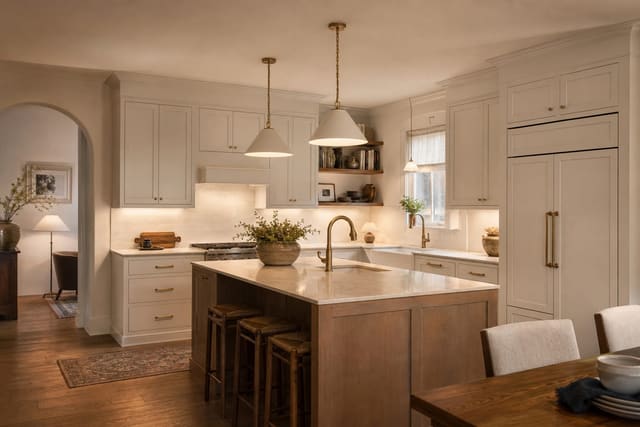
A dark kitchen brightens without cabinet paint when the lighting commits to under-cabinet LED at 3000K (4 to 5W per linear foot), the wall surfaces between the cabinets get a lighter treatment — high-LRV backsplash, pale countertop, or warm white walls — and reflective accents (brass hardware, polished pulls, glossy backsplash tile) bounce the existing light back into the room. A dark kitchen isn't a renovation problem. Most of them are a lighting problem stacked on top of three other small problems that compound. Owners look at a dark kitchen and assume the answer is more windows or a skylight; the actual answer is usually $300 of better bulbs, a coat of warm white paint, and one or two carefully placed reflective surfaces. Get those three things right and a kitchen that's been depressing for ten years reads bright by the weekend.
How do I make my dark kitchen look lighter?
Replace cool-white bulbs with 2700K–3000K warm bulbs, add or upgrade under-cabinet lighting, paint the upper cabinets a warm white if they're a dark or builder-grade tone, and add at least one large reflective surface — backsplash tile, mirror, or polished countertop — to bounce light back into the room. Lighting and reflectivity do 80% of the work. Color does the remaining 20%.
Lighting changes that punch above their cost
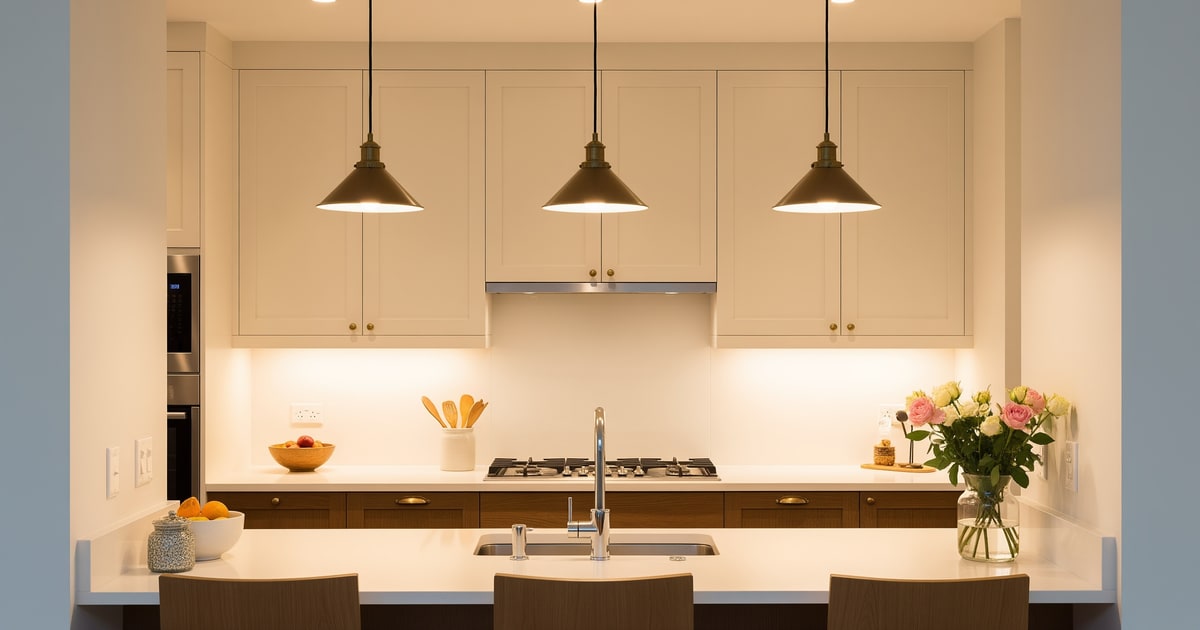
- Under-cabinet lighting at 2700K. This is the single highest-ROI kitchen upgrade. A continuous LED strip or puck system at 2700K on a dimmer transforms the counter from a dark cave to the visual focal point of the room. The counter is where 90% of kitchen work happens; lighting it correctly changes the entire mood. ~$80–$200 for a peel-and-stick system that plugs into an outlet. Hardwired is better long-term but plug-in works.
- Pendants over the island or peninsula. Two or three pendants hung 30"–36" above the counter at 2700K give the room visual rhythm and a strong middle layer of light. The pendant becomes a focal point, which also draws the eye to the brightest part of the room.
- Overhead recessed cans with the right beam angle. If your kitchen has recessed cans, swap the bulbs to 2700K wide-beam (90°+) LEDs. Narrow-beam recessed lights cast harsh circles on the floor and leave the cabinet faces dark. Wide beams light the room evenly.
- A small light inside open shelves or glass-front cabinets. A puck or strip light inside a glass-front cabinet creates a glow that humans read as "the kitchen of a real restaurant." Disproportionate impact for $40.
- Toe-kick LED strip. A 2700K LED strip tucked under the toe-kick of the lower cabinets makes the floor recede and the cabinetry appear to float. Especially powerful in narrow galley kitchens.
Test this on your own room photo with ReDesign before you choose the final direction; keep the doorway, walls, windows, main furniture, lighting, and awkward fixed features visible so the preview solves the room you actually have.
Paint changes that brighten without a remodel
- Paint the uppers, leave the lowers. A two-tone kitchen with warm-white uppers (Benjamin Moore Simply White, Sherwin-Williams Alabaster) and existing dark or wood lowers reads bright and intentional. This is the single most popular new-build kitchen direction and it's almost free to replicate.
- Paint the ceiling a half-shade lighter than the walls. A ceiling painted "ceiling white" or stark white in a warm-toned room reads cold. Mix the wall color at 50% saturation and use it overhead.
- Skip cool gray. A cool gray kitchen reads gloomy under almost every lighting condition. If your kitchen is currently cool gray, swap to warm white or greige before you do anything else.
- Paint the back of open shelves. A warm-white wall behind open shelving reflects light onto plates and glassware, which then bounces light back into the room.
Reflective surfaces and where to put them
- Glossy or polished countertop. If you're already replacing counters, choose a polished quartz, marble, or quartzite. Honed surfaces look beautiful but absorb light; polished surfaces bounce it.
- Glossy or semi-gloss backsplash tile. A high-gloss subway tile, zellige, or polished marble backsplash reflects under-cabinet lights and pendant light back into the room. A matte backsplash absorbs both.
- Glass-front upper cabinets. Either swap a few door fronts to glass or remove the doors entirely on one section. The depth-of-field through glass adds perceived volume.
- A large mirror over a banquette or breakfast nook. Unconventional but extremely effective in a kitchen with a dark dining nook.
Start at the work plane, not the ceiling. A dark kitchen with 300 to 500 lumens per linear foot of under-cabinet light suddenly feels useful because counters stop falling into shadow; choose 3000K LED tape or bars with 90+ CRI so food, stone, and cabinet paint stay accurate. Put the strip toward the front third of the cabinet, not against the wall, or it will light the backsplash while leaving the cutting board dim. That same placement rule shows up in the kitchen task lighting guide, and it is the cheapest way to know whether the kitchen needs new finishes or just actual light.
For finishes, one lighter surface has to be large enough to matter. A creamy zellige-look backsplash, a pale quartz counter, or a warm white upper cabinet does more than ten small brass accessories. If the cabinets are staying dark, satin brass or aged bronze pulls read warmer than chrome, while a honed backsplash avoids mirror-like glare. Renters can use plug-in under-cabinet bars and a removable backsplash panel; owners should price hardwired tape and a dimmer before discussing cabinet replacement. If the cabinet color itself is the problem, compare it against the decision framework in kitchen cabinet colors.
Cabinet interiors are another place to steal brightness. White or maple-look interiors, a pale shelf liner, and glass-front uppers near the sink can make a dark kitchen feel less closed even when the exterior cabinet color stays deep. If you are repainting, a satin finish usually reads cleaner than dead-flat paint on cabinets because it returns a little light without showing every fingerprint. Keep the hardware simple: a 5 to 7 inch pull in satin brass or aged bronze gives the hand a warm highlight without turning the room into a jewelry display.
Do not ignore the floor. A dark floor plus dark lowers plus dim counters creates a stack of shadow from ankle to eye level. A washable runner with a pale ground, a honed light stone threshold, or even a warmer wood tone in the adjacent room can change how the kitchen is perceived from the doorway. The test is the first photo from the entry: if the counter edge, sink, and range still disappear, the next dollar should go to light, not styling.
Common dark-kitchen mistakes
- Adding more cool-white recessed cans. More cool light is still cool light. The room ends up looking like a hospital.
- Painting the walls a pale gray. Reinforces the gloom rather than fixing it.
- Leaving the cabinet interiors dark. Dark interiors absorb every photon. Paint cabinet interiors warm white before you do anything else.
- Going all-black appliances in an already-dark room. Black appliances against dark cabinets read as a void.
- Skipping the under-cabinet layer. The single most impactful light in the room and the most commonly missing.
- Heavy window treatments. Replace heavy drapery with linen Roman shades, simple roller shades, or nothing at all if privacy isn't a factor.
- Letting the backsplash absorb the light. A matte dark backsplash can swallow the expensive lighting you just installed. Pair under-cabinet lights with a surface that gives some of that light back.
- Adding pale decor while the counters stay dark. Bowls and towels cannot compensate for unlit work surfaces or a backsplash that absorbs every lumen.
Use AI design to preview your bright kitchen
The hardest part of changing a kitchen is committing without being able to see the result. AI design lets you photograph your existing dark kitchen and preview it with warm-white uppers, polished counter, brass hardware, and under-cabinet lighting — alongside the current version — in minutes. Owners who hesitate for a year on cabinet color end up choosing in an evening because they can finally see the difference.
Frequently Asked Questions
How do I brighten a dark kitchen without painting cabinets?
Add three lighting layers — 3000K under-cabinet LED, two or three pendants over the island, and one warm flush mount or chandelier — and the same cabinets read modern and intentional instead of dim. Use the room photo to compare the visible layout and fixed constraints before committing, because door swings, windows, outlets, storage reach, circulation, and existing furniture decide whether the idea survives daily use.
What backsplash makes dark cabinets look brighter?
A high-LRV light backsplash (white zellige, marble slab, pale subway, or polished metal) bounces light back across the cabinet faces; dark backsplashes double down on the dark cabinet read. Keep the preview honest by leaving the problem area visible in the frame, then compare one conservative version against one bolder version before you buy lighting, paint, furniture, or storage.
Should the countertop be light if the cabinets are dark?
Yes — a white or pale quartz countertop is the single biggest brightener for a dark kitchen, reflecting light off the cabinet faces and resetting the contrast ratio so the cabinets read intentional dark, not gloomy. Check the result against ordinary movement first: drawer clearance, chair pullout, walkway width, glare, switch access, and sightlines matter more than a perfect catalog angle.
Will brass or chrome hardware brighten dark cabinets?
Brass adds warmth that reads bright at any light level; polished chrome reflects more light per square inch but reads cooler; matte black reads bold but does not contribute to perceived brightness. Use the image to narrow priorities and measurements before ordering anything custom; final purchases still need real dimensions, outlet locations, installation limits, and product clearances.
Is white grout or contrasting grout better with a light backsplash?
White or very pale grout extends the backsplash's brightness; dark contrasting grout reads designed but reduces the brightening effect — choose by goal. If the preview invents architecture or hides the awkward feature you need solved, rerun it with stricter instructions so the result remains tied to your actual room.
> Try this: Ready to see this on your own room? Open ReDesign and run the preview.
Three transformations to try
1. Dark cabinets with under-cabinet LED and bright backsplash 2. Dark cabinets with white quartz counter and brass hardware 3. Dark cabinets with layered overhead and pendant lights