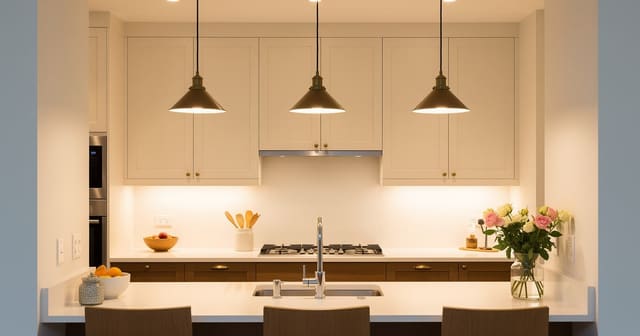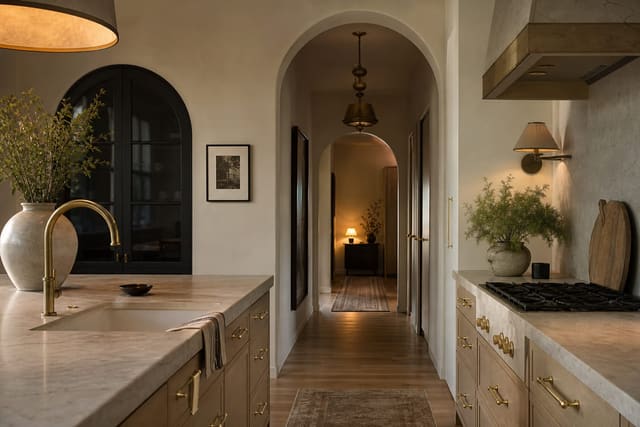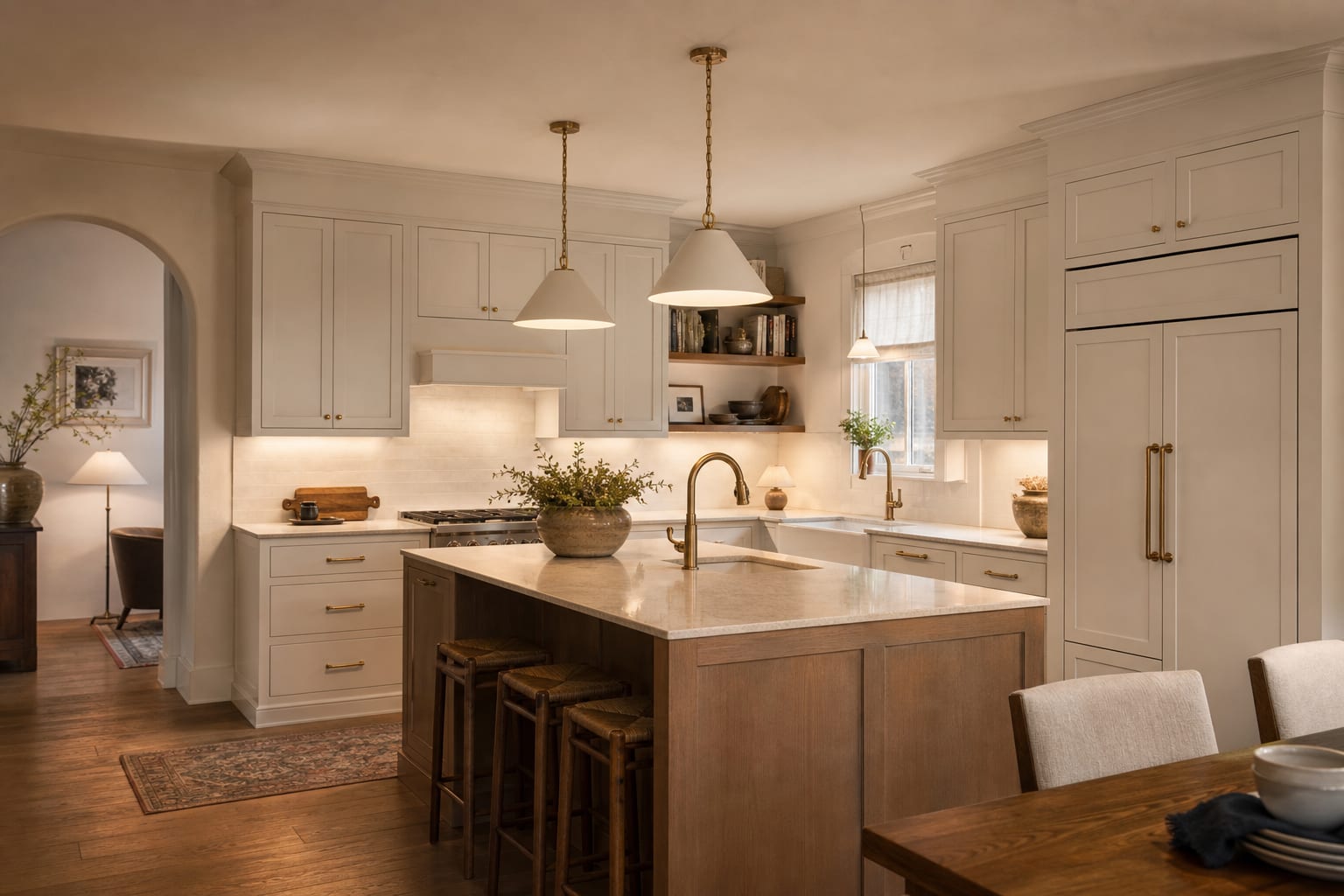
Builder-grade kitchens upgrade fastest when you swap the five things hands and eyes meet daily: cabinet hardware, faucet and sink details, lighting, outlet plates, and backsplash coverage. None require demolition, but all are visible from the doorway. A flimsy faucet, shiny knobs, weak ceiling light, and beige plates can make solid cabinets look worse than they are — fixing them gives the room a more intentional finish without a full remodel budget.
What are the best builder-grade kitchen upgrades to make first?
Start with cabinet hardware if the kitchen has tiny chrome knobs or none at all. Measure existing screw spacing first; common pull sizes run 3 inches, 96mm, and 128mm center to center. On wide drawers, a pull around one-third of the drawer width looks more substantial than a small centered knob. Use a paper template and test one door before drilling the whole wall.
The faucet is next because it sits at eye level. Match its finish to at least one other element — pulls, appliance trim, or the light fixture — and favor a pull-down sprayer over a decorative bridge faucet in a tight kitchen. Check deck holes before ordering; use an escutcheon plate only if it cleanly hides old holes.
Lighting deserves priority because cheap fixtures make even good materials look tired. Replace a boob light, tiny pendant, or blue-white bulb before judging cabinet color. For placement details, see task lighting for kitchens.
Which fixture finishes make a cheap kitchen look intentional?
Limit finishes to two and repeat them: stainless plus black, stainless plus aged brass, or black plus warm brass with paneled appliances. Aged brass suits warm white, navy, olive, mushroom, and wood cabinets, but bright yellow brass can clash with cool gray. Matte black works cleanly on white or light oak — keep shapes slim so the kitchen doesn't become a grid of black dots.
Scale matters as much as finish. A 1-inch knob suits a narrow upper cabinet but feels flimsy on a tall pantry door; standard drawers usually want 4- to 6-inch pulls, while large pot drawers take 8- to 12-inch pulls. Small kitchens benefit from the same editing rules covered in micro kitchen design for small spaces: fewer, calmer lines instead of every door as a decorative event.
Don't ignore outlet covers and switch plates. Builder beige plastic can undercut a fresh faucet and new pulls. Switch to screwless plates in white, black, stainless, or a paintable finish, and match backsplash-mounted plates to the tile so they don't read as mismatched rectangles.
Test this on your own room photo with ReDesign before ordering — keep the doorway, walls, windows, and main fixtures visible so the preview solves the kitchen you actually have.
What are the most common builder-grade fixture mistakes?
Replacing everything in one trendy finish just creates a new generic package. Brass pulls, brass faucet, brass pendants, and brass hinges can feel as flat as the original chrome — pick one lead finish and one support finish, each repeated at least twice in view.
Buying hardware before checking door style creates awkward scale. Tape a sample pull to the cabinet and open the door several times; if it hits the rail or overpowers a narrow stile, the size is wrong even in the right finish.
Swapping a pendant without checking position wastes money. Island pendants generally look best 30–36 inches above the counter with room to breathe between shades; if the junction box is off-center, use a canopy or different fixture rather than living with a crooked light.
Choosing cool bulbs because the kitchen "feels yellow" often backfires — most builder kitchens are dim, not warm. Try 2700K–3000K bulbs at 90+ CRI near prep areas. If the whole room reads dark, see making a dark kitchen feel brighter.
Finally, don't skip the sink zone. A new faucet beside a stained flange, rusty disposal ring, and chipped caulk won't read as an upgrade — refresh the drain trim and caulk, and pare counter accessories to one tray or soap set.
How can AI design help preview builder-grade upgrades?
Small metal and lighting choices change dramatically against your actual cabinets, counters, and floor — something product photos never show. Photograph the kitchen from the entrance or a back corner so the preview includes the sink, cabinet runs, ceiling light, and at least one appliance, with lights on and counters cleared but not staged unrealistically.
Run focused comparisons: one version with black pulls, stainless faucet, and warmer bulbs; another with aged brass hardware and screwless plates; a third that only changes the faucet, pendant, and under-cabinet lighting. Keep cabinet color and countertops constant unless you're actually changing them.
The useful result is the version where your existing kitchen looks less temporary — not the most dramatic image. If the best preview only works after replacing cabinets, counters, backsplash, and appliances, it's not solving the fixture problem. Use it to narrow the first order to one pull sample, one faucet finish, and one light direction.
What should you replace first on a tight budget?
Replace whatever looks cheapest from the doorway and whatever annoys you daily — often hardware plus bulbs, or faucet plus outlet plates. Finish one zone completely rather than leaving the whole room half-upgraded.
- Change bulbs first, then test hardware samples with painter's tape before buying a full set.
- If spending more, focus the sink wall: better faucet, fresh drain trim, new towel hook, cleaner under-cabinet light.
- If the kitchen feels dingy after cleaning, prioritize lighting — mount LED strips toward the front of the cabinet underside and use diffused channels to avoid dotted reflections on glossy stone.
- Edit what competes with new fixtures: remove unused counter appliances and keep one lamp or tray.
Builder-grade doesn't disappear because you bought expensive pieces — it disappears when the visible details finally agree with each other.
Frequently Asked Questions
What is the highest-impact builder-grade kitchen upgrade?
Painting cabinets a saturated mid-tone (sage, navy, or warm white) and swapping every pull reads as a full remodel from six feet away for roughly $400–$1,200 total.
Should I replace builder-grade cabinets or just paint?
Paint solid-wood door cabinets like oak, maple, or cherry. Replace particleboard or thermofoil cabinets that already flake or chip, since paint can't fix a failing substrate.
What backsplash works over builder-grade counters?
A 2x6-inch handmade-look ceramic or zellige, or a slab marble or porcelain backsplash, lifts a granite or laminate counter without replacing it. Full-height tile reads more custom than a partial 18-inch strip.
How do I update a builder-grade hood vent?
Replace the under-cabinet hood with a wall-mounted chimney hood or a custom drywall hood surround. The hood is the largest visual element on the cook wall and dates faster than cabinets.
Is it worth replacing builder-grade countertops?
Yes if the counter is laminate or stained — a quartz upgrade runs $3,000–$6,000 for a typical kitchen and lifts the whole room. Neutral granite or quartz can stay as-is.
> Try this: Ready to see this on your own room? Open ReDesign and run the preview.
Three transformations to try
1. Painted cabinets with brass pulls and tile backsplash 2. Custom drywall hood surround over range 3. Under-cabinet LED strip and pendant lights