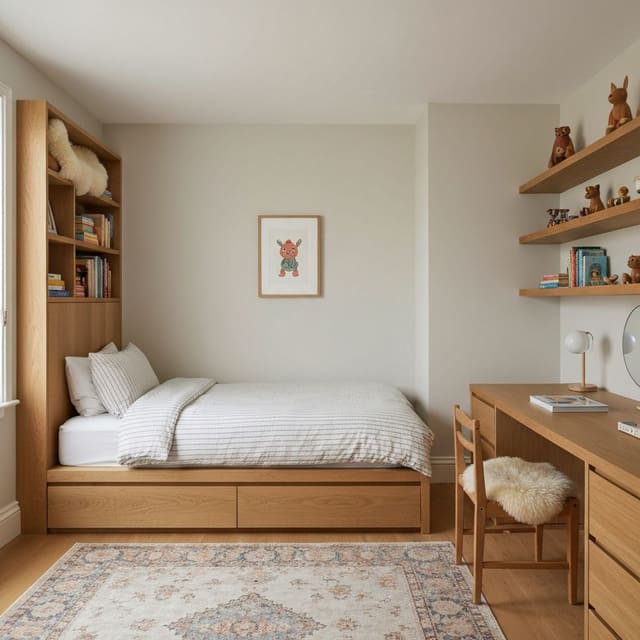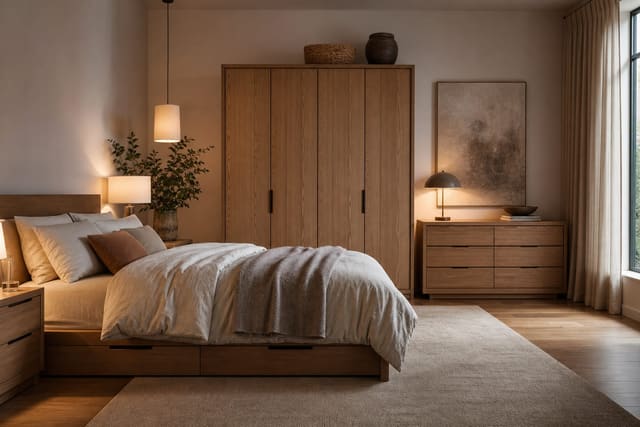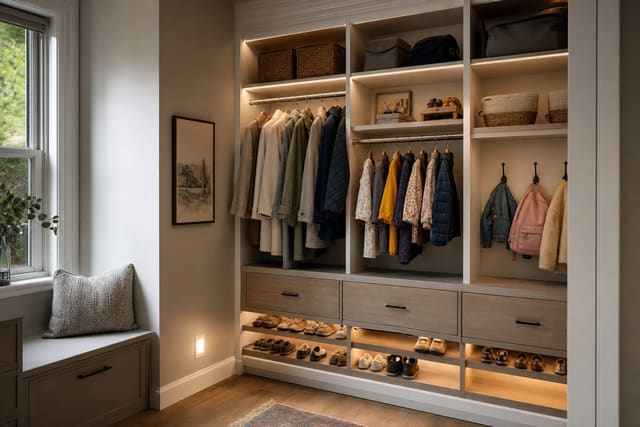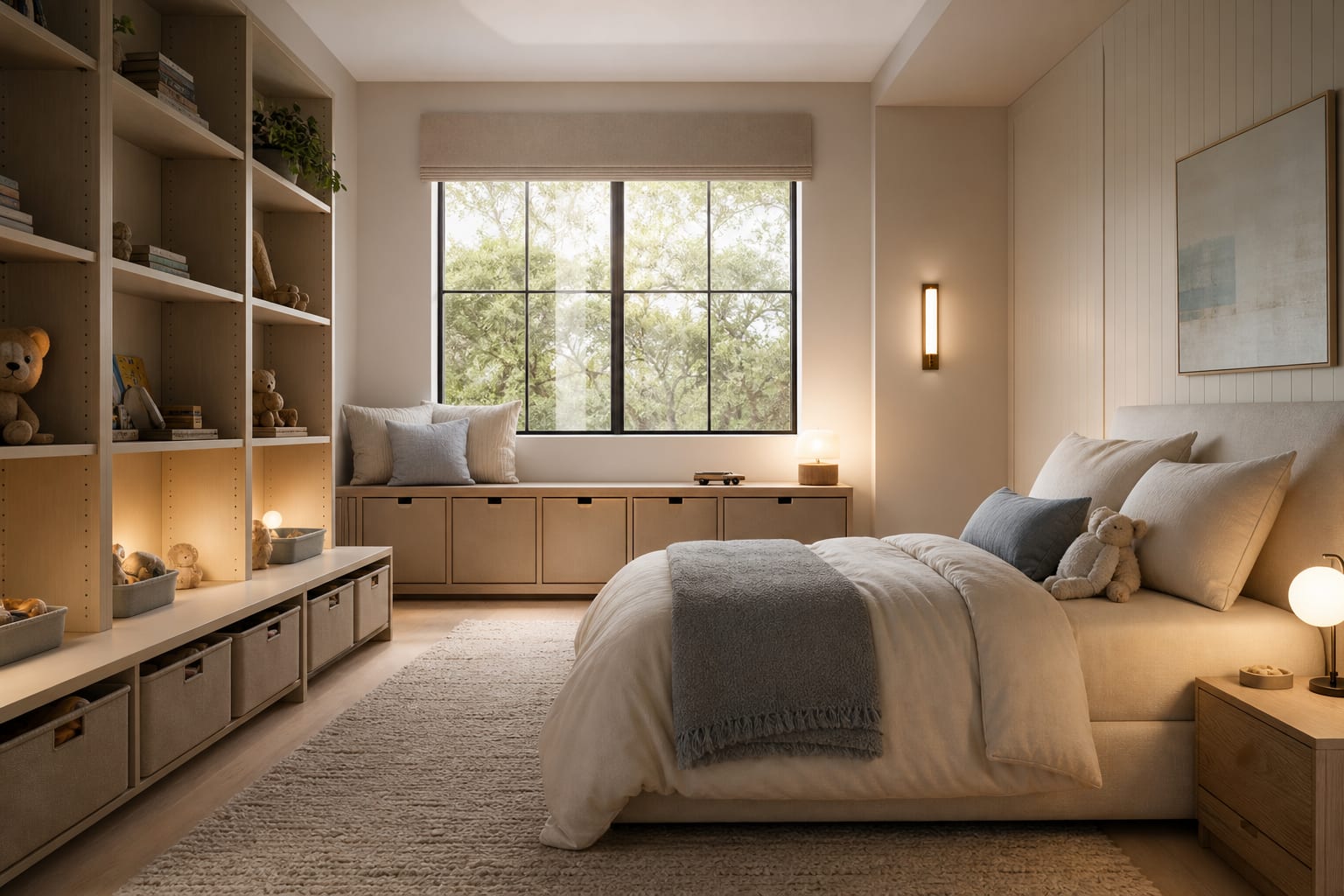
Kids bedroom storage ideas that grow with the child rely on adjustable cube shelving (open bins at toddler height, closed storage by school age), a wardrobe with adjustable double-hang rods, and one floor-level toy zone that later converts to a study desk. Committing to three modular, adjustable pieces beats buying age-specific furniture twice, so the room handles toys at three, Lego at seven, sports gear at eleven, and hoodies at sixteen without a new shopping project every summer.
What storage works from toddler to teen?
Storage that lasts is adjustable, reachable, partly closed, and modular enough to shift from toys to books, clothes, school supplies, and hobbies. Skip the single giant toy organizer in favor of a layered room: low access now, adult-scale storage waiting above it.
Start with three zones — clothing, play/hobby, and display. A toddler manages bins 10"–12" high on the floor; an elementary-age child manages drawers around 24"–30" up. By middle school, a normal dresser, a desk with drawers, and a closet with a second rod usually beat any kid-specific system.
If the bedroom doubles as a playroom, borrow the long-view approach from a playroom that converts to a teen room: keep the shell calm and let contents change. The bed, dresser, wardrobe, and shelving should look fine with a teenager's backpack and sneakers, not just with pastel bins.
Which pieces should adjust, and which should stay fixed?
Fixed pieces should be the plainest and strongest: bed, dresser, wardrobe, one serious bookcase. Adjustable pieces are the inserts — bins, dividers, rolling carts, under-bed boxes, peg rails, closet components.
- Dresser depth: choose 14"–18" deep drawers, not a shallow nursery chest; they hold baby blankets now and teen sweatshirts later.
- Shelf spacing: adjustable tracks every 1"–2" let a 10" gap (books, small bins) become a 13"–15" gap (binders, board games) as needed.
- Closed storage: keep at least one cabinet or drawer bank for glue, chargers, socks, and half-finished collections that don't need to be on display.
- Closet rods: a lower rod at 38"–42" lets small children reach shirts; an upper rod at 78"–84" holds off-season or parent-managed items.
Under-bed storage works for seasonal bedding, costumes, or keepsakes in lidded bins under 8" high — skip it for daily socks or favorite toys. If the child moves from twin to full or queen, slimmer nightstands or wall shelves may be needed to protect walkway space; the logic mirrors making a small bedroom work with a king-size bed.
Test this on your own room photo with ReDesign before committing — keep the doorway, walls, windows, main furniture, and fixed features visible so the preview solves the room you actually have.
How do you zone toys, clothes, and books as they age?
A bedroom that grows well has zones that change purpose, not location. The toy shelf becomes the hobby shelf; the low bin for blocks becomes the bin for shoes or sports gear.
For toddlers, keep the most-used items between the floor and 30" high, with visual (photo) labels for pre-readers. For school-age kids, add a 24"–36" wide desk with a drawer, plus a nearby shelf for current books and supplies — route craft mess into a lidded box. For tweens and teens, prioritize closed clothing storage and an easy laundry system: a 14"–18" wide hamper works for one child, or two smaller hampers for sorting.
Books follow their own rule: face-out ledges work for picture books, but spine-out shelves store more once a child hits eight or nine. Leave 20%–30% of shelf space empty, since trophies and projects accumulate fast.
Lighting matters too — dark corners become dumping zones. If the room has only one window, pair tall storage with a lamp or sconce; see these single-window bedroom lighting ideas.
Common kids bedroom storage mistakes to avoid
- Buying themed storage as the main system. Character bins expire with the phase; put the theme on bedding or pulls instead.
- Making everything open. Open bins suit daily toys, but too much open storage reads as messy. Aim for roughly half closed, half open.
- Placing storage at adult height. If a child can't reach it, it's not really their system — keep routine items low.
- Ignoring floor clearance. Keep about 30" of clear walkway; choose vertical storage over deep furniture in tight rooms.
- Trying to store every childhood object. Route keepsakes to a memory box and edit school papers and outgrown toys on a schedule.
Use AI to preview your child's bedroom before you commit
Growth is hard to picture from a product page — a toddler shelf might feel too short for books later, and a nursery dresser might look flimsy beside a teen bed. Upload a straight-on photo from the doorway with the bed, window, closet, dresser, and current clutter visible; don't stage a fantasy version first.
Ask for three versions: a low toy-and-book wall, a closet-focused plan with double rods and drawers, and a teen-ready version with a desk and closed dresser storage. Keep wall color, floor, and bed size unchanged so you're judging storage, not a fake renovation.
Check the small decisive details: Does the dresser block a drawer path? Is the shelf low enough for a six-year-old but not childish for a twelve-year-old? Then translate the answer into a buying brief — dresser width, shelf depth, bin height, rod placement, hamper size — so the plan expects change instead of being surprised by it.
Frequently Asked Questions
What storage works from toddler through teen?
Cube shelving with removable bins (IKEA Kallax, Trofast, or equivalent) handles ages 2 to 18 because the bins absorb toys at 5, books at 10, and binders at 14 — the unit itself never needs replacing.
How do I keep a child's wardrobe usable as they grow?
Install adjustable closet rods. Plan two rods at 30" and 60" for young kids' short hangers, then move to one full rod once they pass age 12; track-based systems handle this without rebuilding the closet.
What height should kids be able to reach their own clothes?
Set the top rod at 36" for ages 3–6 so kids can dress themselves, raise it to 48" for ages 7–10, and to 60" past age 12. This rewards independence at every stage.
Open shelves or closed cabinets in a kid's room?
Open shelves with bins work best for ages 3–10 because kids can see and use their things easily. Closed cabinets suit age 11 and up, hiding accumulating mess and signaling the room is theirs to manage.
How do I avoid replacing kids' furniture every 3 years?
Buy adult-scale neutral furniture — an oak dresser, simple desk, modular shelving — and add juvenile accessories like bedding, art, and baskets. When the child outgrows the accessories, the furniture stays and the room's personality refreshes for free.
> Try this: Ready to see this on your own room? Open ReDesign and run the preview.
Three transformations to try
1. Toddler bedroom with floor-level bins and low rod 2. School-age bedroom with cube shelving and study desk 3. Teen bedroom with adjustable closet and closed cabinets