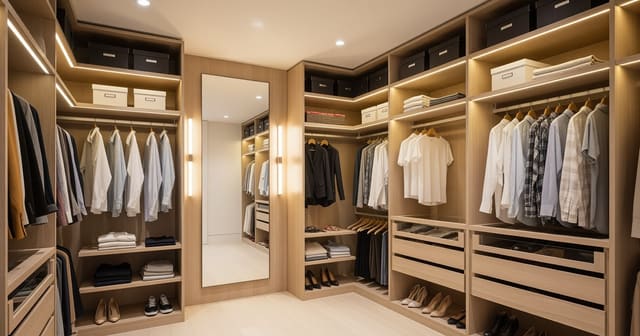
Coat closet organization for a family of four works when each person gets a dedicated, reachable zone for their daily coat, shoes, and bag, kid gear sits at kid height, and off-season jackets move to a different closet. The closet does not need more hangers — it needs assigned territory so a missing coat has an address.
What Makes Coat Closet Organization Work for a Family?
Decide what the closet is allowed to hold during the current season: one daily coat per person, one backup layer, exit-only shoes, bags, umbrellas, gloves, and hats. Formal coats, outgrown jackets, and off-season gear belong elsewhere until their season returns.
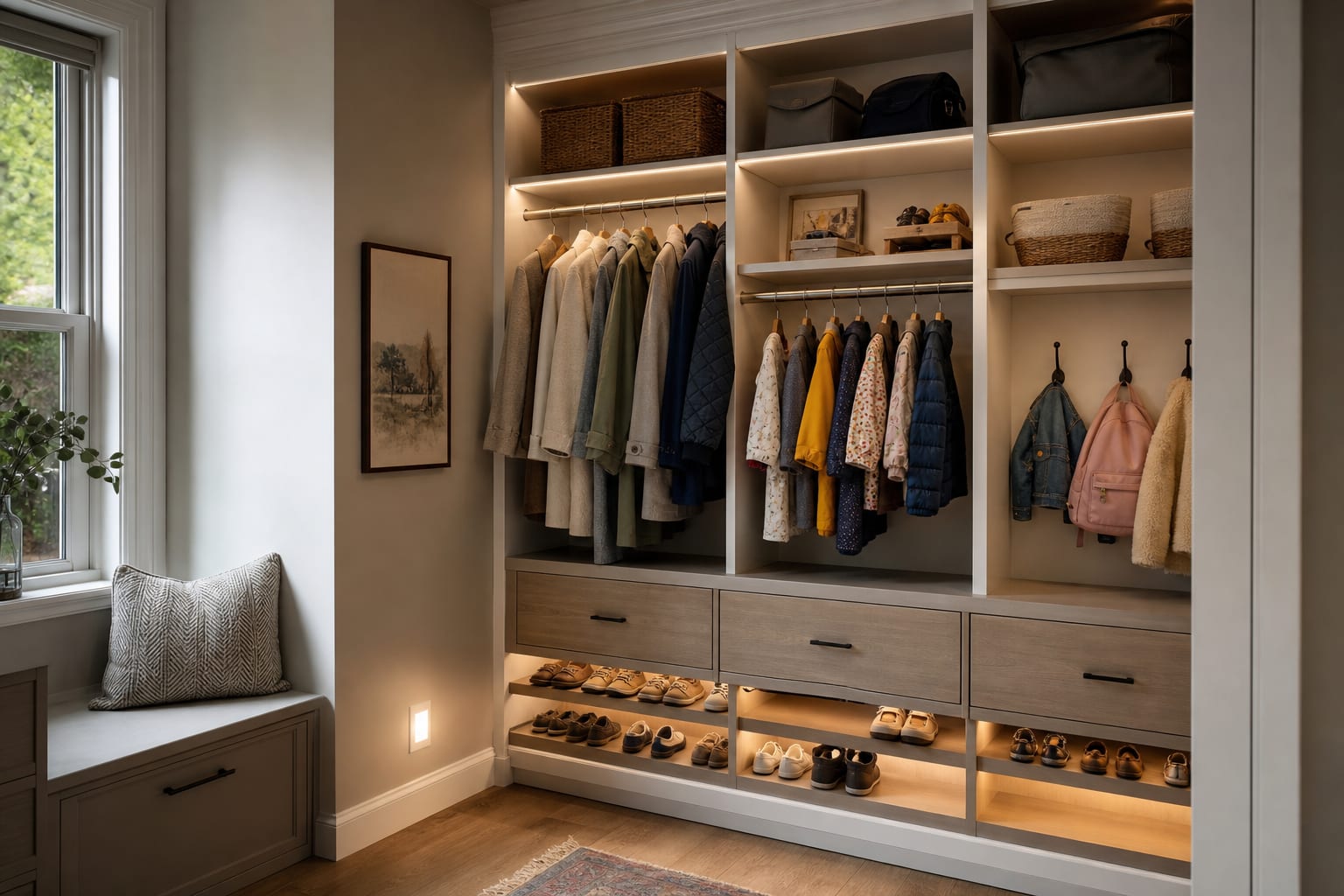
Use height in layers. Adults can keep the original rod, but kids need a lower hook rail around 36"–42" they can use unassisted, with adult hooks around 60"–66" for longer coats. Reserve anything above 72" for rare-access seasonal bins, not tomorrow's gloves.
If the closet sits beside a chaotic front door, pair this project with an entryway clutter drop zone so the closet handles clothing and exit gear only — not mail, keys, or library books.
How Should Coats, Shoes, and Bags Be Divided Among Four People?
Divide the closet width into four vertical zones, even if only visual: two rod sections for adults, hooks or cubbies below for kids. A winter coat needs 3"–4" of rod width once sleeves puff out, so four daily coats can fill 24"–30" fast — don't try to store every jacket the family owns in a 36" closet.
Double hanging works only with short coats: a lower rod at 40"–42" and upper rod at 78"–82" suits kids' jackets and raincoats, but adult parkas bunch and make the closet feel stuffed. In narrow closets, hooks often beat rods for backpacks and lumpy snow gear.
Give each person a 10"–12" bin for gloves, hats, and sunglasses, labeled with names, with kids' bins below 48".
Test this on your own room photo with ReDesign — keep the doorway, walls, and fixed features visible so the preview solves the room you actually have.
Shoes reveal whether the system is honest. A boot tray around 24" x 36" handles two or three wet pairs; limit the closet to daily and weather-specific shoes and rotate the rest out. Match shelf depth to the object — 10"–12" for shoes, 14"–16" for bags — since an oversized shelf just invites stacking, and stacking is where mittens and permission slips vanish.
Mount backpack hooks into studs with 6"–8" spacing: two kid hooks at 38"–42" and two adult hooks at 58"–64" for a family of four. Wet gear needs air, not a sealed bin — use a vented basket or a hook zone with drip protection. If the entry is tiny, borrow ideas from tiny entryway apartment solutions: protect the walking path first, then add storage.
A battery motion light around 2700K–3000K near the front of the closet makes navy coats and missing gloves easier to find.
What Mistakes Ruin a Family Coat Closet?
- Buying bins before editing. Matching baskets won't fix outdated jackets and boots nobody wears — sort by person and season first, then return only current gear.
- Giving adults all the useful height. If kids can't reach hooks or shelves, the floor becomes their storage system; keep their zone under 48".
- Turning the closet into whole-house storage. Vacuum attachments and bulk supplies may fit, but they slow down daily exits. If the entry still feels unresolved, use how to design an entryway from scratch to decide what lives outside the closet.
- Ignoring the floor. Loose shoes and a collapsed tote read as messy even with a perfect rod — use a tray for wet footwear, a shelf for dry shoes, and a slot for umbrellas.
- Making the system too precious. Hooks, open cubbies, and labeled bins survive family traffic better than color-matched hangers that must be faced just so.
How Can AI Help Preview a Coat Closet Before You Buy?
Storage products look small online and bulky inside a real doorway — a shelf tower can technically fit and still block the stroller or a child's reach.
- Photograph the open closet straight-on, then again from the side to show door swing and floor space, leaving the actual mess visible.
- Preview a hook-heavy four-zone version, a double-rod version for short coats, and a shoe-and-bag plan with low cubbies and an upper seasonal shelf.
- Keep width, trim, flooring, and door style unchanged so the test evaluates storage, not a bigger hallway.
- Check reach and clearance: can a seven-year-old use the lower hook, does the shoe shelf still let the door close, is the boot tray leaving a dry path?
Turn the strongest preview into a shopping brief — hook heights, shelf depth, bin count, boot tray size, rod length, and light placement — so coat closet organization becomes a working system instead of a cleanout that collapses after the next rainy school morning.
Frequently Asked Questions
How do I make a small coat closet hold a family of four?
Install a double-hang rod (full above 60in, half-hang at 30in below), add a cubby bench for shoes underneath, and use one over-door rack for hats and gloves. This roughly triples the usable volume of a standard closet.
Where should kids' coats hang?
On low hooks at 36–42in so kids hang their own coat. Adults use full-rod hangers; mixing kids onto the same rod means parents end up doing the work kids should handle themselves.
Should winter and summer coats live in the same closet?
No. Keep only the current season in the entry closet so it stays usable, and store off-season coats in a bedroom closet, attic bin, or under-bed storage, rotating twice a year.
How do I handle shoe overflow in the entry closet?
Use one cubby bench inside the closet for current shoes and a separate rack just outside for daily rotation. Pushing all family shoes into the closet means the floor disappears and the door won't close.
Is a closet system worth the cost?
Yes. A custom or IKEA system at $400–$1,500 roughly doubles a coat closet's capacity and lasts decades, versus repeated reorganization that never holds more than a few weeks.
> Try this: Ready to see this on your own room? Open ReDesign and run the preview.
Three transformations to try
1. Coat closet with double-hang rod and cubby bench 2. Coat closet with kid hooks and over-door rack 3. Mudroom coat closet with seasonal-only contents