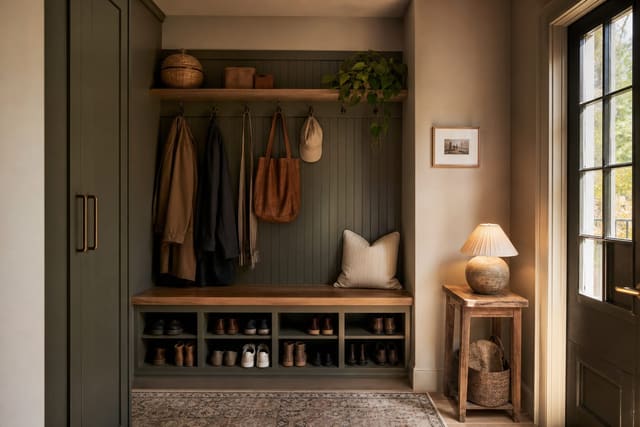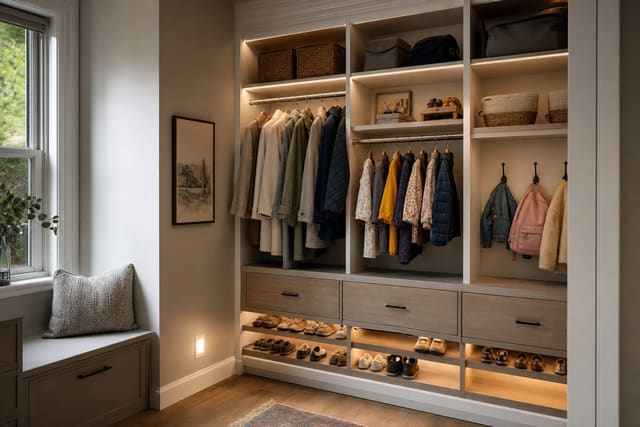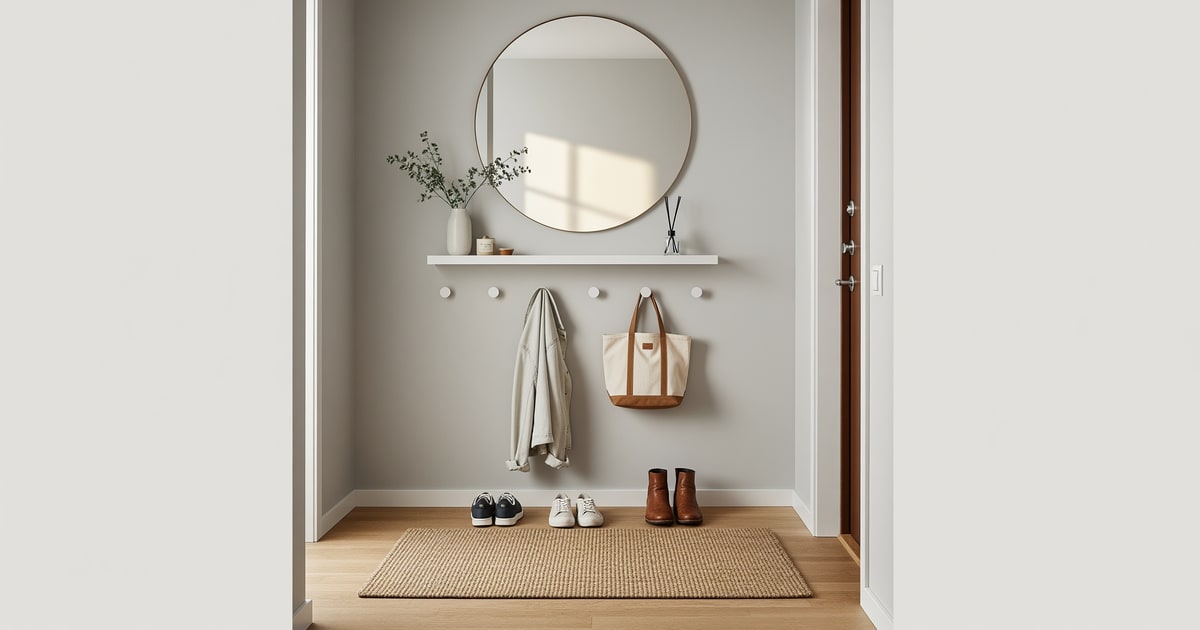
An apartment entryway works without a foyer when one 24 to 36-inch wide zone inside the door becomes the named landing — a 12-inch deep console or floating shelf, two to four wall hooks at 60 inches, one mirror above the console, and one woven floor mat — the smallest possible footprint that signals 'home starts here' to every guest. Most apartments in the US have no dedicated foyer. You open the front door and you're in the living room, standing on the same flooring, with no visual signal that one space has ended and another has begun. The result is a door that opens onto a pile of shoes, a chair loaded with coats, and a wall that's simultaneously entryway and living room backdrop. The fix is not a renovation — it's a zoning strategy that costs under $500 and reads as a designed foyer to every guest who walks in.
How do you create an entryway when your apartment has no foyer?
Define a zone 3'–4' deep immediately inside the front door with four elements: a wall-mounted coat hook system, a narrow console or floating shelf at 30"–36" height, one mirror at eye level, and a defined floor mat or small area rug. The zone says "this is the entry" to your brain and to anyone who visits, even though the floor plan doesn't change. Landlord-friendly versions are available entirely on adhesive hooks and pressure-mounted shelving — no drilling required.
The four elements of a defined entry zone
1. Coat hook system (mandatory). Everything else can wait; the coat system cannot. Without it, the nearest chair becomes the coat closet. Options: - Wall-mounted multi-hook rail at 68"–72" from the floor. IKEA Tjusig, CB2 Grid hooks, Anthropologie wood rails — 4–6 hooks minimum. Studs preferred; heavy-duty adhesive anchors (Command L-hooks plus a wood backing strip) work for light coats in rentals. - Freestanding hall tree if the wall is load-bearing plaster you can't touch. A hall tree at 72"–78" takes 12"–18" of floor depth and includes a bench or bottom shelf for shoes. - Vertical pegboard panel (3'x4') mounted to the wall and painted the same color as the wall. Looks architectural; holds coats, bags, hats, and umbrellas.
2. Narrow console or floating shelf at 30"–36" height. Functions as a drop zone for keys, mail, and the objects that otherwise scatter across every surface. Ideal depth: 10"–14". Thinner reads elegant; thicker looks like furniture that wandered from another room. - Floating shelves (IKEA LACK, CB2 Trace) avoid the floor-to-ceiling visual of console legs. - A wall-mounted key cabinet (IKEA HEMNES key cabinet) combines the shelf and the hook rail into one.
3. Mirror at eye level. Required for the zone to read as a designed entry rather than a wall with hooks on it. 24"x36" minimum. Hung with the center at 57"–60" off the floor (standard hanging height). The mirror signals "this is a place you check yourself before leaving" — which is the subconscious definition of an entryway.
4. Floor mat or small area rug. Defines the perimeter of the zone. The mat edge is where the entry ends and the living room begins. A 24"x36" natural fiber mat (jute, sisal, coir) is appropriate for the entry; anything smaller reads decorative, not functional.
Test this on your own room photo with ReDesign before you choose the final direction; keep the doorway, walls, windows, main furniture, lighting, and awkward fixed features visible so the preview solves the room you actually have.
Shoe storage solutions that don't eat the zone
The shoe accumulation at the front door is the most common apartment entry failure. Solutions by depth available:
- Bench with shoe shelf underneath. An 18"–24"-deep bench with slatted or solid shelving below handles 6–8 pairs without spilling onto the floor.
- Vertical shoe cabinet. A 12"-deep rotating or hinged shoe cabinet (IKEA HEMNES, Brimnes) stores 16–20 pairs in the footprint of a small table. Best for entrances with more than 3' of wall depth.
- Over-door shoe organizer. Works when the entry is truly a corridor — no floor space at all. 24-pocket versions hold 12 pairs.
- Stair-step display rack. 3–4 tiers, angled 15°, 10"–12" deep. Visible but designed-looking if you curate which shoes live there.
Borrowed tricks from small-space designers
- Run the entry floor material differently from the living room. A different tile, a darker stain, or a contrasting grout pattern visually defines the zone without any physical barrier.
- A pendant or semi-flush light directly over the entry zone if the ceiling is accessible. Overhead light above the door says "this is a room zone" better than any furniture.
- Paint the entry wall a different color from the living room. Even one wall at 90° to the front door creates a color transition that reads as a room change.
- A narrow bookcase behind the door. A 10"–12"-deep bookcase pushed to the hinge side of the door adds storage without blocking circulation.
A no-foyer apartment needs a landing strip with exact limits. Use an 8 to 10 inch deep shelf, a mirror or art piece above it, two to four hooks, and shoe storage no deeper than 12 inches. IKEA Trones, Yamazaki-style tower racks, and wall-mounted rails work because they acknowledge the shallow depth instead of pretending the entry is a mudroom. Keep the total width close to 30 to 42 inches so the zone reads deliberate. Renters can do the whole thing with adhesive hooks, a freestanding shoe cabinet, and a leaning mirror; owners can add blocking, a real sconce, and a built-in bench. The removable playbook from rental-friendly design fits this problem exactly.
The visual boundary can be tiny. A washable 2 by 3 foot mat, a painted or peel-and-stick panel, or a single pendant at the door tells the eye where arriving ends and living begins. Do not put the boundary in the walking path; it should sit against the wall that first receives keys, bags, and shoes. A closed cabinet usually beats open baskets because entry clutter is repetitive and not attractive. If the apartment is one open room, borrow the zone-making rules from the small space studio guide: light, rug, and storage have to agree or the entry disappears.
Lighting is the quickest way to make the new zone feel real. A plug-in picture light over the mirror, a tiny shaded lamp on the shelf, or a rechargeable sconce by the door gives the entry a job after sunset. Keep it warm and low; the goal is arrival glow, not a spotlight on shoes. If outlets are scarce, a motion puck inside the shoe cabinet can be more useful than another decorative basket.
Common no-foyer apartment mistakes
- Doing nothing. The pile-of-shoes default. Costs no money upfront; costs daily friction forever.
- Console table too wide. Anything over 18" depth in a zone under 4' deep becomes an obstacle.
- No coat hooks. The nearest chair fills the role instead.
- No mat. Without it, the zone dissolves back into the living room.
- Oversized mirror. A 3'x4' leaning mirror in a 3'-deep entryway takes more than half the available depth.
- Making the entry cute but not functional. A bowl, candle, and tiny art print do not solve shoes, mail, or a wet coat. Storage must come before styling.
- Creating open storage for every daily object. Keys, shoes, mail, and bags need at least one closed place to disappear.
Use AI design to preview your entry zone before installing
Deciding between a hall tree vs. floating shelf vs. console in a space you see every day is hard without a visual. AI design lets you photograph the wall immediately inside your front door and preview the zoned version — hooks, shelf, mirror, mat — alongside the current blank-wall state in minutes. The preview removes the hesitation and you install the hooks the same week.
Frequently Asked Questions
How small can an apartment entryway be and still function?
A functional entryway runs 18 to 36 inches wide along the wall inside the door — enough for a slim console or floating shelf, a hook rail, and one floor mat; below 18 inches, use wall hooks alone. Use the room photo to compare the visible layout and fixed constraints before committing, because door swings, windows, outlets, storage reach, circulation, and existing furniture decide whether the idea survives daily use.
What goes on the wall in a tiny apartment entryway?
A 12-inch deep console or floating shelf for keys and mail, two to four wall hooks at 60 inches, a small mirror for last-look, and optional one piece of small art; the entire kit is under 36 inches wide. Keep the preview honest by leaving the problem area visible in the frame, then compare one conservative version against one bolder version before you buy lighting, paint, furniture, or storage.
How do I store shoes in an apartment with no entryway closet?
A 24-inch wide bench with under-seat shoe storage, a slim wall-mounted shoe shelf (4 to 5 tiers), or an over-the-door shoe organizer in the nearest closet handle 2 to 4 pairs of daily-rotation shoes. Check the result against ordinary movement first: drawer clearance, chair pullout, walkway width, glare, switch access, and sightlines matter more than a perfect catalog angle.
Should an apartment entryway have a rug?
Yes — a 2 by 3 foot or 3 by 5 foot indoor mat in jute or wool defines the landing visually and protects the floor; without a rug, the entry blurs into the living room and the front door reads as a doorway, not a threshold. Use the image to narrow priorities and measurements before ordering anything custom; final purchases still need real dimensions, outlet locations, installation limits, and product clearances.
What lighting works in a tiny apartment entryway?
A small wall sconce above the console, a plug-in mini-lamp on the shelf, or a smart bulb in the existing overhead at 2700K — warm light at the entry sets the home's tone in the first three seconds. If the preview invents architecture or hides the awkward feature you need solved, rerun it with stricter instructions so the result remains tied to your actual room.
> Try this: Ready to see this on your own room? Open ReDesign and run the preview.
Three transformations to try
1. Floating shelf entryway with hooks and small mirror 2. Slim console plus bench with shoe storage 3. Wall-only entry with hook rail and mat