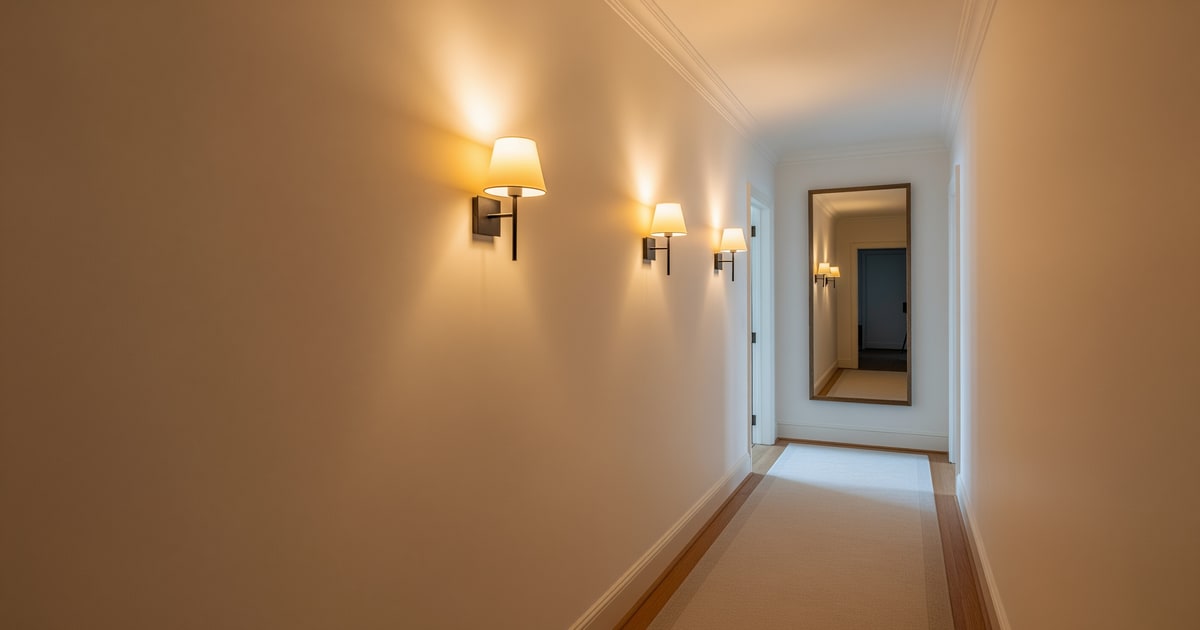
A windowless hallway brightens when the lighting commits to three layers — flush mount or surface-mount LEDs at 3000K every 6 to 8ft for ambient, 2700K sconces at 60in centerline for warm accent on the long walls, and a focal-point fixture at the end of the run (pendant, larger sconce, or art light) that gives the eye a destination — single overhead recessed cans alone always read tunnel. A dark hallway is the most overlooked design problem in any house. Owners spend tens of thousands on the rooms it connects but leave the connecting space lit by a single 60-watt bulb in a builder-grade dome. The hallway is the corridor every guest walks through to get to the rest of your house — it is also the cheapest room in the house to transform. Two evenings of work and the hallway reads designed, not utility.
What lighting works best in a hallway with no natural light?
A repeating rhythm of warm wall sconces every 6'–8' of length, at 60"–66" off the floor, paired with a single ambient ceiling fixture and one terminating reflective surface (mirror or backlit art) at the far end. The combination gives the eye a series of bright destinations to walk toward, which the brain reads as a longer, brighter, more intentional space. Adding more recessed cans in the ceiling is the most common mistake; rhythm and verticality matter more than raw lumens.
The sconce rhythm that does most of the work
A windowless hallway transforms when you treat the long walls like a gallery, not a passage. The structure:
- Sconces every 6'–8' along one wall at 60"–66" off the floor (centerline). For a 24' hallway, plan on three sconces.
- Stagger to one wall, not both. Sconces on both walls feel oppressive and double the install cost. One wall reads gallery-like; both walls read corridor.
- Pick a sconce that throws light up and down, not a flush half-dome that only throws sideways. Up-light hits the ceiling and bounces back as ambient; down-light grazes the wall to highlight texture and any art beneath it.
- 2700K bulbs only. Cool-white sconces in a windowless hallway read like an office building.
- Hardwire if you can; plug-in works if you can't. Plug-in sconces with a cord run through the baseboard look almost identical to hardwired in finished photos. Renters can use battery-powered LED puck sconces from Mitzi or Ikea ~$30 each.
Test this on your own room photo with ReDesign before you choose the final direction; keep the doorway, walls, windows, main furniture, lighting, and awkward fixed features visible so the preview solves the room you actually have.
The ceiling fixture: one good one, not three okay ones
- Skip the row of recessed cans. They read as a commercial corridor.
- One flush-mount or semi-flush at the midpoint of the hallway, with a diffuser (glass globe, fabric drum, or alabaster). Acts as gentle ambient fill between sconces.
- For long hallways (over 20'), use two identical fixtures evenly spaced. Same model, same height — the repetition reads architectural.
- Skip the dome with the bare bulb. It's the default in 80% of houses and it is the worst possible choice for this room.
Art lighting and the terminating mirror
Every great-looking hallway has a destination at the end — a piece of art, a mirror, or both — lit deliberately.
- A 36"-wide mirror at the end of the hallway doubles the apparent length of the corridor and bounces every photon of light back down the hall. The single highest-impact change you can make.
- A picture light over a single artwork at the midpoint or end of the hallway. A battery-powered LED picture light ($60–$120) clamps onto a frame and turns the wall into a feature. Use 2700K.
- A console table with a single lamp at the end of the hallway anchors the space and adds floor-level light. Even a 10"-deep console works against the wall.
Floor and wall finish moves that compound the lighting
- A long runner in a warm pale tone. A jute or wool runner in cream, soft sage, or putty makes the floor reflect light back up. Avoid dark navy or black runners in dark hallways — they swallow the light layers you just installed.
- Warm white paint on walls and ceiling. Same color or ceiling one shade lighter. A bright white ceiling against a beige wall in a windowless hall reads disjointed.
- Glossy or eggshell trim, never matte. Trim catches and reflects light along the length of the corridor.
- Avoid heavily textured wallpaper. Subtle linen-weave or limewash is fine; bold pattern in a dim hall reads chaotic.
A hallway needs rhythm more than drama. Place sconces about 60 to 66 inches from the floor to the center of the shade, then repeat them every 6 to 8 feet if the run is long enough. Keep projection under 4 inches in tight halls so the fixture does not violate the walking path; low-profile opal cylinders, half-moon sconces, or picture lights are safer than deep fabric shades. If wiring is not available, rechargeable picture lights over art can create the same cadence. Pair the end point with the mirror rules in mirrors that amplify light so the hall has a destination instead of just a brighter tunnel.
The finish pick should be quiet because hallways are close-range spaces. Satin brass, bronze, or matte white fixtures with frosted glass look intentional without shouting. A runner with a pale ground and dark border can pull length through the hall, but leave at least 3 inches of floor visible on both sides so it does not look like wall-to-wall carpet. Renters should use plug-in or battery fixtures and adhesive cord channels; owners should hardwire the sconces and put the ceiling fixture on a dimmer. If the hall still feels flat, use one diffused lamp in the adjacent room from the fake natural light guide to borrow glow through the doorway.
Paint and art should support the rhythm instead of fighting it. A warm white in the LRV 75 to 85 range keeps the walls bright, but a slightly darker trim or handrail can make the passage feel tailored rather than blank. Use two or three larger frames instead of a dozen tiny ones; small frames create visual static in a space where people are already moving. If the ceiling is under 8 feet, skip hanging pendants and put the character on the walls, where the eye can read it safely.
Common windowless-hallway mistakes
- Single dome fixture with a 60W bulb. Standard. Wrong. Replace it.
- Recessed cans every 4 feet. Reads as a commercial building.
- Dark paint to "make it cozy." Without natural light and without enough fixture count, dark paint reads as a cave.
- No art and no mirror. Eliminates the rhythm and the terminating destination.
- Cool-white bulbs at 4000K. Reads like a hospital corridor.
- Skipping the dimmer. A dimmer on the sconces lets you run the hallway at 100% for guests and 30% as a nightlight. Free upgrade.
- Using one bright fixture at the center. A single ceiling fixture makes the floor bright and the walls gloomy, which is exactly what makes a hallway feel narrow.
- Picking fixtures that protrude too far. A pretty sconce that clips shoulders will make the hall feel narrower every time someone walks through.
Use AI design to preview your hallway as a designed space
Owners who have walked past the same dim hallway for ten years often can't picture the gallery-like alternative. AI design lets you photograph the existing hallway and preview it with three warm sconces, a terminating mirror, a runner, and warm-white walls — alongside the current dim version — in minutes. The preview is what unlocks the commitment to spend an afternoon installing sconces.
Frequently Asked Questions
What is the best ceiling light for a long windowless hallway?
Surface-mount or semi-flush 3000K LEDs every 6 to 8ft on center deliver even ambient light; recessed cans alone leave dark spots between fixtures and read more institutional. Use the room photo to compare the visible layout and fixed constraints before committing, because door swings, windows, outlets, storage reach, circulation, and existing furniture decide whether the idea survives daily use.
Are sconces worth adding in a hallway?
Yes — sconces at 60 to 66in centerline along the long wall add the warm layer recessed cans cannot, and they transform a hallway from utility into an architectural element. Keep the preview honest by leaving the problem area visible in the frame, then compare one conservative version against one bolder version before you buy lighting, paint, furniture, or storage.
How do I light hallway art without harsh spots?
Use small picture lights mounted above frames, or 2700K mini-cans aimed at a 30° angle from the wall; flat overhead light flattens art and removes the reason it is on the wall. Check the result against ordinary movement first: drawer clearance, chair pullout, walkway width, glare, switch access, and sightlines matter more than a perfect catalog angle.
What paint color brightens a windowless hallway?
High-LRV warm whites (LRV 75+) bounce the most light; the trick that fails is painting hallways stark white — warm-toned whites work, cool whites read clinical. Use the image to narrow priorities and measurements before ordering anything custom; final purchases still need real dimensions, outlet locations, installation limits, and product clearances.
Should hallway lighting be on a timer or motion sensor?
Motion sensors at both ends and a timer at the focal-point fixture is the gold standard — the hallway is always lit when someone is in it and saves energy when empty. If the preview invents architecture or hides the awkward feature you need solved, rerun it with stricter instructions so the result remains tied to your actual room.
> Try this: Ready to see this on your own room? Open ReDesign and run the preview.
Three transformations to try
1. Long hallway with semi-flush mounts and wall sconces 2. Gallery-style hallway with picture lights over art 3. Hallway with end-of-run pendant focal point