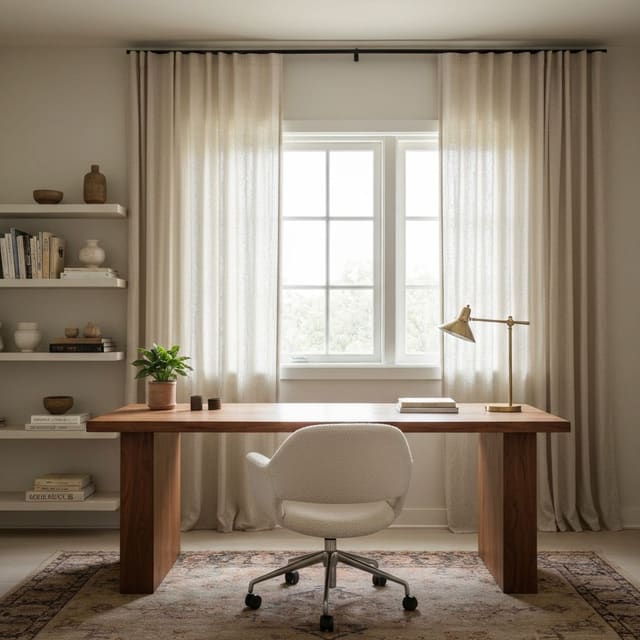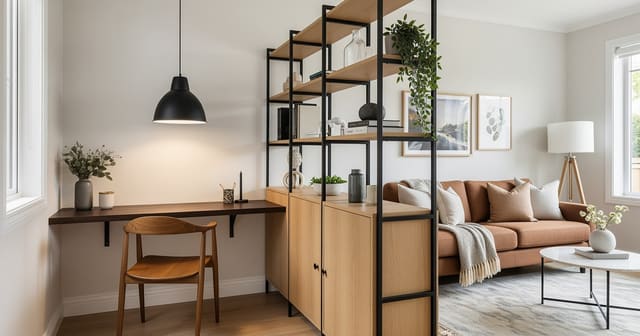
A compact home office works in as little as a 36in wide by 24in deep desk plus 30in for the chair pull-back, about 9 square feet total, when the desk is wall-mounted, storage stacks vertically on shelves, and lighting handles its own job instead of relying on the room's overhead fixture. The setup fails only when the chair, storage, and cords compete for the same few inches.
How much space does a compact home office really need?
The smallest workable footprint is about 30 inches wide by 48 inches deep, assuming a shallow desk, a chair that can pull out, and storage that moves up the wall. Desk depth depends on what you're running:
| Setup | Min Width | Min Depth |
|---|---|---|
| Laptop only | 30in | 18-22in |
| Laptop + one monitor | 36in | 24in |
| Dual monitors | 42-48in | 24-30in |
Standard desk height runs 28 to 30 inches, and most adults need about 24 inches of knee width underneath. The chair is what people underestimate: a chair tucked under a desk needs 30 to 36 inches behind it the moment someone sits, turns, or stands. If the office sits in a living room, protect the walking route before protecting the symmetry of the desk wall — the same zoning logic used in a living room home office zone applies to a single-wall setup.
Vertical storage matters more than floor storage here. A shelf 10 to 12 inches deep above the desk can hold paper, a small printer, or closed boxes without eating chair clearance, as long as the lowest shelf sits at least 16 to 18 inches above the desktop.
Which desk type fits a tiny footprint?
The desk type decides whether the office borrows space politely or steals it all day.
| Desk Type | Best For | Key Requirement |
|---|---|---|
| Freestanding writing desk | A room with a clear wall | 36x20in minimum, full chair clearance behind |
| Wall-mounted drop-leaf | Renters, narrow bedrooms | Studs or proper anchors, ~29in mount height |
| Closet conversion | Hiding the office after hours | 48-60in wide closet, door removed, outlets accessible |
A shallow writing desk (36x20in) handles a laptop, lamp, and notebook well, but not dual monitors and a document tray at once — use a monitor arm if you need two screens. A wall-mounted drop-leaf works for narrow bedrooms as long as the folded depth doesn't block a closet or walkway. A closet office needs one continuous desktop and a place for the chair to go when the doors are open; the scaled-down version of a walk-in closet office conversion applies here.
Test this on your own room photo with ReDesign before committing — keep the doorway, windows, and main furniture visible so the preview solves the room you actually have.
Which small-office ideas are worth the inches?
The best ideas solve a daily irritation, not just a photo.
- Match the chair to the desk, not the mood board. An armless chair 18-22 inches wide slides under a compact desk without blocking the walking path.
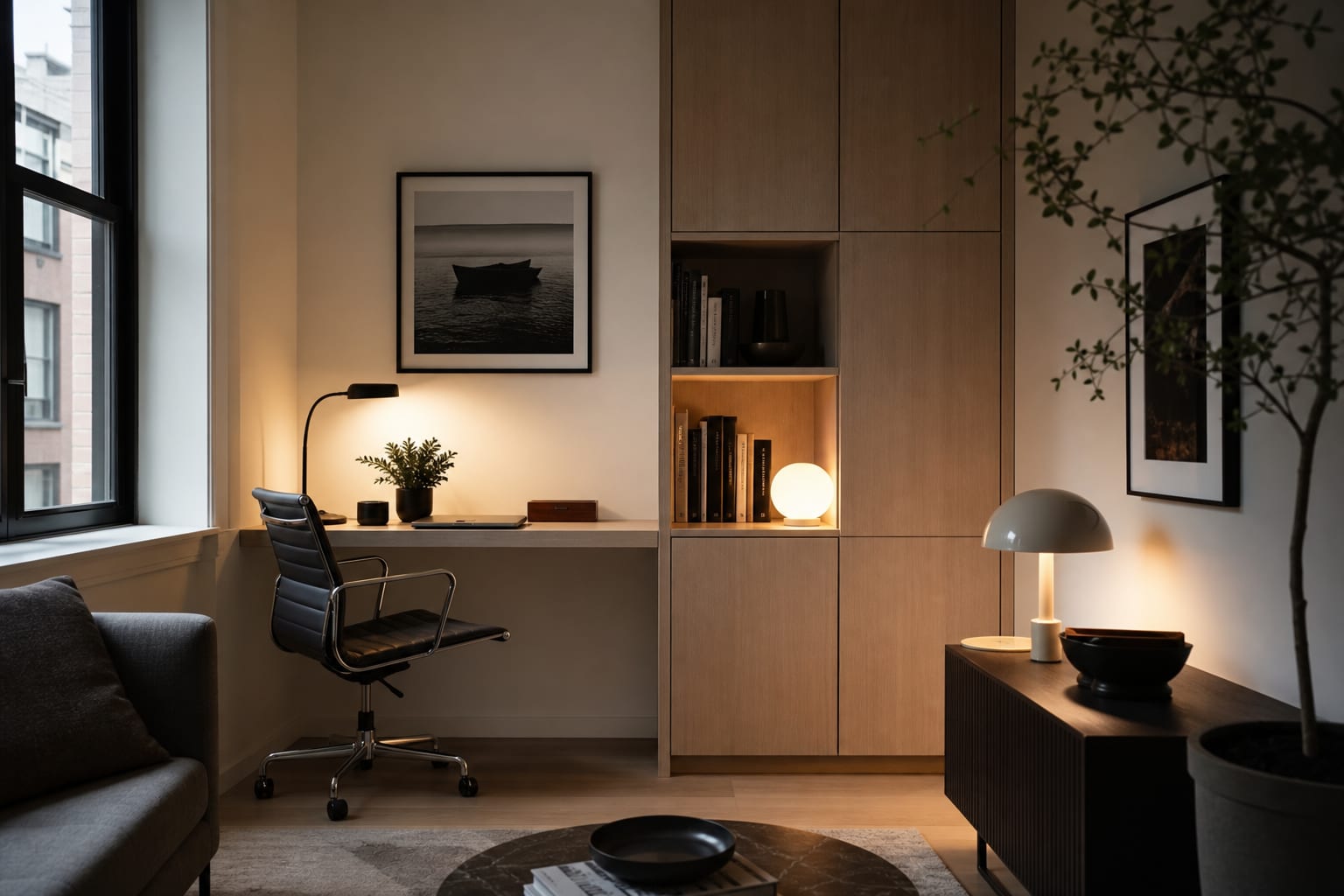
- Place the lamp where your hand casts the least shadow. Right-handed users usually want light on the left, left-handed on the right; 2700-3000K feels comfortable for evening work, 3500K helps daytime focus in a dark corner.
- Split storage by visibility. A 12-inch deep closed cabinet hides printer paper and chargers; one open shelf keeps daily items reachable. Too many open shelves turn the office into a supply display.
- Plan one cable route from the start. A clamp-on tray, adhesive channel, or grommet near the back corner keeps power bricks off the floor.
- Let the wall do one visual job. A pinboard or magnetic rail sized to about two-thirds the desk width looks deliberate; four wall treatments at once looks scattered.
Lighting deserves more attention than the square footage suggests — a task lamp under a dim ceiling still needs a glare check from the seat you actually use. Pair the plan with home office lighting for focus before buying another organizer.
What mistakes shrink a compact office further?
- Choosing the desk by width only. A 32-inch-wide, 28-inch-deep desk can still block a walkway; test depth with painter's tape before ordering.
- Using a dining chair long-term. It may match the room, but a seat that hurts after 40 minutes sends you back to the sofa — get a supportive task chair with a smaller base instead.
- Letting supplies spread past the footprint. If paper lands on the dresser and cartridges sit on the floor, give every recurring item a named home within 36 inches of the desk.
- Ignoring the camera background. Sit in the chair, open the laptop camera, and check what's behind you — a calm wall or narrow bookcase beats a door gap or bright window.
- Buying a desk that can't be cleared fast. A real work surface should reset in two minutes: laptop closed, mug removed, cords contained.
How can AI design help preview a compact office?
Upload a straight photo of the proposed wall, a wider shot showing the nearest door or sofa, and one angle from the seat looking outward. Those views reveal whether the office feels tucked in, exposed, or heavier than expected. Ask for exact specs, not a vague "stylish office" prompt — try `30 inch wall-mounted desk, armless upholstered task chair, two 10 inch deep shelves, warm brass task lamp, hidden cord channel, soft white walls`, then compare against `42 inch oak writing desk, closed wall cabinet, black adjustable chair, linen pinboard, 3000K task light`, keeping the room layout unchanged.
Check three things in the results: does the chair pull out without hitting furniture, does the desk look deep enough for elbows, and is the storage within reach. AI can't confirm wall anchors, outlet load, or exact hardware fit — but it can settle whether the office belongs in a closet nook, a living room wall, or a bedroom corner before you spend money. After choosing a direction, tape the desktop size and chair pullout on the floor and sit there with your laptop for ten minutes.
A compact home office works when every inch has a job: protect chair clearance, buy the right depth before the prettiest finish, and make lighting part of the plan from day one.
Frequently Asked Questions
What is the smallest home office desk that still works?
30in wide by 18in deep is the smallest comfortable laptop-and-notebook desk; 36in by 24in is the smallest that holds a laptop plus an external monitor. Below those sizes, peripherals stack up and the desk reads cluttered.
How much chair clearance does a small office need?
30 inches behind the desk lets a task chair roll back fully and the user stand without hitting a wall. Below 24 inches, the chair traps against the wall and standing requires shoving it sideways first.
Where can I fit a home office in a small apartment?
Top options are a closet with the door removed, a wide hallway alcove, a living room or bedroom corner, and a wall-mount fold-down desk in a kitchen pass-through. Any of these adds 9 to 20 square feet of dedicated work space.
Do I need a separate room for a home office?
No. A defined corner with a desk, lamp, chair, and a clean camera background works for most daily remote work. Separate rooms only matter for client-facing roles or calls that would disturb others in the home.
What is the best monitor setup for a small office?
A single 27-inch monitor on a clamp-mount arm keeps the desk clear for paper and notebooks. Dual monitors need 48 inches or more of desk width and often defeat the point of a compact office.
> Try this: Ready to see this on your own room? Open ReDesign and run the preview.
Three transformations to try
1. 36in wall-mount desk in living room corner 2. Closet office with door removed and shelving above 3. Hallway alcove desk with floating shelves