The contemporary kitchen is not about stripping the room bare — it is about placing every element with intent so nothing competes for attention. Slab-front cabinets, integrated appliances, and a single dominant countertop material are the starting points, but the layout and lighting are what make them cohere.
A well-executed contemporary kitchen handles a dinner party and a Tuesday morning with equal ease. That means drawer inserts for utensils, panel-ready appliances that disappear into the cabinetry line, and an island sized for real meal prep rather than just aesthetic symmetry. Looks follow function when the design decisions are made in the right order.
Cabinetry Profiles and Hardware Choices
Flat-panel, also called slab-front, cabinet doors are the foundation of contemporary kitchen design. The door surface is uninterrupted — no raised panels, no routed details — which means the material itself carries the entire visual weight of the cabinet. That material can be a painted lacquer in white, charcoal, or sage; a matte laminate in a warm wood grain; or a high-gloss finish for maximum reflectivity.
Handle choice is the most debated detail in a contemporary kitchen. Integrated J-pull channels routed into the top or bottom of the door create a completely hardware-free face — clean, but harder to grab in daily use. Long bar pulls in brushed metal are ergonomically practical and add a graphic horizontal rhythm that reinforces the cabinet lines. Finger pulls recessed into the door edge split the difference.
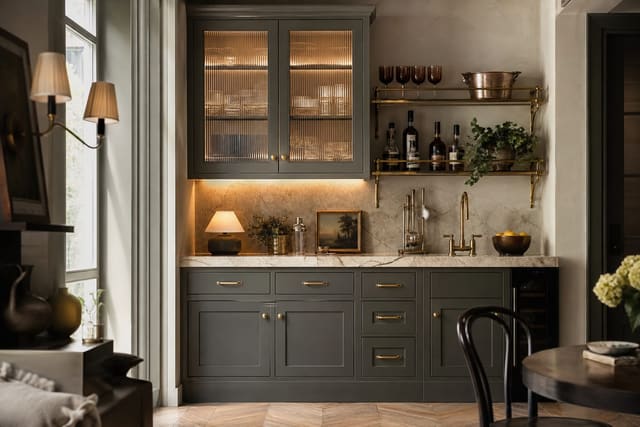
Two-tone cabinetry — upper cabinets in a light color, lower cabinets or island in a contrasting dark — is the most durable contemporary configuration because it grounds the room visually and ages better than an all-white kitchen that shows every scuff. Keep the same door profile and hardware finish across both colors or the contrast reads as mismatched rather than deliberate.
See also our guide to Kitchen Home Bar Design for more on contemporary kitchen ideas.
Countertop and Backsplash Strategy
The countertop is the workhorse surface in the kitchen and the visual anchor of a contemporary design. Quartz engineered stone is the dominant choice because it offers the veined-stone aesthetic with consistent patterning and no sealing requirement. Porcelain slab countertops are a newer option that extends the same material used on the floor or backsplash onto the work surface, reducing visual transitions.
Extending the countertop material up the wall as a full-height backsplash slab — rather than installing a separate tile — is the contemporary move that most significantly simplifies the room. It eliminates grout lines from the busiest visual zone and makes the backsplash read as a continuation of the counter rather than a separate decision.
Waterfall edges, where the countertop material folds down the side of the island to the floor, are a signature contemporary detail. They work best when the material has strong natural movement — a dramatic quartz vein or an engineered porcelain with depth — so the vertical face is genuinely interesting rather than a plain slab of grey.
For a related angle on contemporary kitchen ideas, read Cottagecore Kitchen Ideas.
Appliance Integration and Layout Efficiency
Integrated appliances — refrigerators, dishwashers, and sometimes ovens — accept custom panel overlays that match the surrounding cabinetry. The result is a kitchen where the appliance footprint disappears into the cabinet run and the room reads as a single coherent surface. The premium is real, but it is concentrated: panel-ready dishwashers are a modest upcharge, while panel-ready column refrigerators are a significant investment that pays off most in large, open kitchens where the appliance is always visible.
For kitchens where full panel-integration is not in budget, choosing appliances with a matte black or matte stainless finish rather than standard polished stainless is a lower-cost route to visual consistency. The matte surface reads quieter against cabinetry and does not catch every fingerprint and light reflection.
Layout efficiency in a contemporary kitchen means the work triangle — sink, cooktop, refrigerator — stays under 26 feet of combined perimeter. A galley or L-shaped layout achieves this naturally. Island configurations work when there is enough room for the island not to interrupt the primary work path, which typically means a kitchen footprint of at least 12x12 feet before the island occupies its zone.
Lighting and the Open-Plan Connection
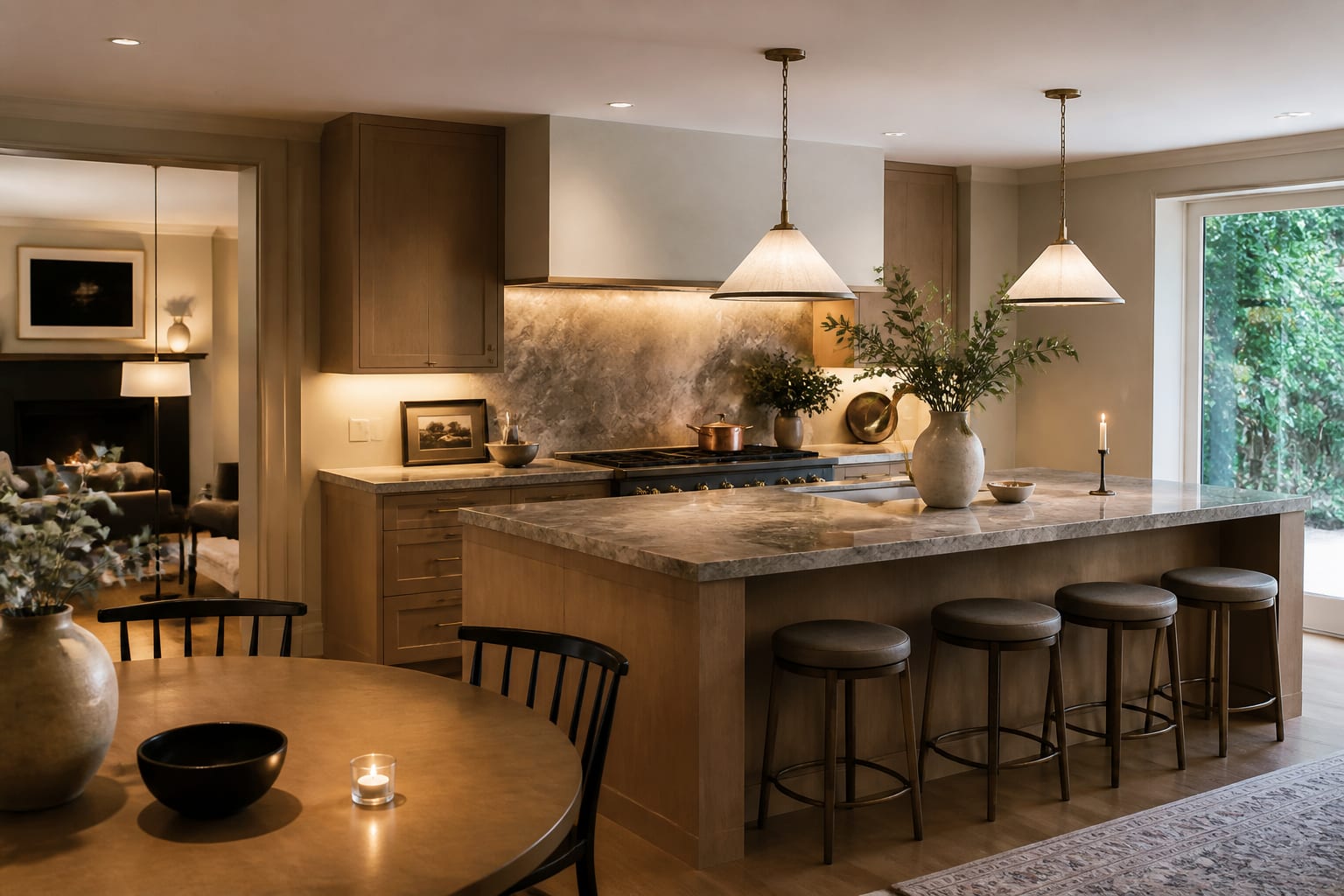
Contemporary kitchens in open-plan homes need lighting that marks the kitchen zone as distinct from the dining and living areas without installing a ceiling that separates the spaces. A run of recessed lights on a dedicated circuit, closely spaced above the perimeter counters and island, establishes the kitchen zone. Pendant lights above the island double as visual markers of the island's boundary from the living side.
Pendant proportion matters more than style. The bottom of the pendant should hang 30 to 36 inches above the island surface, and the total pendant diameter should not exceed one-third of the island length. Two pendants on an island under eight feet look right; three pendants read as too dense unless the island is very long.
Under-cabinet lighting is non-negotiable in a contemporary kitchen. It illuminates the countertop where prep work happens and reduces the shadowed look that overhead lighting creates when your body blocks the light. LED tape in a warm white at 2700K, recessed into a routed channel under the upper cabinet face, is invisible during the day and essential at night.
- Specify slab-front cabinet doors in a matte finish to eliminate visual noise across every surface in the kitchen.
- Carry the countertop material up the backsplash as a full-height slab to simplify the room's most active visual zone.
- Install a panel-ready dishwasher so the appliance disappears into the cabinet line without a custom budget.
- Use a two-tone cabinet palette — light uppers, dark lowers — to ground the room and give it lasting visual depth.
- Size pendant lights so their diameter is no more than one-third of the island length and hang them 32 inches above the surface.
- Route under-cabinet LED tape into a channel so it illuminates countertops without the fixture being visible from normal height.
- Plan at least 42 inches of clearance on all sides of the island so two people can work in the kitchen simultaneously.
Bring the look home with Re-Design
Choosing between cabinet colors, countertop materials, and pendant styles is genuinely hard when you can only look at samples. Re-Design lets you upload a photo of your current kitchen and preview a fully rendered contemporary redesign — different cabinet finishes, countertop patterns, and lighting configurations — so you can make confident decisions before the first cabinet is ordered or a single wall is opened.
Frequently Asked Questions
What cabinet color works best in a contemporary kitchen?
There is no single answer, but the most durable contemporary palettes are warm white, charcoal, warm grey, or a muted sage — all in a matte finish. High-gloss white reads very contemporary but shows fingerprints aggressively in a working kitchen. Two-tone schemes with a light upper and a dark or wood lower cabinet age particularly well because the contrast keeps the room from feeling dated when trends shift.
How do I make a small kitchen feel contemporary without a full renovation?
Replace cabinet hardware with a single unified pull style in brushed nickel or matte black, then add under-cabinet lighting. Those two changes cost a fraction of a renovation but immediately shift the room's register. If the budget allows one more move, replace the backsplash with a full-height slab tile in a large format — eliminating the grout grid behind the counter is the single most impactful visual change after cabinet hardware.
Are open shelves a good idea in a contemporary kitchen?
Open shelves work in a contemporary kitchen only when the items stored on them are curated and consistent — a set of matching ceramics, a few cookbooks with uniform spines, a small collection of glassware. Random everyday clutter on open shelving undermines the clean horizontal logic that contemporary kitchens depend on. A hybrid approach — closed cabinets for the majority of storage with one short run of open shelves as a display zone — is the most realistic option for a working kitchen.