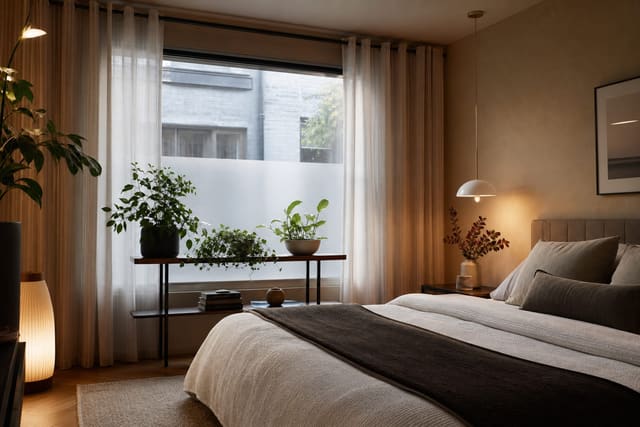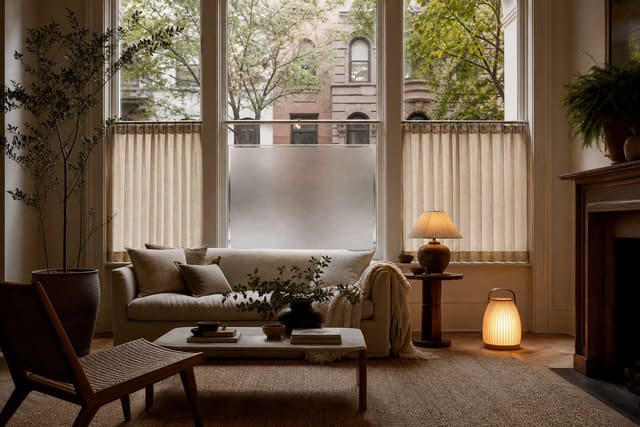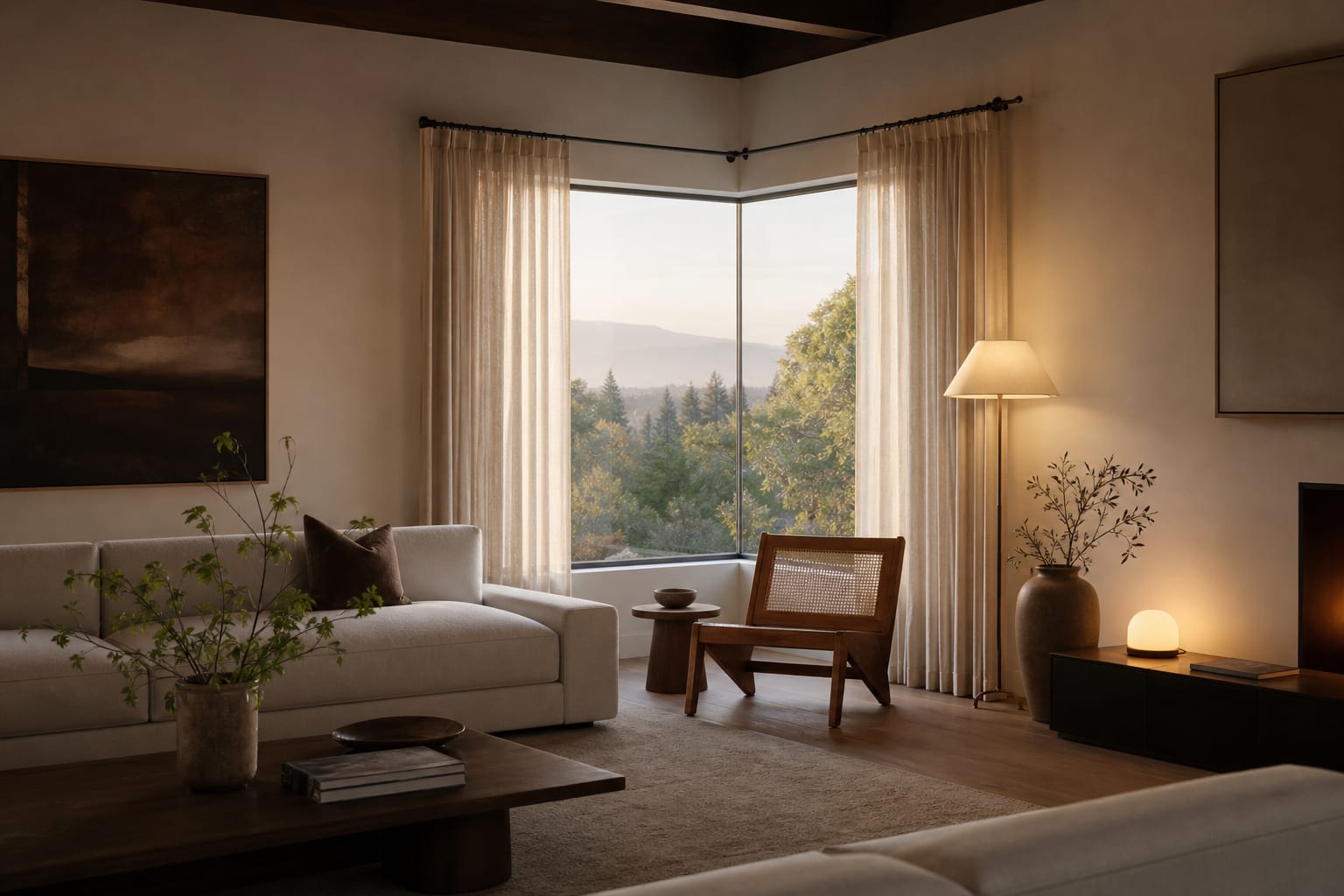
Corner windows treat cleanest with shades mounted inside each frame, a ceiling-mounted rod that wraps the corner, or one wide ripple-fold drape that bypasses the corner entirely. Do not treat each window as a separate project if the glass visually shares a corner — mismatched rods, colliding finials, and bunched panels make the room feel nervous around its own architecture. Pick one coordinated system for both windows and let AI preview which fits before you drill.
How do you treat corner windows without making the corner bulky?
Choose one system for both windows: a shared corner rod, matching Roman shades, inside-mount shades with slim panels, or a softened treatment on one side if furniture blocks the other. The right call depends on clearance, privacy, and how tight the windows sit to the corner.
Measure from each casing to the corner first. Less than 4 inches on either side means standard finials will collide — use a corner connector, ceiling track, inside-mount shades, or short return rods instead.
If the windows are close and similar in height, treat them as one feature: hang drapery 4 to 8 inches above the casing (higher in low-ceiling rooms), extend the outside ends 6 to 10 inches beyond the outer casings, and keep the inside corner clean with a curved rod or no inside finial at all.
If the windows differ in width or height, or a radiator or sofa interrupts them, matching Roman shades are calmer than full curtains. The corner needs the same logic repeated on both sides, not fabric volume.
This is the same planning issue as a room with windows on two adjacent walls — the corner reshapes furniture placement and light pattern.
The rod decision that controls two windows in a corner
Pretty finials are irrelevant if they block panels from closing or leave fabric jammed into the corner. Choose hardware for the corner first.
- Ceiling-mounted bendable track: cleanest for modern rooms, rentals, or windows nearly touching the corner. Mount 2 to 4 inches off the wall to clear handles and trim.
- Corner rod with a 90-degree elbow: works for traditional rooms; use a center connector or small end caps at the inside corner, saving decorative finials for the outer ends only.
Panel fullness matters: sheers need about 2x the window span to hold folds when closed; heavier linen or cotton needs 1.5 to 2x. Flat, stretched panels look temporary, especially at night.
Check stack-back. If each panel needs 8 to 12 inches to stack and the corner has no spare wall, the rod must extend outward on the far ends so open panels don't cover too much glass. When furniture sits behind one window, pair stationary side panels with functional shades — panels frame the architecture, shades handle privacy.
Test this on your own room photo with ReDesign before choosing a direction; keep the doorway, walls, windows, furniture, and lighting visible so the preview solves the room you actually have.
Which treatment works when curtains are wrong for the corner?
Some corners are too tight, too busy with trim, or too small a room for extra fabric — shades are the better call.
| Treatment | Best for | Key detail |
|---|---|---|
| Roman shades (outside mount) | Softness with room to spare | Extend 1-2 in. beyond casing each side |
| Roman shades (inside mount) | Plain, deep trim | Needs at least 2 in. frame depth |
| Woven shades | Texture, cottage/coastal rooms | Add privacy liner for bedrooms/street-facing |
| Roller shades | Quiet architecture | Warm white/oatmeal, not stark white |
| Café curtains | Low sightline privacy only | Mount at lower sash, simple linen or voile |
If the corner wall is the room's main light source, don't smother it — use a sheer light-filtering shade or frosted lower film instead of heavy cloth. For rooms still dim after dressing the window, borrow lamp logic from fake natural light for any room: brighten surfaces near the glass, not just the ceiling.
Common corner window mistakes to avoid
- Two unrelated treatments with no reason. A shade on one side and blinds on the other only works if there's a clear cause, like a sink versus a reading chair.
- Rods colliding in the corner. Large finials and rings that can't turn the angle create clutter exactly where it's already busy.
- Mounting too low. Placing rods directly on the casing squats the windows; raise hardware 4 to 8 inches for more height.
- Ignoring furniture. Fabric that drags on radiators, vents, or a moving chair never hangs right — leave about 1/2 inch of floor clearance.
- Overdecorating the corner. Pick one supporting piece (a lamp, a tall plant, a slim table), not five.
Respect the view too: a garden corner can stay quiet and let the glass lead; a corner facing a neighbor or alley needs layered privacy — film, lined shades, or sheers with night panels.
Use AI design to preview your corner windows before you drill
Corners are hard to judge from product photos. A slim-looking rod can turn heavy once it wraps two walls, and a shade that seems quiet can chop the room into separate rectangles.
Photograph the room from the opposite corner so both windows, the shared corner, ceiling line, floor, and nearby furniture are visible. Take a second straight-on shot if furniture blocks one window. Leave real constraints in frame — lamps, vents, the sofa you won't move.
Test controlled versions: a ceiling track that turns the corner, matching Roman shades, woven shades with stationary side panels, and roller shades with panels on the outer edges only. Keep wall color, rug, and furniture steady so you're judging the treatment, not a fantasy.
Prompt for specifics: rod 4-8 inches above casing, returns 6-10 inches beyond outer trim, no finials jammed in the corner, light-filtering fabric, privacy lining where needed, and panels clearing the floor by about 1/2 inch. If the room also has a bay window, compare results with bay window furniture arrangement so seating and treatment don't compete for the same corner.
The winning preview makes the corner feel calmer before it feels decorated — both windows related, light still coming through, furniture placement unchanged.
Frequently Asked Questions
Can I hang curtains on corner windows?
Yes. Use a ceiling-mounted track that wraps the corner with a bend connector, or run two separate rods that meet inside the corner; both let curtains stack at the outer edges and clear the glass.
Are shades easier than curtains on corner windows?
Often yes. Inside-mount cellular or roller shades on each window control light independently without any corner hardware, making this the cleanest and lowest-cost option.
Should the corner be left undressed?
In modern rooms with strong architecture, leaving the corner bare and treating only the outer half of each window can highlight the corner geometry, provided the windows have nicely framed mullions.
What if I want full blackout on corner windows?
Use blackout cellular shades inside each frame plus side-channels that block light bleed at the corner mullion. Standard curtains usually cannot fully blackout a corner window.
Does AI preview corner window treatments?
Yes. Upload the corner window photo and AI previews shades, wrap-curtains, and bare-corner options against the existing wall and trim before you commit.
> Try this: Ready to see this on your own room? Open ReDesign and run the preview.
Three transformations to try
1. Inside-mount shades on each corner window 2. Ceiling-mount wrap-curtain on corner 3. Bare corner with framed mullions exposed