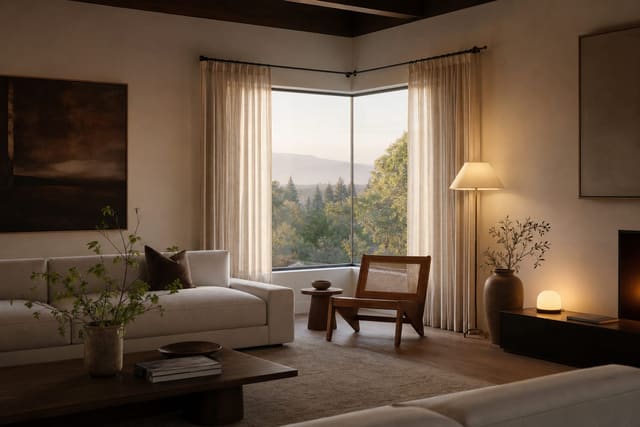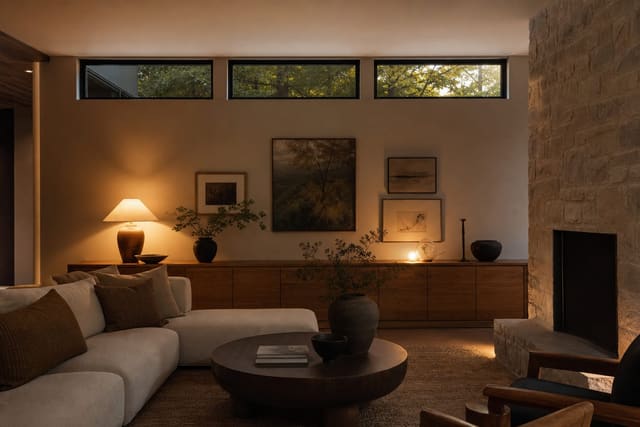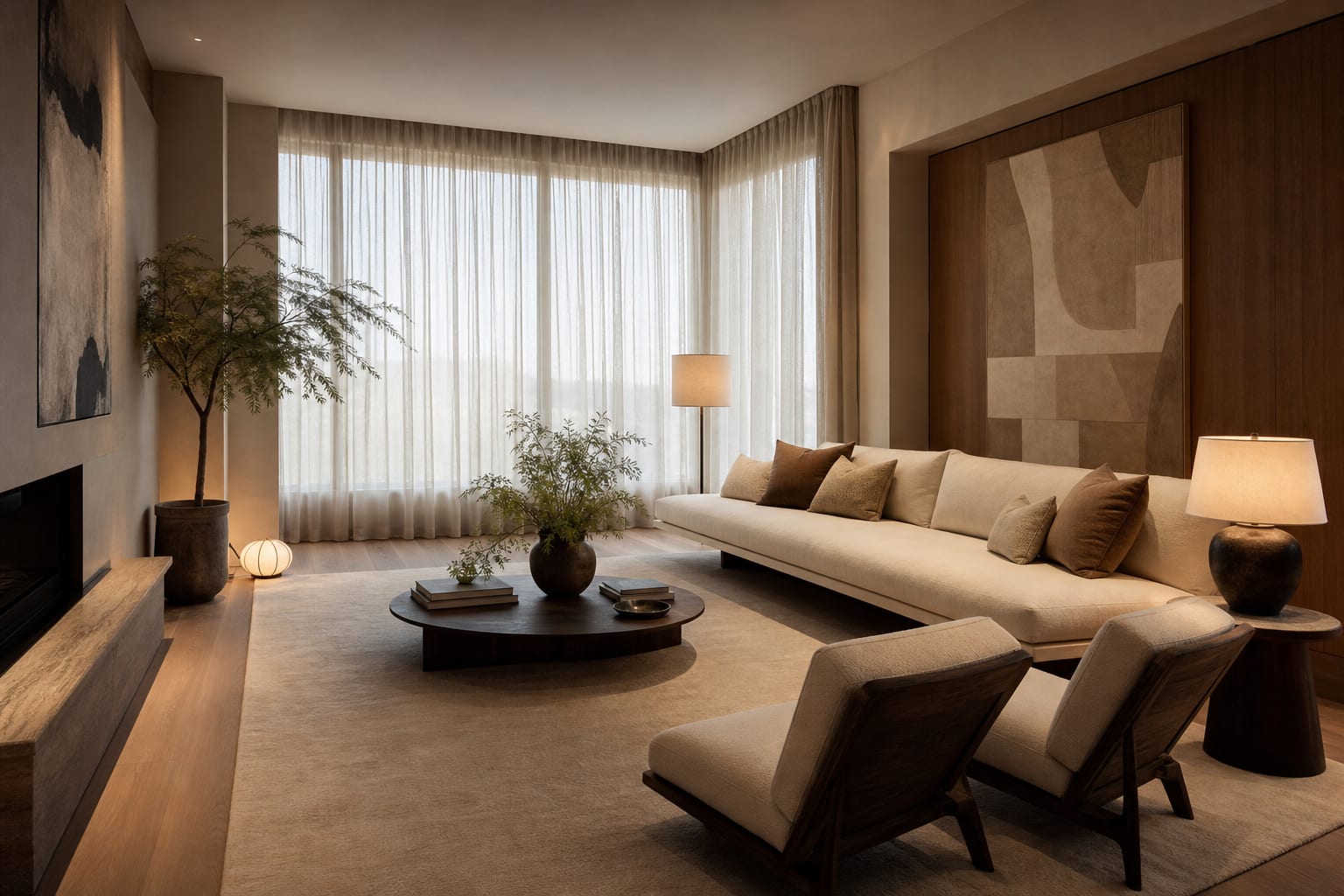
Arrange furniture in a room with windows on two adjacent walls by floating the main piece away from the glass, keeping window-side pieces low, holding 30-36 inches for traffic, and giving the bright corner one clear job instead of treating it as dead space. The corner of glass should become the room's advantage, not the excuse for furniture jammed against the one blank wall.
How do you arrange furniture when two adjacent walls are windows?
Start with the largest piece and stop asking it to touch drywall. In a living room, face the sofa toward the room's real purpose: conversation, TV, fireplace, or a pair of chairs. A sofa can sit 12-18 inches from a window wall if the back looks tidy and the treatment still operates; add a 30-inch path if people walk behind it.
In a bedroom, the bed can sit between the two windows, under one of them, or on the opposite wall, but the headboard shouldn't barricade the best daylight. Choose a headboard lower than the sill, or an open metal, cane, or low upholstered profile near a window wall.
A rug becomes the substitute wall. An 8x10 rug can unify a sofa and two chairs; a 9x12 works in a larger room or when seating floats fully away from the perimeter. At least the front legs of major pieces should land on the rug, or the group looks like it drifted away from the windows by accident.
The corner decision that controls the whole room
The bright corner needs one job, not three. Decide whether it's for reading, plants, a small table, a desk, or negative space — assigning it multiple jobs makes the room look like it's apologizing to the windows.
- Reading corner: one chair with a back under 34 inches, a 16-20 inch side table, and a floor lamp outside the curtain stack. Angle the chair 15-30 degrees into the room, not straight at the glass.
- Plants: layer a 24-inch stand, a 36-inch tree, and a low planter instead of one tall plant that blocks both windows at once.
- Dining: a 36-inch round pedestal table beats a rectangle since chairs can pivot around the angled walking paths.
- Near a radiator or vent: leave 3-6 inches of breathing space and skip closed benches that trap warm air.
Window coverings decide how much furniture can live nearby. Inside-mount shades keep the glass wall slim; drapery needs stack space outside the casing or between the windows. If the two windows meet tightly, review corner window treatment options before buying panels — fabric that collides in the corner undoes a good layout.
Test this on your own room photo with ReDesign before committing; keep the doorway, windows, main furniture, and fixed features visible so the preview solves the room you actually have.
Which furniture pieces work when the best walls are glass?
Two window walls expose backs, sides, and shadows, so bulky pieces with raw backs or tall profiles get noticed fast. Pieces that float well or stay low let the windows remain the architecture.
| Piece | Sizing/placement | Why it works |
|---|---|---|
| Floating sofa | Clean back, console behind 10-14" deep if space allows | Claims the rug zone without blocking glass |
| Low lounge chairs | 28-32" wide, angled toward each other or a table | Avoids sealing off the glass corner like a sectional would |
| Window bench | 16-18" seat height, 15-18" deep | Shallow enough to stay functional, not a dumping ledge |
| Desk | 20-24" deep surface, 30" clearance behind | Set perpendicular to a window wall to cut screen glare |
| Low storage | 60" console, 48" sideboard, or 30" bookcases under sills | Anchors the eye without crowding the windows |
If the room feels dim despite all the glass, use strategies for faking natural light on the darker interior corners instead of crowding the windows further. Bay windows follow similar logic but sharper geometry — compare bay window furniture arrangement before choosing between a bench, table, or chair pair.
What mistakes ruin furniture arrangement on two window walls?
- Saving the blank wall for the wrong piece. The sofa, bed, or desk often lands on the only solid wall by default, leaving the room's best light behind it with no center. Let the blank wall hold art or storage instead.
- Blocking the windows halfway. A tall chair back, oversized headboard, or deep cabinet across the lower glass reads as chopped. Keep window-adjacent pieces below the sill or on open legs.
- Ignoring curtain operation. Mark the curtain stack, shade drop, and any crank handle before buying furniture, and leave hand space beside the frame for casement windows.
- Treating the corner as storage overflow. Baskets, bins, and extra chairs turn a bright corner into visual noise — pick one use and store the rest elsewhere.
- Relying on daylight alone at night. Add a floor lamp near the floating sofa or a table lamp on the window-side table. Warm bulbs around 2700-3000K keep evening light comfortable instead of turning the glass into black mirrors.
How can AI design test the window-wall layout before you commit?
Upload a photo from the room entry, one facing the window corner, and one from the opposite wall so the preview understands the blank wall, the glass walls, and the walking paths together. Ask for a version with a floating sofa, two low swivel chairs, an 8x10 rug, and a reading chair in the bright corner, then a second with the sofa on the solid wall and a low console under the windows. Keep window positions and floor color consistent so the comparison tests the arrangement, not a different room.
Check each preview with practical suspicion: Does the sofa back look finished from the entry? Do curtains still have stack room? Is there 30 inches for the actual walking path? AI can't verify radiator clearance, drapery hardware, or laptop glare, but it can show which composition suits the room before you order a sectional or headboard. After choosing a direction, tape the sofa depth, rug edge, and curtain stack on the floor, then walk the path and check the layout at night with lamps on.
Frequently Asked Questions
Where should the sofa go in a corner-windowed room?
Float the sofa parallel to one window wall with one short side toward the corner. Pushing it into the corner blocks light from two windows and creates a dead zone in the room's brightest spot.
Can the corner stay empty?
No. A corner with two windows becomes the visual center of the room, so place one anchor piece there — a tall plant, floor lamp, accent chair, or sculpture — so the eye reads it as designed rather than skipped.
Should both windows match treatments?
Yes. Matching shade type or curtain fabric on both windows reads as intentional, while mixing a shade on one and curtains on the other usually reads as disconnected or unfinished.
How do I keep light in a corner-windowed room?
Use inside-mount cellular or roller shades on both windows to control glare without covering the corner glass. Floor-length curtains on both walls also work but stack heavier in the corner than shades do.
Does AI preview the layout?
Yes. Upload the corner-window room photo and AI previews sofa orientation, corner anchor choice, and treatment options before you buy anything.
> Try this: Ready to see this on your own room? Open ReDesign and run the preview.
Three transformations to try
1. Floating sofa parallel to one window wall 2. Tall plant anchor in window corner 3. Matched shades on both windows