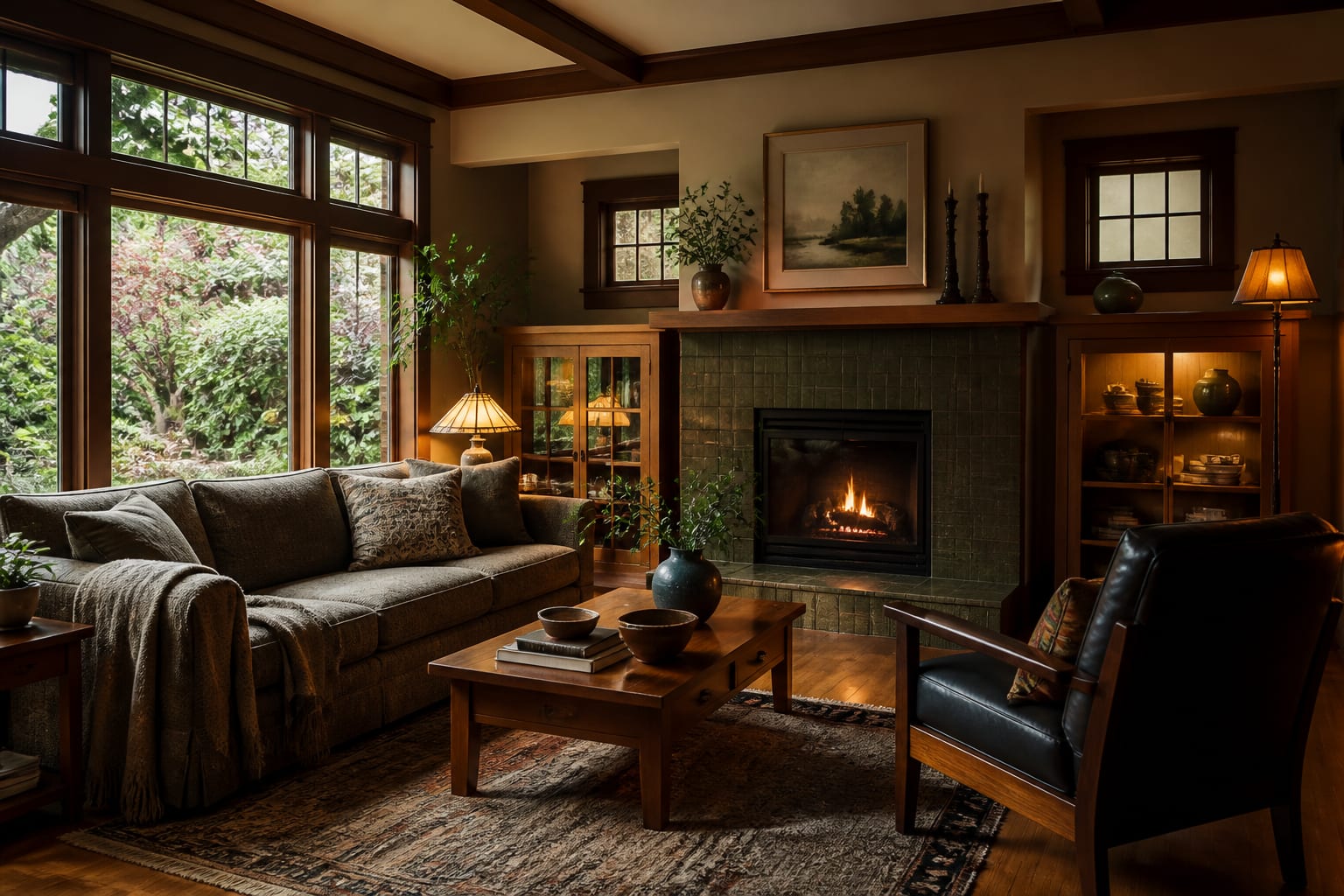
Craftsman interiors are built on one belief: show the handwork and let honest materials carry the room. Growing out of the Arts and Crafts movement and popular in American bungalows from roughly 1905 to 1930, the style pushed back against mass-produced Victorian fussiness with exposed joinery, sturdy built-ins, and natural finishes. My read is that the heart of a Craftsman room is wood you can read, grain, joints, and all, rather than paint hiding the structure.
The architecture leads here more than in almost any style. Low ceilings around 8 to 9 feet, deep window and door casings, box-beam ceilings, and built-in cabinetry are baked into the house. The design job is to honor that woodwork and surround it with the earthy, handmade textures that make a bungalow feel grounded.
Keep the woodwork honest and exposed
The first rule of a Craftsman interior is to let the wood be wood. The style prizes quartersawn white oak for its dramatic ray-fleck grain, finished with a warm stain rather than paint so the structure stays visible. Box-beam ceilings, picture rails, wainscoting, and wide door casings are not decoration laid over the house; they are the house showing its bones. Painting that joinery white, as tempting as it is in a dark bungalow, erases the entire point of the style.
Casing profiles are simpler and bolder than in older styles. Where Victorian and Edwardian trim layered curves, Craftsman casings run wide and flat, often 4 to 5 inches with a clean square-cut headpiece that sits proud of the side casings. If you are replacing trim, that flat, substantial profile is what reads as authentic. The same goes for doors: five-panel or single-panel doors with strong horizontal lines, not fussy raised paneling.
If your bungalow runs dark, and many do under an 8 to 9 foot ceiling, resist the urge to paint your way to brightness. Lighter walls and warm layered lighting do the job while keeping the wood intact. The mood-lifting accent ideas in my dopamine decor ideas guide can add cheer through textiles and pottery without sacrificing the honest joinery underneath.
Build around the built-ins
No style depends on built-in furniture the way Craftsman does. Bungalows were designed with bookcases flanking the fireplace, a window seat under the front bay, a built-in buffet in the dining room, and sometimes a cozy inglenook around the hearth. These are the soul of the house. Restore and use them rather than blocking them with freestanding furniture that competes for the same wall.
The fireplace is usually the anchor, often faced in art tile or brick with a sturdy wood mantel and flanking bookcases. Keep that zone uncluttered so the joinery reads clearly. When you do add freestanding pieces, choose Mission-style furniture: straight lines, exposed mortise-and-tenon joints, and the same warm oak as the trim. The point is continuity between the built-in and the movable.
A few details that make a Craftsman room read as genuinely handmade:
- Hammered copper or wrought-iron hardware on doors, cabinets, and lighting.
- Mica-shade table lamps and lantern pendants that throw a warm amber glow.
- Handmade art tile, often matte and earth-toned, on the fireplace surround or a backsplash.
- Stained-glass or leaded-glass accents in cabinet doors and high windows.
Set the earthy palette and natural textures
Craftsman color comes straight from nature. Think ochre, mustard, moss and olive greens, terracotta, rust, and the warm browns of the wood itself, a palette deliberately set against the pale, delicate schemes of the era's other styles. Walls often took a deeper, warmer tone than we are used to today precisely because the wood was so dominant; a soft olive or a warm clay grounds the room and lets the oak glow.
Texture does the rest of the work. Hand-knotted rugs with stylized natural motifs, linen and wool upholstery in solid earthy tones, and pottery with matte glazes all reinforce the handmade ethic. Avoid anything that looks slick or mass-produced; the whole movement was a reaction against that. The way I warm a hard, plain shell with tactile layers in my soft industrial style ideas guide maps closely onto bringing softness into a wood-heavy bungalow.
Lighting should stay warm and low. Mica and amber-glass fixtures around 2700K keep the wood looking rich rather than orange, and a few well-placed table lamps beat one bright ceiling fixture every time in a room built around a ceiling near 96 inches. Hang a lantern pendant about 60 to 66 inches off the floor over a table so the light feels intimate rather than institutional. Keep bulb brightness modest, in the 450 to 800 lumens range per fixture, and let several warm pools overlap instead of blasting the room with one cold source that washes the grain flat.
Common mistakes to avoid
The most common mistake is painting the original woodwork to brighten a dark bungalow, which destroys the honest-material principle the entire style rests on. Keep the wood stained and add light other ways.
A second frequent mistake is removing or ignoring the built-ins, then crowding the same walls with freestanding furniture; restore the bookcases, buffet, and window seat and let them lead. A third is installing thin, fussy modern trim that contradicts the wide, flat 4 to 5 inch Craftsman casing. People also reach for a cool, pale, contemporary palette that fights the warm earth tones the style was built on. The last common mistake is filling the room with slick, mass-produced pieces, which betrays the Arts and Crafts reaction against exactly that kind of machine fuss; choose handwork wherever you can.
Use AI design to test a Craftsman scheme before you commit
The genuine difficulty with a Craftsman home is deciding how dark to go: a warm olive wall might make the oak glow or might tip the whole bungalow into a cave. Re-Design lets you find out first. Upload a photo of your actual Craftsman room, built-ins, box beams, and stained trim in frame, and the AI design re-renders it with earthy walls, Mission furniture, and warm lighting so you can judge the look against your own woodwork.
Because you upload your real space, the preview respects your existing oak tone, your ceiling height, and the light your bungalow windows actually let in. Test a moss-green scheme with copper accents, then try a warm clay tone with art tile, and see which one makes the joinery sing before you commit a single stain sample to the wall.