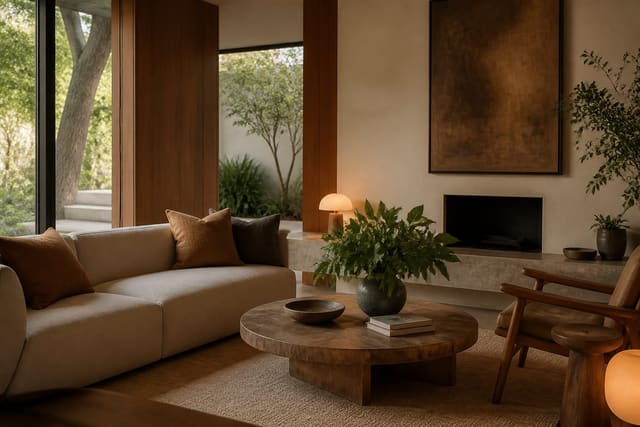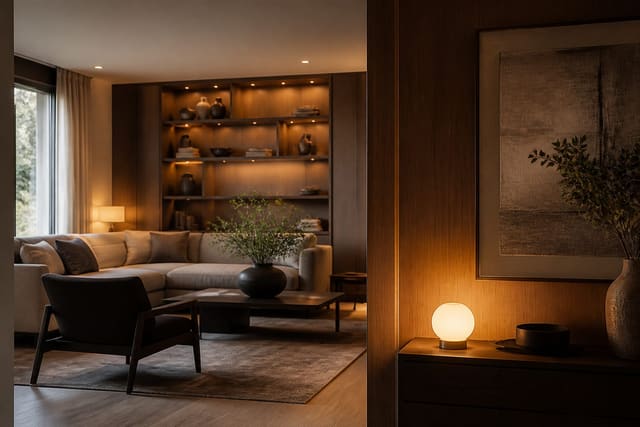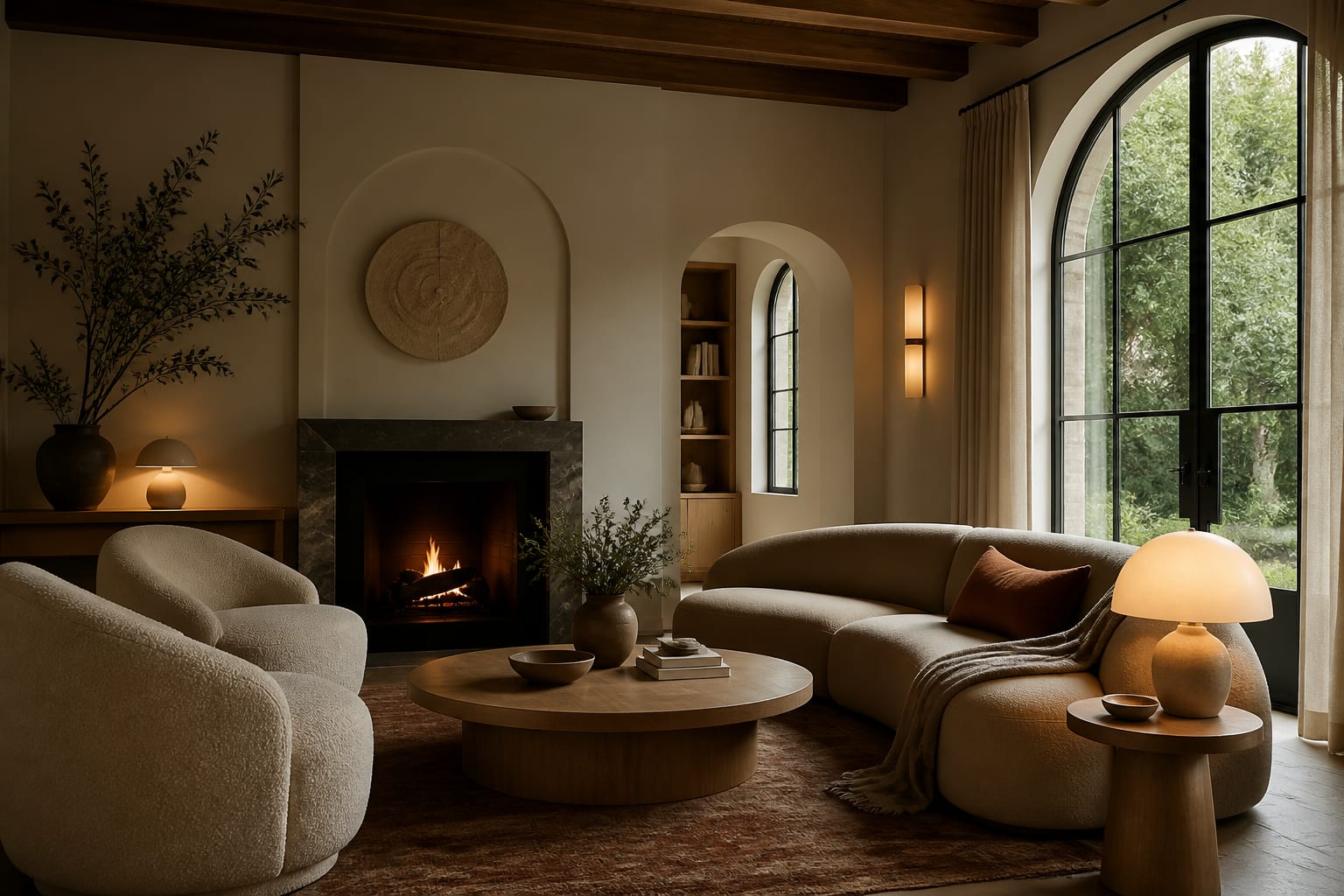
Straight lines are losing. The defining move of 2026 interiors is the soft profile: rounded sofa arms, arched cased openings, kidney-shaped coffee tables, and mirrors with no corner in sight. Round reads as modern now precisely because the boxy, hard-edged minimalism it replaced started to feel like a rented office.
Why curved and organic shapes are trending
Curved shapes are trending because they answer a fatigue that built up over years of hard-edged, rectilinear rooms. A space full of right angles feels efficient but tense; introduce a rounded sofa back or an arched doorway and the same room reads as calmer and more forgiving. Our eyes track a curve more smoothly than a corner, so a curved room literally takes less visual effort to be in.
The trend goes by a few names, including biomorphic and organic modernism, but the principle is consistent: forms borrowed from nature, where almost nothing is perfectly straight. A kidney-shaped coffee table around 48 inches long, a barrel chair with a continuous curved back, and a wavy-edged mirror all reference the same idea. They also solve a practical problem, since rounded corners are safer in homes with small children, eliminating the shin-and-hip bruises that square coffee tables guarantee.
Curves change circulation, too. A rounded sectional pulls people into a defined conversation pocket, while a straight sofa pushed against a wall pushes everyone apart. Designers lean on this in open-plan spaces, where a single 96-inch curved sofa can carve a living zone out of a great room without a single wall. The shape does the room-dividing that architecture used to.
The trend also rides a wave of new manufacturing. Foam and frame technology that used to make a tight radius prohibitively expensive has gotten cheaper, so a rounded sofa that cost a custom premium five years ago now shows up at mainstream price points around $1,800 to $3,500. That accessibility is a big reason curves moved from designer showrooms into ordinary living rooms this fast. Arched millwork follows the same logic: a pre-formed arched cased opening kit runs $200 to $500 and turns a plain doorway into a soft architectural moment over a weekend.
How to bring curves into a room without overdoing it
- Choose one curved hero per room, such as a 90-inch rounded sofa or a barrel chair, before adding smaller round notes.
- Add an arched detail in the architecture, whether a cased opening with a 12-inch radius or an arched alcove for shelving.
- Layer in a kidney or oval coffee table around 48 inches, keeping at least 16 inches of clearance to the seating.
- Round off lighting with a globe pendant or a fluted, cylindrical lamp base to echo the curves overhead.
- Use a round or oval rug under a curved seating group so the floor plane agrees with the furniture.
- Soften the walls with an arched mirror, 40 to 60 inches tall, to bounce light and repeat the motif.
The restraint matters because a room of nothing but curves tips into a cartoon. Two or three deliberate curved gestures against a backdrop of calmer rectilinear pieces is the ratio that reads as designed. Think of curves as the punctuation, not the whole sentence; one strong arch and one rounded sofa say more than ten wavy objects competing.
Material choice keeps a curve from reading as cheap. A continuous radius shows every flaw, so a rounded piece in a tight-grained walnut, a boucle with no visible seams, or a solid-plaster arch looks intentional, while the same form in glossy molded plastic skews toy-like. The eye forgives a square object in a budget material far more readily than it forgives a curved one, which is why spending the money on the single curved hero, rather than spreading it across several, almost always produces the better room.
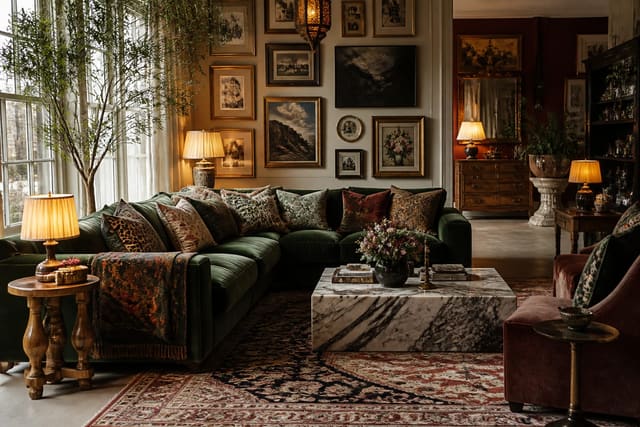
Curves also carry an emotional payload that connects to bigger 2026 themes. The soft, womb-like quality of a rounded room overlaps with the restorative aims of wellness-focused interiors, where reducing visual sharpness is treated as a way to lower ambient stress. And in a loud, pattern-rich space, a curve gives the eye relief, which is why the maximalism revival of 2026 so often pairs a busy palette with one big, calming curved sofa.
The smallest way to test the trend is at the object scale before the furniture scale. Swap a square mirror for an arched one, trade a rectangular tray for an oval one, or add a fluted, cylindrical lamp base, and watch how a single soft form changes the temperature of a corner. These moves cost under $150 each and tell you quickly whether you want to commit to a larger curved piece. Buying down from a big rounded sofa is expensive to undo; building up from a few curved accents is nearly free to reverse.
Common mistakes to avoid
The first mistake is going all-in on curves and ending up with a playroom. When the sofa, table, rug, mirror, and lamp all curve, the room loses tension and reads as juvenile. Keep a few straight lines, including the architecture and at least one rectilinear piece, as a foil.
The second mistake is buying a curved sofa that is too small for its job. A 72-inch curved loveseat looks lost in a 16-foot great room and fails to define the zone; the curve only works at scale, generally 90 inches or more in open plans. The third error is poor clearance, since curved pieces eat floor space differently than boxes. Leave at least 30 inches of walkway around a rounded sofa so the bulge does not pinch a path.
A fourth mistake is forgetting that curves are hard to upholster and reupholster, so a cheap curved sofa often shows pulling and pilling within a year. Spend on the one curved hero and economize elsewhere. Finally, do not let curves clash with overtly techy hardware; a sleek rounded room undercut by a boxy wall tablet feels off, which is part of why the hide-the-tech approach to smart homes suits organic interiors so well.
Preview curved furniture in Re-Design
Frequently Asked Questions
Why are curved shapes trending in interior design? Curved and organic shapes are trending because they soften the hard-edged, right-angle rooms that dominated the last decade and read as calmer and more natural. The eye tracks a curve more easily than a corner, so curved rooms feel more relaxed. They also guide foot traffic and define zones better than straight furniture.
How many curved pieces should one room have? Two or three deliberate curved gestures is the sweet spot. One rounded sofa, one arched detail, and an oval table read as intentional, while curving every object tips the room into looking like a playroom. Keep some straight lines as a foil.
Are curved sofas practical for small rooms? They can be, but scale is critical. A curved piece needs to be large enough to define a zone, usually 90 inches or more in open plans, and it requires generous clearance, so a tight room may do better with one barrel chair instead. Measure walkways before committing.