Minimalism ran out of road. After more than a decade of greige walls and empty surfaces, 2026 belongs to rooms that are full, layered, and unapologetically personal. Maximalism is not clutter; it is editing in reverse, where you keep adding until the room finally feels like someone lives a vivid life inside it.
Why maximalism is trending in interior design
Maximalism is trending because the pendulum swung as far toward emptiness as it could go, and people noticed their homes felt like waiting rooms. Saturated walls, layered textiles, and shelves crowded with real objects read as warm and lived-in, which is exactly what a screen-saturated life makes us crave at home. The revival is also practical: a maximalist room hides wear, tolerates a stray toy or stack of books, and forgives the imperfection that minimalism punishes.
The color story is the clearest signal. Where minimalism leaned on white and warm gray, 2026 maximalism reaches for oxblood, forest green, mustard, and deep teal, often two or three in the same room. These are not accent-wall colors; they are full-room commitments, ceiling included. A dining room wrapped in a single deep green from baseboard to ceiling costs about $250 in paint for a 12-by-14-foot space and instantly does more than any furniture swap.
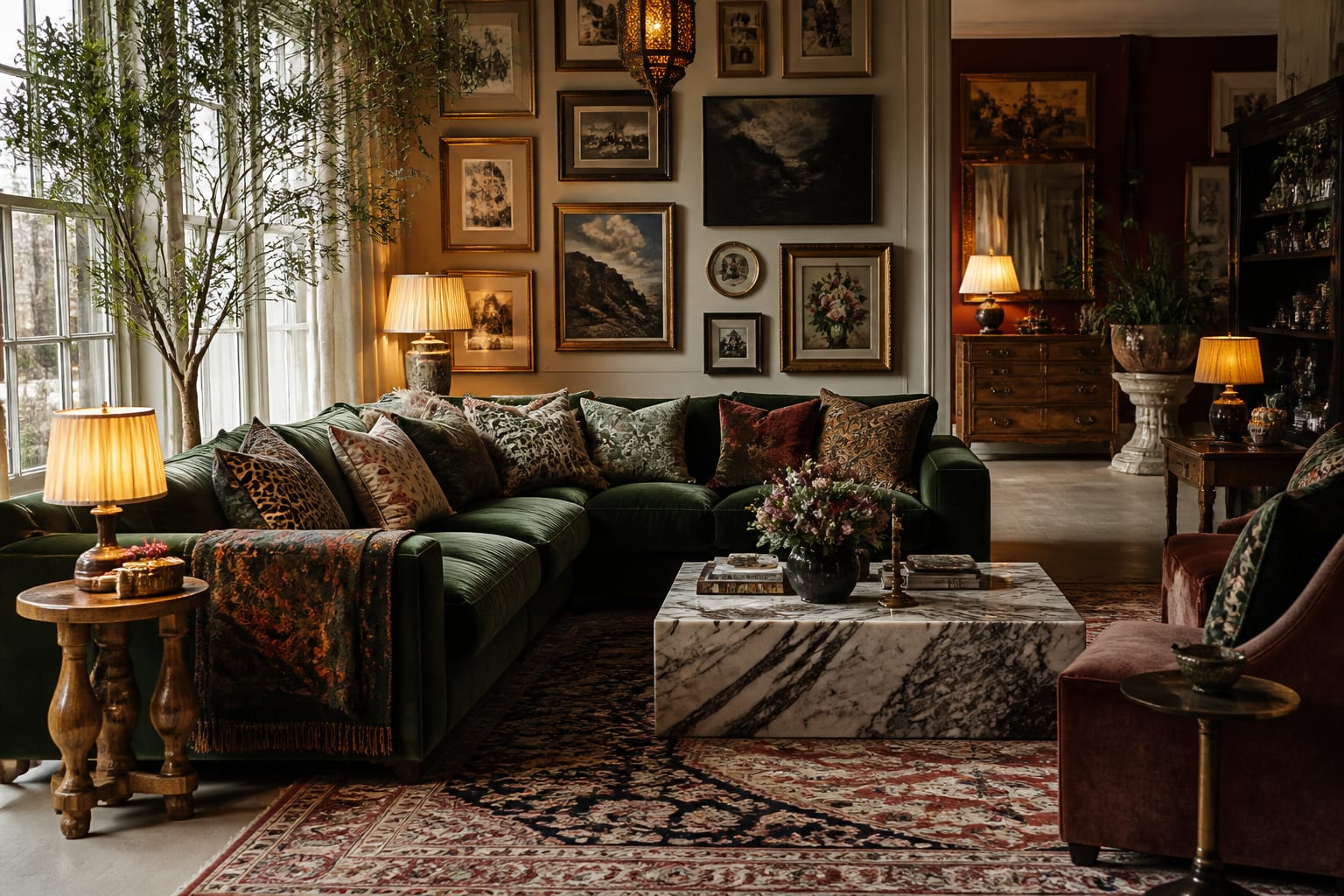
Pattern is the second engine. The current revival mixes scales deliberately: a large floral, a medium stripe, and a small geometric in a roughly 60/30/10 split so no two patterns fight at the same volume. This is why a maximalist room can hold a chintz sofa, a striped cushion, and a checkerboard rug without descending into noise. The discipline is in the ratio, not in restraint.
There is also a generational signal worth naming. Younger buyers who grew up scrolling past identical minimalist feeds now treat a personal, idiosyncratic room as the actual flex, and secondhand and vintage shopping makes that look affordable. A maximalist scheme rewards the chipped inherited lamp, the souvenir textile, and the slightly odd flea-market chair in a way a matched showroom set never could. The trend is partly an economic argument: collected beats new, and patina beats polish.
How to build a maximalist room without it reading as clutter
- Pick a 3-color palette and repeat each color in at least three places, so a mustard appears in a lamp, a spine of books, and a throw.
- Mix pattern across three scales using the 60/30/10 rule, anchoring with the largest pattern on the biggest surface.
- Layer two rugs, with a flat-weave base around 8-by-10 feet and a smaller patterned rug angled on top.
- Build a gallery wall with frames hung 2 to 3 inches apart, treating the cluster as one rectangle, not scattered dots.
- Crowd shelves to about 80 percent full, leaving 20 percent breathing room so the abundance reads as curated.
- Add one oversized object per room, such as a 6-foot palm or a 40-inch mirror, to keep the scale from feeling fussy.
The ratio thinking matters because maximalism fails when everything competes at full volume. A room needs a hierarchy: one hero, a few supporting players, and a chorus of small repeated notes. When the 60/30/10 logic holds, even a wildly busy room feels composed, and a guest's eye knows where to land first.
Texture carries as much weight as color and pattern in this look. A successful maximalist room layers velvet against rattan, lacquer against linen, and matte ceramic against polished brass, so that even a tonal corner stays interesting up close. Aim for at least four distinct textures in any seating group; the contrast is what keeps a saturated room from flattening into a single mood. Books, in particular, do enormous work here, since a wall of mismatched spines adds color, pattern, and the unmistakable signal that a real person lives with this stuff.
Maximalism also pairs surprisingly well with technology, since a busy room camouflages hardware that a stark room would expose. The same logic behind keeping smart devices visually quiet works in reverse here: a speaker grille or thermostat vanishes against a patterned wall. And because maximalism prizes personality and comfort over sterile order, it shares DNA with the restorative goals of wellness-driven interiors, where a room that feels like you lowers stress more than one that merely looks tidy.
Start small if the whole look feels intimidating. A single room, often a dining room or a powder room, makes the perfect testing ground because it is contained and you do not live in it all day. Paint it a saturated color, hang a dense gallery wall, and add one bold patterned textile, then live with it for a month. Most people find the courage to extend the approach once they see how forgiving and warm a fully committed room actually feels, and how much less precious it is to keep tidy than a minimalist space that punishes a single stray object.
Common mistakes to avoid
The most common mistake is confusing maximalism with accumulation. Buying more stuff without a repeating palette produces clutter, not maximalism; the fix is the 3-color rule applied ruthlessly before anything new enters the room. The second error is mixing too many patterns at the same scale, so three medium florals cancel each other out. Stagger the scales instead.
A third mistake is leaving the architecture neutral while the contents go loud, which makes the room feel like objects floating in a white box. Commit the walls, the trim, or the ceiling to color so the shell participates. The fourth is forgetting negative space entirely; even a maximalist room needs a few calm surfaces, roughly 20 percent of any shelf or wall, so the eye can rest.
The last mistake is ignoring lighting. A saturated, pattern-heavy room swallows light, so a single overhead fixture leaves it gloomy. Add at least three light sources per room, including a 2700K table lamp and a floor lamp, to keep the depth from turning into murk. Curves help too; the soft profiles in the curved and organic shapes trend round off a busy room and give the eye a place to breathe.
Preview a maximalist makeover in Re-Design
Frequently Asked Questions
Why is maximalism trending in interior design? Maximalism is back because a decade of minimalism left rooms feeling cold and impersonal, and saturated, layered spaces read as warm and human by contrast. It also forgives daily life: a busy room hides wear and clutter that a stark one exposes. The trend rewards personality over showroom perfection.
How do I do maximalism without it looking messy? Work from a 3-color palette repeated across at least three objects each, mix patterns in a 60/30/10 ratio across scales, and keep about 20 percent of every surface clear. The discipline lives in the ratios, not in restraint. A clear color hierarchy turns abundance into composition.
Is maximalism expensive? Not necessarily. A convincing start can run under $600 using paint, textiles, and objects you already own, since the look rewards collected and layered items over new matched sets. Color on the walls delivers the biggest change per dollar.