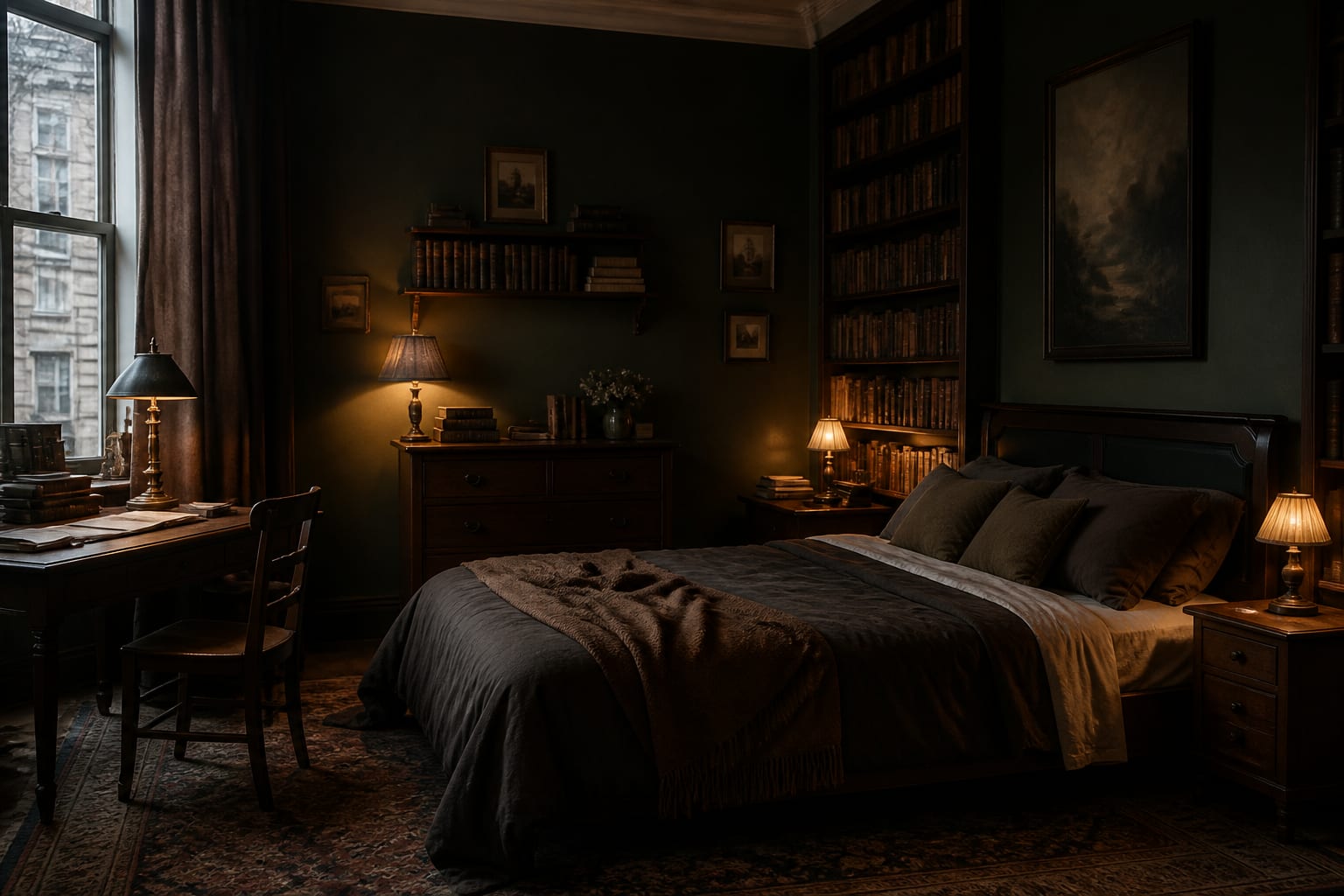
Dark academia bedrooms work best when you treat the room like a private library rather than a showroom. The aesthetic rewards depth and restraint, so commit to one moody base color and let aged wood, leather, and stacked books carry the mood. I prefer this style for bedrooms because low light and heavy texture genuinely help you wind down. These dark academia bedroom ideas lean on antique forms, candle-warm bulbs, and personal collections, giving you a space that feels studied, lived-in, and quietly dramatic without tipping into costume-set territory.
Choose a Moody Base Palette With Conviction
The dark academia bedroom lives or dies on its base color, so pick one rich tone and surround yourself with it rather than scattering accents across pale walls. Deep forest green, oxblood, charcoal, and inky navy all read as scholarly without feeling cold, and they make antique wood glow against them. I recommend painting all four walls plus the ceiling in your chosen shade when the room gets decent daylight, because a fully wrapped color cocoons you and erases the boxy edges that make small bedrooms feel sterile. For darker rooms, keep the walls deep but lighten the trim a half-step so the architecture still reads. Avoid pure black, which flattens texture and kills the candlelit warmth this aesthetic depends on. Matte and eggshell finishes suit the mood far better than gloss, since they absorb light and emphasize the velvety quality that makes dark academia feel like an old reading room. Bring the palette onto soft goods too: a tobacco linen duvet, a moss wool throw, and curtains just off the wall color build the layered, faded look. Think of the palette as the binding of a leather book, with everything else acting as the gilt lettering. When the base color is confident, even budget furniture and thrifted frames suddenly look intentional, because the eye reads the whole room as one deliberate, atmospheric composition rather than a collection of separate purchases competing for attention. Test your shortlisted shade at the darkest hour you actually use the room, since a green that sings at noon can turn muddy under a single bedside lamp. Paint a large sample on two walls and live with it for a few days, because deep colors shift with orientation. That patience pays off when the finished room wraps you in the hush you imagined.
See also our guide to Small Master Bedroom Luxurious for more on dark academia bedroom ideas.
Furnish With Aged Wood and Patina
Furniture is where the dark academia bedroom earns its scholarly credibility, so prioritize aged wood, turned legs, and pieces that look inherited rather than ordered last week. A dark-stained oak or walnut bed frame, ideally with a tall paneled or spindle headboard, sets the period tone and gives the room a vertical anchor. Flank it with mismatched nightstands instead of a matching pair, because slight asymmetry reads as a collection assembled over years, which is exactly the lived-in feeling this aesthetic chases. Hunt estate sales for a leather club chair, a campaign desk, or a glass-front cabinet, and resist refinishing away every scratch since patina is the point. Brass hardware, even swapped onto plain dressers, pushes a piece toward the antique end. Layer in a worn Persian or kilim rug to soften the floor and add the faded color these rooms love. Keep upholstery in cognac leather, deep velvet, or heavy linen, materials that age gracefully and catch warm light. If your budget is tight, a single statement antique, such as a carved armoire or a roll-arm chair, can do more work than a roomful of new reproductions. The trick is restraint with quantity and generosity with character: fewer pieces, each with weight and history, will always feel more genuinely scholarly than a crowded room of glossy modern furniture trying to play dress-up in moody paint. Watch the scale of each find, because a hulking armoire can swallow a small bedroom while a delicate writing desk anchors a corner without crowding the bed. When you do buy new, choose solid-wood frames over veneer and matte finishes over shine, since both age into the look. A little wax on tired wood revives the patina you want and ties mismatched pieces into one quietly collected room.
For a related angle on dark academia bedroom ideas, read Reading Corner Kids.
Build Layered, Candle-Warm Lighting
Lighting separates a convincing dark academia bedroom from one that merely looks dark, so abandon the single overhead fixture and build several pools of warm, low light instead. Use bulbs in the 2200 to 2700 Kelvin range, which throw the amber, candle-like glow this aesthetic depends on, and put them on dimmers so you can drop the whole room to a study-late softness after dark. A brass desk lamp with a green glass shade is the genre's signature piece, casting focused light over a reading corner while leaving the rest in shadow. Add a floor lamp beside the club chair, a picture light over a framed print, and a few candles on the dresser to scatter flicker across the walls. Wall sconces flanking the bed free up nightstand space and reinforce the old-library feel. Avoid cool white and bright daylight bulbs, since they wash out the deep palette and make wood read orange and cheap. The goal is contrast: bright enough to read where you sit, dim everywhere else, so the room has depth rather than flat illumination. String a few warm fairy lights along a bookshelf if you want a subtle glow without another lamp. When the lighting is layered and warm, even an empty wall feels atmospheric, and the whole bedroom takes on the hushed, contemplative quality that makes dark academia so restful. Position one lamp low, near the headboard, so light spills upward across the wall and casts long, soft shadows instead of glaring down. Keep any overhead fixture on its own dimmer and treat it as a cleaning light. If you read in bed, aim a clip lamp at the page so the rest of the room stays dim. That imbalance, bright where you need it and shadowed elsewhere, gives the room its depth.
Style With Books, Art, and Curios
Styling is the final layer that makes a dark academia bedroom feel personal rather than staged, and it rests almost entirely on books, framed art, and small curiosities you actually care about. Stack real hardbacks on the nightstand, lay a few flat under a lamp, and fill any shelf with spines turned outward so the worn leather and faded cloth become part of the texture. Frame botanical prints, old maps, anatomical sketches, or moody oil-painting reproductions in dark or brass frames, then hang them in a tight gallery cluster above the desk or bed rather than spacing them thinly. Mix in antique objects that suggest a curious mind: a globe, a brass telescope, pressed flowers under glass, or a tray of fountain pens. Greenery grounds the heaviness, so add trailing ivy or a fern in an aged terracotta pot to soften the dark surfaces with living color. Keep the surfaces slightly full but composed, because a touch of controlled clutter reads as scholarly accumulation while true mess just looks unfinished. Layer textiles too, draping a wool throw over the chair and stacking a couple of velvet cushions on the bed. The aim is to make the room look like it belongs to a reader who has been collecting for decades, where every object has a reason to be there and the overall effect is intimate, intellectual, and unmistakably yours. Rotate the styling seasonally so the room never freezes into a static display, swapping in fresh stems, current reading, or a different framed print. Edit ruthlessly when a surface feels busy rather than rich, removing anything that does not earn its place. The best dark academia bedrooms reveal details slowly, rewarding a second look, so build the styling as a story about you rather than a one-time photo opportunity.
- Paint walls and ceiling deep forest green for a full cocoon effect.
- Hunt secondhand for a carved oak headboard with real patina.
- Swap plain dresser pulls for aged brass to age the piece instantly.
- Cluster botanical and map prints tightly in dark frames above the bed.
- Set a brass lamp with a green glass shade on the desk.
- Drape a worn kilim rug to soften floors with faded color.
- Stack real leather-bound books on nightstands and any open shelving.
Bring the look home with Re-Design
Want to see these dark academia bedroom ideas on your own four walls before committing to paint? Open Re-Design and upload a clear photo of your bedroom, then preview deep green or oxblood walls, antique wood furniture, and warm candle-style lighting in seconds. Test a fully wrapped color against your existing window light, swap a modern bed for a paneled headboard, and judge whether a moody palette reads cozy or cramped in your specific room. It is the fastest way to commit to the look with confidence.
Frequently Asked Questions
What colors define a dark academia bedroom?
Deep forest green, oxblood, charcoal, and inky navy form the core palette. Pair these saturated bases with aged wood tones, cognac leather, and brass accents. Skip pure black, which flattens texture, and favor matte or eggshell finishes that absorb light and deepen the moody, scholarly atmosphere.
Can I do dark academia in a small bedroom?
Yes, and a small bedroom often suits it. Wrapping all walls and the ceiling in one deep color hides boxy edges and creates a cozy cocoon. Use warm dimmable bulbs, one statement antique, and tightly clustered art so the compact space feels intimate rather than cluttered or cramped.
How do I get dark academia on a budget?
Lean on paint, secondhand finds, and books you already own. A single moody wall color transforms a room cheaply, thrifted frames and aged brass hardware add instant character, and stacked hardbacks supply free texture. One quality antique chair will outperform a whole set of new reproductions every time.