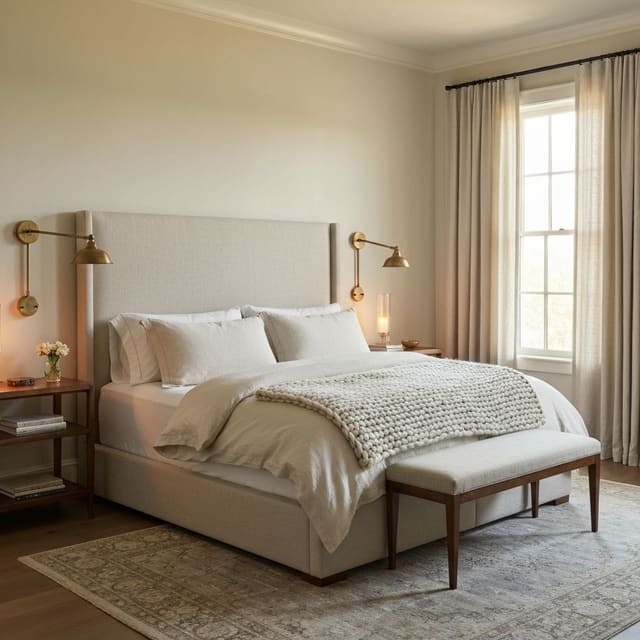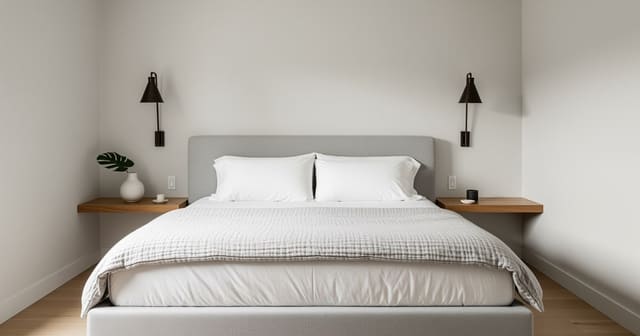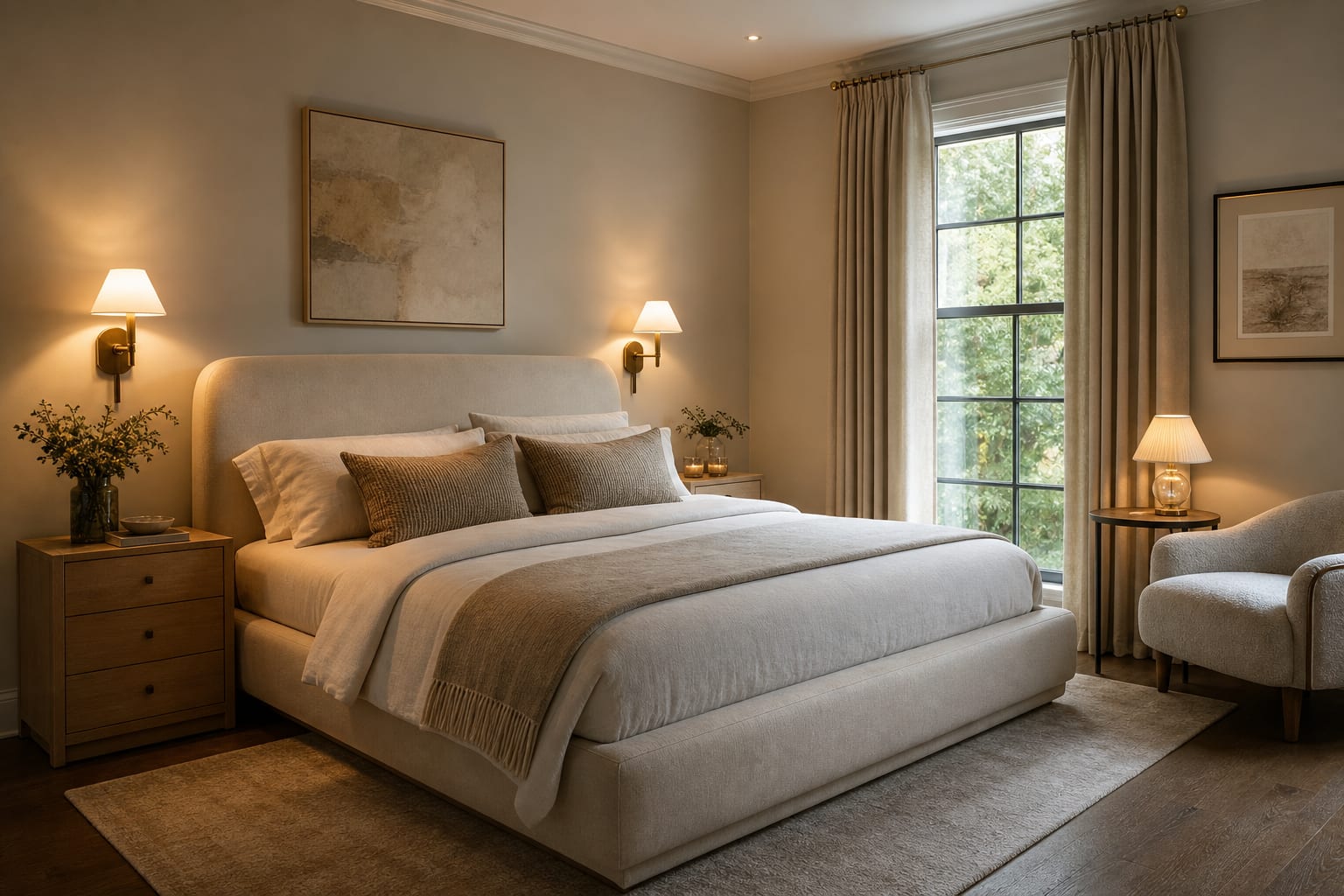
A small master bedroom feels luxurious when the bed wall is treated as the room's main scene: an oversized headboard scaled to the wall, two matching slim nightstands with dimmable lamps, one rug large enough to extend past the bedsides, and a single restrained palette across walls and bedding. Editing the floor plan matters more than adding decor.
What Makes a Small Master Bedroom Feel Luxurious?
A small master bedroom feels luxurious when the largest pieces look deliberate, the lighting flatters the bed, and every visible surface has room to look chosen rather than crowded. Luxury in a compact room is mostly restraint with better proportions — a king bed can work in a 10x12 room only if the frame is slim and the nightstands are narrow.
Protect the walking zone around the bed: aim for 24 inches on the side you use daily, and accept 18 inches only on the less-traveled side. On ceilings around 8 feet, keep the headboard 48 to 54 inches high; on 9-foot ceilings, a 60-inch headboard can look tailored, especially with sconces beside it. Hang drapery 6 to 10 inches above the window casing and let panels reach the floor.
One stone-topped nightstand, one linen shade, one upholstered bed, and one quiet rug beat five small decorative objects every time. If you want a seating moment, check clearances in a bedroom sitting area design before adding a chair that becomes a laundry dock.
How Do I Choose the Right Bed and Rug Size?
The bed is the room's traffic planner, not just its centerpiece. Choose the mattress, frame, headboard, nightstands, lamps, and rug as one composition rather than separate purchases.
| Bed Size | Mattress Dimensions | Recommended Rug | Headboard Height (8-ft ceiling) |
|---|---|---|---|
| Queen | 60 x 80 in | 8 x 10 ft | 48-54 in |
| King | 76 x 80 in | 9 x 12 ft | Up to 60 in (9-ft ceiling) |
In a room under 11 feet wide, a queen often gives the most luxurious result because the extra floor space can become symmetry or better lighting. If you choose a king, avoid sleigh frames, footboards, and wings that add 4 to 8 inches beyond the mattress on each side. If a full-size rug overwhelms the floor plan, run a 3 x 8-foot runner on each side instead of a small rug floating at the foot.
Nightstands should be 18 to 24 inches wide with tops within 2 to 4 inches of the mattress height. If space allows only 14 inches, use a floating shelf or wall-mounted nightstand instead. Mount bedside sconces so the shade center sits 54 to 60 inches from the floor, using warm bulbs around 2700K to 3000K on dimmers.
Test this on your own room photo with ReDesign before choosing a direction; keep the doorway, walls, windows, and main furniture visible so the preview solves the room you actually have.
Which Design Moves Actually Earn Their Space?
A move earns its place when it improves storage, softness, light, or circulation without asking the room for a favor it can't give.
- Bedding texture over pillow count. Use a fitted sheet, flat sheet, duvet, two sleeping pillows per person, and no more than three decorative pillows. Linen, percale, matelassé, bouclé, wool, and velvet all read luxurious when the palette stays disciplined.
- Storage in dead zones, not open floor. A 12 to 15-inch deep dresser can work better than a 20-inch piece when bed clearance is tight. Under-bed bins only help if they glide freely.
- One composed opposite wall. A low dresser, one large mirror, and one lamp feel calmer than a tall chest, TV, gallery wall, and hamper competing for attention.
If the bedroom doubles as a guest room or office, borrow planning logic from flex room spare bedroom ideas so the primary suite doesn't become the house's storage overflow.
What Mistakes Make a Small Master Bedroom Feel Cheap?
Buying a matching bedroom set is the most common mistake — a bulky bed, two heavy nightstands, tall chest, and mirror create a wall of furniture. Mix pieces with related finishes instead: one upholstered bed, one wood dresser, and metal or painted nightstands feel more collected than a full suite.
Dark paint used as a shortcut to drama without improving light is another trap. Deep blue, tobacco, or chocolate walls can work, but the room still needs lamps and a clean ceiling line — test the color beside your actual bedding first, especially in north-facing rooms.
Avoid overfilling the foot of the bed. A bench needs about 18 inches of depth plus walking room; if the bed already points toward a closet or door, a folded throw gives the same hotel signal without stealing floor space. Undersized art is another giveaway — choose one piece roughly half to two-thirds the width of the headboard, hung 6 to 10 inches above it.
Parents often let the primary bedroom collect kids' books and toys because it's the calmest room in the house. Give kids a dedicated cozy reading corner elsewhere instead, and keep the adult bedroom visually quiet.
Can AI Help Me Preview a Small Master Bedroom?
AI design helps because the expensive choices are visual before they're technical: bed scale, headboard height, wall color, rug size, and nightstand width. Photograph the bedroom from the doorway, each side of the bed, and the wall opposite the headboard, with lamps on and clutter removed.
Ask for specific comparisons — for example, a queen upholstered bed with oak nightstands and brass sconces versus a slim king with floating nightstands and a darker headboard wall. Keep the window, closet, and door positions consistent so the test reflects your real room instead of a fantasy version.
Check unglamorous details in the preview: Does the dresser still open fully? Does the rug clear the door swing? AI can't verify outlet locations or exact fabric color, but it can show which direction suits your room before you order furniture. After choosing a concept, tape the bed outline, nightstand widths, and rug corners on the floor, then walk the room at night to check the path to the bathroom.
Frequently Asked Questions
How do I make a small master bedroom feel luxurious?
Scale the headboard to fill the wall, run matching lamps and nightstands for symmetry, layer one large textured rug under the bed, and edit down to one dresser plus one chair. Luxury in tight spaces reads as restraint, not more furniture.
What headboard size works in a small master bedroom?
Use a 48 to 65-inch tall headboard at least as wide as the bed. In low-ceiling rooms, hang an upholstered panel directly on the wall behind the bed rather than mounting it to the frame to extend the visual height further.
What bedding setup makes a small master feel luxurious?
White or warm-tone cotton sheets, two euro shams plus two standard pillows, one textured throw at the footboard, and a duvet that hangs about 2 inches below the mattress. Bedding does most of the luxury work in a small room.
How do I add storage without bulk?
Use under-bed drawers, a low 30 to 36-inch dresser opposite the bed, and a slim hanging armoire in the closet for wardrobe overflow. Tall standing dressers in a small master compete with the bed for visual weight.
Should a small master bedroom have a TV?
If so, wall-mount it 40 to 48 inches center on the wall opposite the bed and skip the media cabinet. Floor-standing TV stands in small primary bedrooms always read as motel-style rather than luxurious.
> Try this: Ready to see this on your own room? Open ReDesign and run the preview.
Three transformations to try
1. Oversized headboard scaled to wall in small master 2. Layered rug pushing past slim bedsides 3. Wall-mounted TV opposite bed in small master