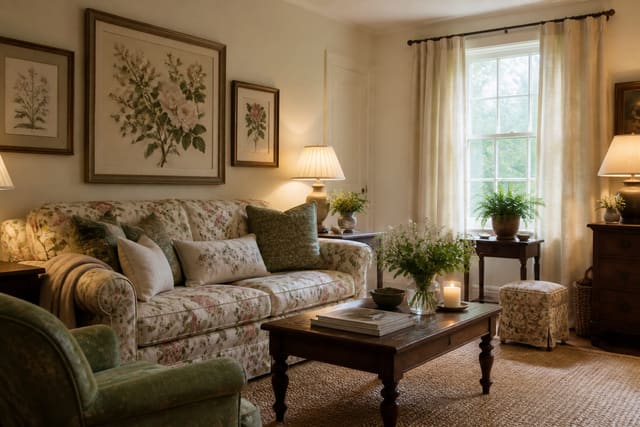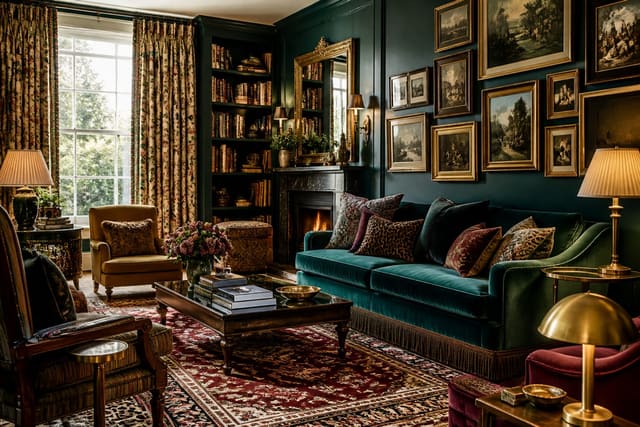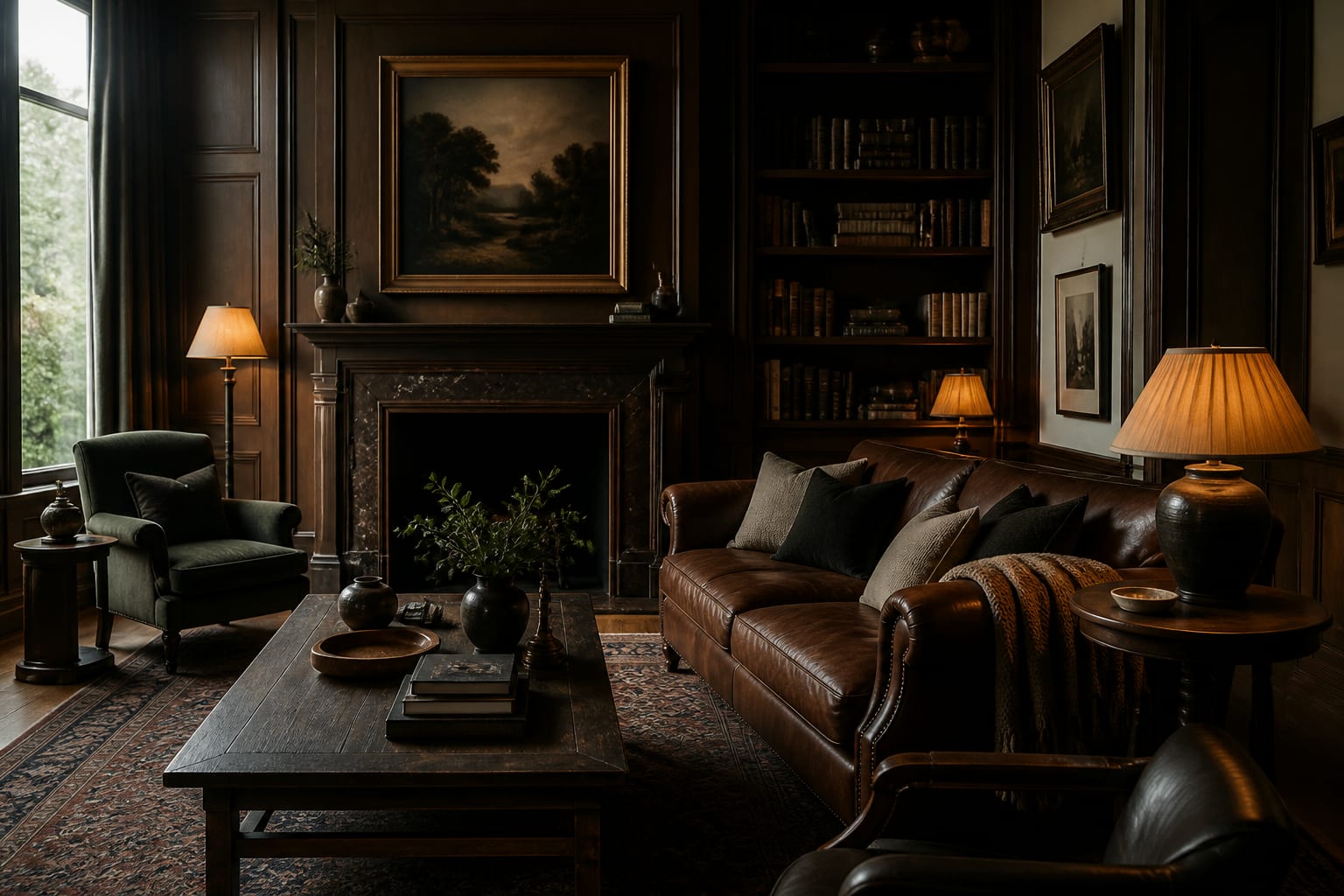
A dark academia living room should feel like a private members' club where you actually read the books on the shelves. The style thrives on gravity, so commit to deep walls, real wood, and worn leather rather than keeping things light and airy. I favor this look for living rooms because it makes conversation and slow evenings feel ceremonial. These dark academia living room ideas focus on a moody envelope, a serious bookwall, layered lamplight, and oil-painting art, giving you a gathering space that reads intellectual and inviting.
Set a Deep, Enveloping Color Scheme
The dark academia living room needs a confident color envelope, because this is the room where guests form their first impression and a timid palette undercuts the whole mood. Choose a single deep tone, forest green, oxblood, bottle navy, or warm charcoal, and carry it across the walls and ideally the ceiling so the space feels wrapped rather than merely painted. In a living room with tall windows or good daylight, a fully saturated treatment reads as intentional and grand; in a darker room, keep the walls rich but lift the trim and ceiling a shade so the architecture stays legible. Matte and eggshell finishes serve the look far better than gloss, since they swallow light and bring out the velvety depth that makes the style feel like an old college study. Bring the palette into seating and curtains with tobacco, moss, and rust tones close to the wall color, building the faded, layered effect these rooms wear so well. Wood paneling or applied molding on a feature wall pushes the period feel further. Resist brightening things with a pale rug or white shelves, which break the spell and make the dark walls look like a mistake. When the color is committed and cohesive, the living room reads as a single atmospheric room, and every leather chair, brass lamp, and stacked book looks like it was always meant to live there. Mind how the color meets adjoining spaces, since a deep living room flowing into a pale hallway can look abrupt unless you echo the tone in art nearby. If full commitment feels daunting, start with a single deep feature wall behind the main seating. Either way, resist mixing more than one dark base color in the same sightline, because competing tones muddy the cohesion the look depends on.
See also our guide to Cottagecore Living Room Ideas for more on dark academia living room ideas.
Anchor the Room With a Bookwall
No element says dark academia living room more clearly than a wall of books, so make a serious bookwall the room's structural and emotional anchor. Ideally run shelving from floor to ceiling along one full wall, in dark-stained oak or painted to match the walls, because the floor-to-ceiling height is what conjures the old-library grandeur the style chases. Fill the shelves mostly with real books, spines out, and let the worn leather, faded cloth, and gold lettering supply texture you could never buy in a single object. Break the rows with horizontal stacks, a few outward-facing covers, and small curios: a bust, a globe, brass bookends, a framed miniature, or a trailing plant in an aged pot. A rolling library ladder, even a decorative one, instantly sells the scholarly fantasy if your ceilings are tall enough. Add a slim picture light or a couple of small clip lamps along the shelves to wash the spines in warm glow after dark, turning the bookwall into a quiet light source of its own. If a full wall is not possible, a tall freestanding bookcase or a glass-front barrister cabinet still delivers much of the effect. The key is density and honesty: shelves that look genuinely used, packed with books someone clearly reads, always feel more authentically dark academia than sparse, styled shelving where three vases sit alone trying to look intellectual without any of the substance behind it. If your collection is thin, buy secondhand hardbacks by the box from charity shops to bulk out the shelves, then refine over time. Arrange a few stacks by color or height for gentle visual rhythm. Anchor the bookcase to the wall studs if you load it heavily, since the grandeur is worthless if the whole thing feels precarious.
For a related angle on dark academia living room ideas, read Maximalist Living Room Ideas.
Choose Leather, Velvet, and Aged Wood Seating
Seating sets the comfort and credibility of a dark academia living room, so build it around materials that age beautifully and forms that recall a gentleman's club or college common room. A cognac or chocolate leather Chesterfield or roll-arm sofa is the genre's backbone, its tufting and patina reading as inherited rather than ordered, and worn leather only looks better with every year of use. Pair it with one or two wingback or club chairs in deep velvet or contrasting leather, choosing slightly different but harmonious pieces so the arrangement looks collected over time rather than bought as a matching suite. Ground the grouping on a faded Persian or kilim rug, whose muted reds and blues add the layered, threadbare color the style loves. A coffee table with turned legs, ideally aged oak or walnut, holds the center, and a leather ottoman or steamer trunk can double as surface and seating. Drape a wool throw over a chair arm and stack velvet or tapestry cushions to soften the leather. Keep the layout conversational and slightly formal, angling chairs toward the sofa and the fireplace if you have one, so the room invites long talks rather than silent screen time. With heavy, characterful seating in rich materials, the living room feels solid and grown-up, the kind of place where people settle in for hours with a drink and a book. Mind the comfort as much as the look, because a stiff antique sofa that nobody wants to sit on defeats the lingering mood; add down-wrapped cushions where the leather runs firm. Leave enough walking room so the heavy pieces feel grounded rather than crammed. When the seating is both handsome and inviting, guests sink in and stay, the truest sign the salon works as a room and not just a set.
Layer Lamplight and Oil-Painting Art
Lighting and art finish the dark academia living room and decide whether it feels atmospheric or simply dim, so layer warm light sources and hang moody, museum-style paintings with intention. Banish the lone bright ceiling fixture and instead distribute several warm pools: a brass floor lamp behind the sofa, table lamps with pleated or green glass shades on side tables, picture lights over framed art, and candles or flameless flickers on the mantel and coffee table. Warm bulbs around 2200 to 2700 Kelvin throw the amber, candlelit glow the style depends on, and dimmers let you sink the whole room into evening softness when guests arrive. For art, lean into oil-painting reproductions: dim landscapes, classical portraits, still lifes, and old maps in heavy gilt or dark wood frames. Hang them in a layered salon arrangement, frames nearly touching in a loose grid, which mimics the crowded picture walls of historic galleries far better than a few pieces floating in space. A large dark portrait over the fireplace gives the room a commanding focal point. Mix in a brass sconce or antique mirror to break the grid and add depth. Greenery in aged brass or terracotta keeps the heaviness from feeling oppressive. When the lamplight is warm and scattered and the walls are dense with painterly art, the living room takes on the hushed, intelligent glamour that defines the entire dark academia aesthetic. Plan the picture wall on the floor first, shuffling frames until the spacing feels balanced, then transfer it to the wall to avoid a mess of holes. Mix frame sizes and orientations so the cluster looks gathered over years rather than bought as a set. Keep the largest, darkest piece at eye level to anchor the group. With art and light working together, even quiet corners hold attention.
- Wrap walls and ceiling in bottle navy for an enveloping salon feel.
- Run floor-to-ceiling oak shelves packed with real, spine-out books.
- Center a cognac leather Chesterfield with tufting and visible patina.
- Layer a faded Persian rug under turned-leg aged oak tables.
- Hang oil-painting reproductions salon-style in heavy gilt frames.
- Scatter brass lamps at 2700 Kelvin instead of one overhead light.
- Add a rolling library ladder to sell the old-library fantasy.
Bring the look home with Re-Design
Curious how these dark academia living room ideas would land in your actual space? Open Re-Design and upload a photo of your living room, then preview deep green or navy walls, a leather Chesterfield, a packed bookwall, and warm lamplight before you spend a cent. You can test whether a fully wrapped color feels rich or heavy with your window light, compare a velvet wingback against your current seating, and confirm the salon-style art wall works on your proportions. It removes the guesswork from a high-commitment look.
Frequently Asked Questions
How do I make a living room look dark academia?
Start with one deep wall color, then add a full bookwall, worn leather seating, and a faded Persian rug. Hang oil-painting art salon-style in gilt frames and light the room with several warm lamps instead of one overhead. Density, real books, and warm light sell the look.
Does dark academia work in a bright modern living room?
It can, with adjustments. Use the abundant daylight to justify a fully saturated wall color, which looks intentional rather than gloomy in good light. Add aged wood, leather, and traditional art to counter modern lines, and warm the cool light with amber bulbs so evenings still feel scholarly and soft.
What lighting suits a dark academia living room?
Layered, warm, and dimmable lighting works best. Use bulbs around 2200 to 2700 Kelvin in brass floor lamps, green-shaded table lamps, picture lights, and candles, distributed in pools across the room. Avoid cool white and a single bright ceiling fixture, which flatten the deep palette and erase the moody atmosphere.