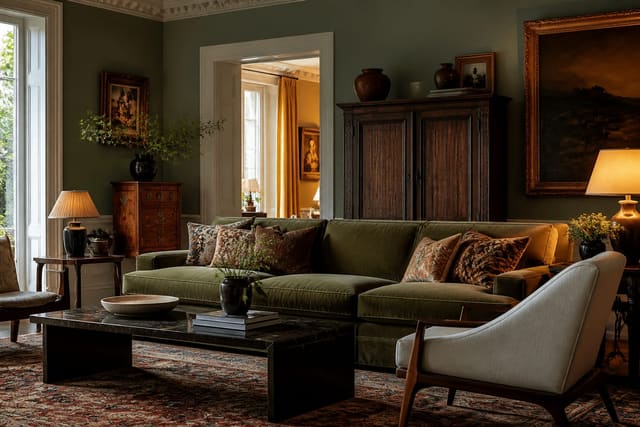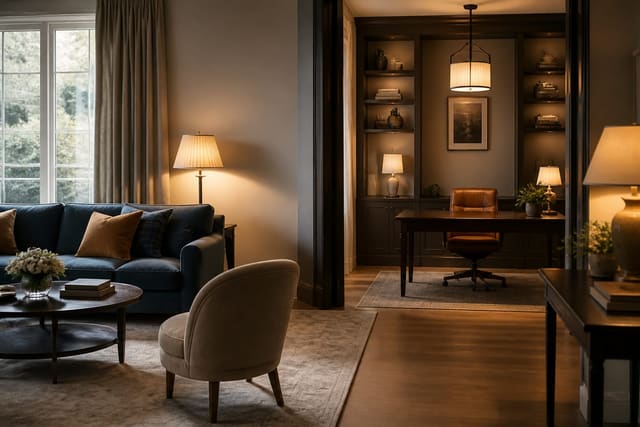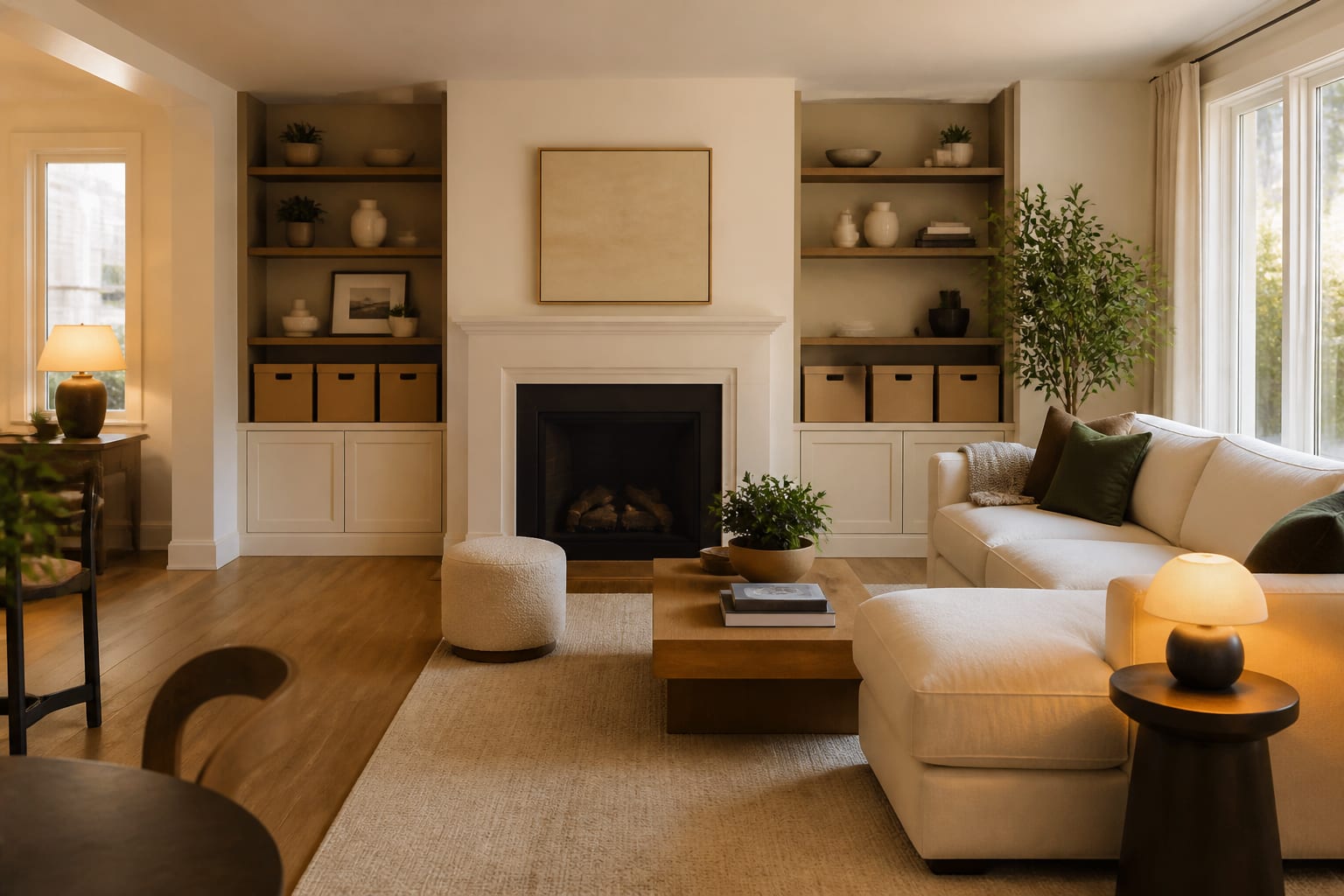
Most redesigns fail before a single new thing is bought, because the room is already full. The honest answer is that you cannot judge a paint color, a rug, or a sofa silhouette when the floor is 40% covered by stuff that has no home. Clutter doesn't just look bad in photos; it physically hides the proportions you are trying to design around.
I treat decluttering as the first design decision, not the chore you do afterward. Strip a room back to its bones and you can finally see the things that matter: where the light falls, how much wall you actually have, and which pieces are worth keeping. Everything in this guide assumes you want a redesign that holds up, not a staged photo that collapses back into chaos in a week.
Why an empty room is the real starting point
Design decisions are proportion decisions. A 7-foot sofa looks generous in a bare 12-by-14-foot room and crowded once you add two bookcases, a side table, and a basket of throws. When you redesign around a full room, you are unconsciously designing around the clutter, leaving 18-inch gaps for piles that should not exist. The new rug you buy gets sized to the cleared floor, not the one you actually live on, and then it never sits right.
The fix is to get the floor to about 70% empty before you commit to anything. Carry out everything that isn't furniture and anything you can lift alone. Then look at what's left. You will usually find that two or three pieces dominate the space and the rest is filler. That clarity is the whole point. It also makes lighting obvious, which matters most in spaces that already struggle, the kind covered in solutions for dark rooms. An empty corner near a window might be the best reading spot in the house, and you'd never see it under a stack of laundry baskets.
There's a measurement reason too. You cannot accurately plan a layout when you can't see the walls. Skirting, outlets at 12 to 18 inches off the floor, radiator positions, the swing of a door, all of these drive where furniture can go, and all of them hide behind a full room. Clear first and you can actually run a tape measure along a bare wall and trust the number you get.
A three-pass system that actually finishes
The reason most decluttering sessions stall is that people make one decision at a time and agonize over each object. Switch to passes. The first pass is keep: anything you've used or worn in the last 90 days goes into a defined keep zone, no debate. The second pass is relocate: items that belong in another room get a labeled box per destination. The third pass is release: donate, recycle, or trash.
Give each object about 20 seconds. If you can't decide, it goes in a maybe box, and that box gets a 30-day deadline written on the lid. Here's the order I work in:
- Start with horizontal surfaces (floor, tables, the top of the dresser) because clearing them changes how the room feels fastest.
- Move to the closet or storage furniture next, since that's where relocated items will eventually live.
- Do sentimental categories last, when your decision muscle is warmed up.
- Bag releases immediately and move them out of the room the same day.
Working surface-first gives you a quick visible win, which keeps the momentum going across a 6-to-10-hour project.
The 90-day rule is doing a lot of the heavy lifting in that first pass. It's a deliberately generous threshold, long enough to catch genuinely seasonal items but short enough to expose the things you keep out of guilt rather than use. Anything you haven't touched in three months but can't release goes in the maybe box with its 30-day deadline, and when that deadline passes unopened, the whole box goes, unopened. You don't re-litigate it. That single rule prevents the slow creep back toward a full room a month after you finish.
Editing, not emptying: what stays
Decluttering is not minimalism for its own sake. The goal is to keep the pieces that earn their footprint and create room for new layers. Once the space is clear, decide what comes back based on function and proportion, not habit. A room with three intentional pieces and breathing space almost always photographs and lives better than one with eight crowded ones.
This editing phase is also when style starts to matter. With a clean slate you can see how existing pieces relate, which is the foundation for mixing design styles without it reading as accidental. If you're working with a space that has to do two jobs, this is the moment to plan zones rather than cram, an approach I get into with dual-purpose room ideas. Aim for surfaces that land around 80% clear: enough open space to read as calm, enough objects to read as lived-in.
The editing test I use is simple: every piece that comes back into the room has to justify both its function and its footprint. A side table that holds a lamp and a book earns its 18 inches; a side table that only collects mail does not. Run that test honestly and you'll usually return about 60 to 70% of what you removed, which is the right number. Keeping everything defeats the purpose; keeping nothing leaves you with a room that's clear but cold and impossible to actually use.
Common mistakes to avoid
The most common mistake is shopping before clearing. New things bought to fix a cluttered room just become more clutter, and you've spent $200 or $2,000 on the wrong problem. Clear first, then see what gaps are real.
Another frequent error is the all-in-one-day blitz. Decision fatigue sets in around hour 3, and everything after that gets dumped into maybe piles you never revisit. Split the work across two sessions. A third mistake is relocating clutter to a garage or spare room instead of releasing it, which just moves the problem 20 feet. And finally, don't skip the empty-room photo. Without a true before, you can't tell whether your redesign actually opened the space up or just rearranged the density.
Use AI design to preview decluttering before you commit
It's hard to imagine an empty room when you're staring at a full one. With Re-Design, you can upload a photo of the cleared space and test layouts before you carry a single piece of furniture back in. Seeing a rendered version of the bare room with a new arrangement tells you fast whether the sofa belongs on the long wall or the short one.
AI design also lets you test the editing decision itself. Upload the room at 70% empty, generate a styled version, and compare it against a denser arrangement to confirm that less really does read as more here. That preview is far cheaper than buying, hauling, and regretting, and it turns decluttering from a leap of faith into a decision you can actually see.