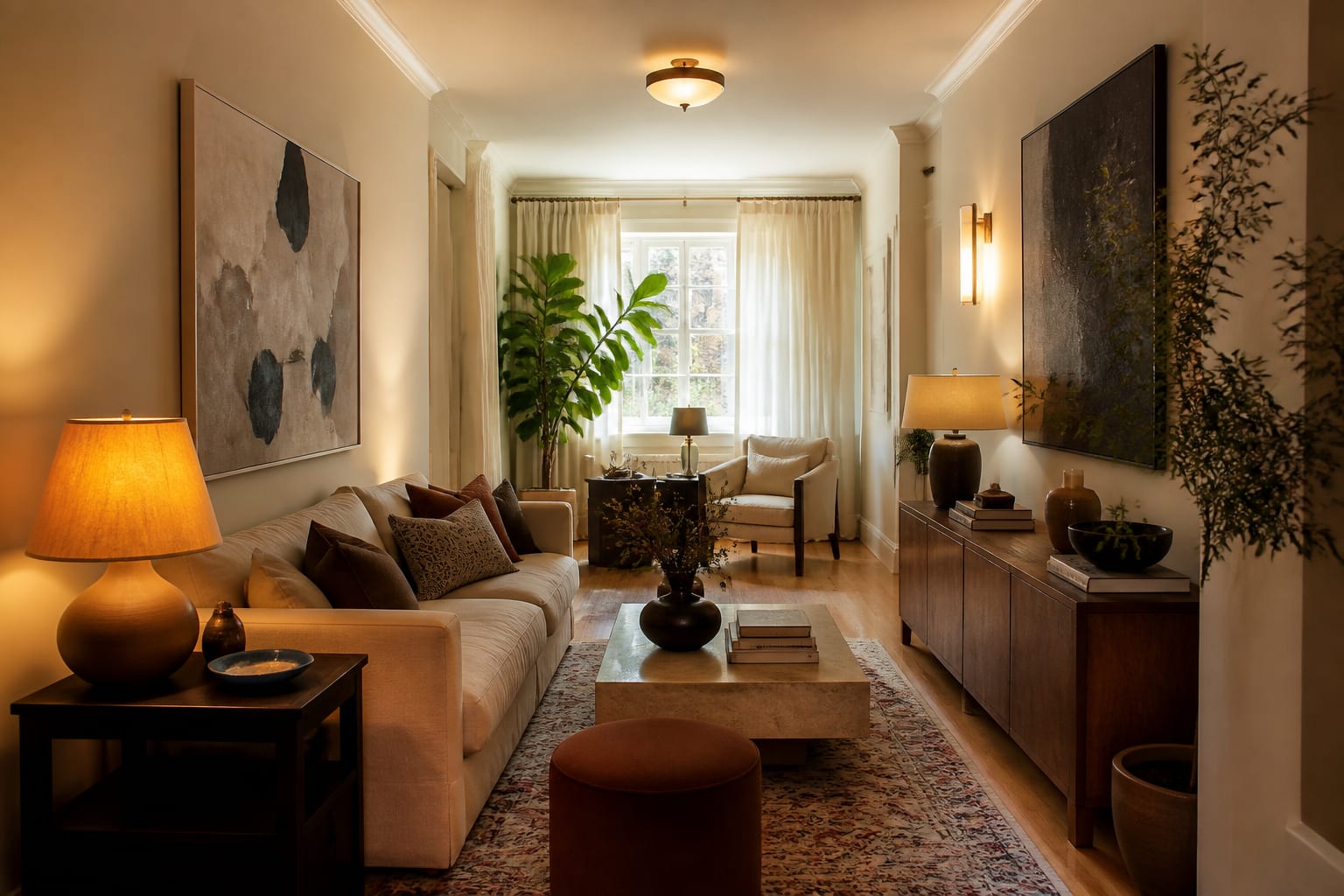
My read is that a long narrow room only feels cramped because everyone shoves furniture flat against the two long walls, which carves the space into a corridor you walk through instead of a room you live in. The honest fix is to stop fighting the length and start dividing it: two or three distinct zones, furniture pulled off the walls, and a far end that pulls light forward so your eye stops traveling down a tunnel.
If you only have ten minutes, the single highest-impact move is splitting the floor into zones with a rug under each grouping. That one decision does more than any paint color, because it tells the eye the room has stops along the way rather than one long runway.
Start by carving the length into zones
The core problem with a narrow room is that it has one obvious axis and nothing interrupting it. Your job is to add interruptions. In a 22-foot living-dining space I usually plan three zones: a seating cluster, a reading or media corner, and a compact dining or desk area at the far end. Each zone gets a defining anchor, and the cheapest anchor is a rug sized to sit under the front legs of the furniture in that group.
Rug scale matters more than people expect. A 5x8 looks like a bath mat in a seating zone and makes the room feel thinner; a seating rug should usually be 8x10 so the sofa and a chair both touch it. When two rugs sit in the same long room, leave 18-24 inches of bare floor between them as a visual seam. If the room pulls double duty for work and rest, the zoning logic is the same one I lay out in my dual-purpose room ideas approach: one room, two jobs, a clear line between them.
Furniture placement inside each zone should turn the seating to face across the narrow dimension, not down the length. A sofa staring straight down a 20-foot room reinforces the corridor; the same sofa turned to face a side wall or window breaks the axis and instantly feels more like a room.
Pull furniture off the long walls and go low
The instinct in a tight room is to push everything against the walls to "save space." That backfires. A sofa floated 10-18 inches off the long wall, with a slim console behind it, actually reads as more deliberate and makes the room feel furnished rather than lined. The gap reads as breathing room, not waste.
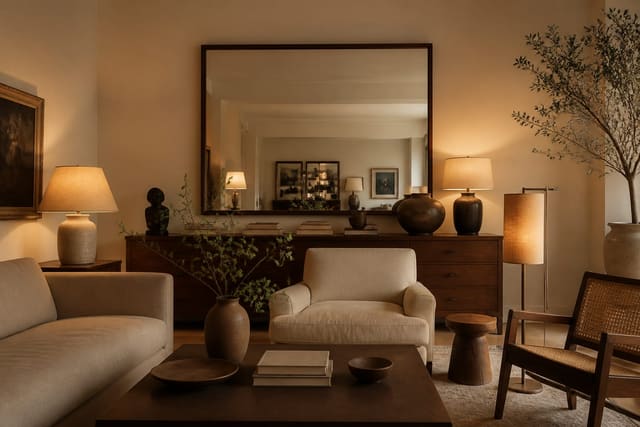
Go horizontal and go low. A low-backed sofa under 34 inches tall keeps sightlines open over the top of the furniture, so your eye crosses the room instead of hitting a wall of upholstery. Long low media units, a wide low coffee table, and art hung in horizontal arrangements all stretch the room across its short dimension. Mirrors help here too: a wide mirror on a long wall, hung landscape, bounces light sideways and visually doubles the width. The trick for making a tunnel feel brighter overlaps a lot with the lighting and reflectivity moves in my dark room solutions playbook.
What to look for when you shop for a narrow room:
- Sofas with exposed legs and a back under 34 inches tall, ideally 78-84 inches long.
- Round or oval tables, which ease traffic flow and remove sharp corners from the walkway.
- Nesting or stackable side pieces you can pull out only when needed.
- Open-base consoles and shelving so the floor stays visible front-to-back.
- Armless accent chairs that tuck close without blocking the path.
Treat the far wall and the floor as your widening tools
The single short wall at the far end of a narrow room is your most underused asset. Paint it a few shades deeper than the long walls, or hang one oversized piece of art there, and the wall advances toward you, which shortens the apparent length of the room. Painting the long walls a light, cool-leaning neutral while keeping the end wall richer is one of the oldest tricks for making proportions feel less stretched.
Flooring direction is the other lever. Run planks or a runner across the narrow dimension, not down the length, and the lines pull your eye side to side. If you are layering patterns and finishes across these surfaces, the restraint I describe in how to mix design styles keeps a small room from feeling busy: pick one bold element per zone and let everything else stay quiet. Lighting finishes the job. Aim for three light sources minimum, all in the warm 2700K-3000K range, spaced so the far third of the room never falls into shadow. A floor lamp at the far end alone can erase the tunnel effect.
Common mistakes to avoid
The most common mistakes to avoid in a long narrow room start with furniture you push flat against both long walls, which is the move that creates the corridor in the first place. Close behind it is the runway rug: a single long runner-style rug down the center that reinforces the exact axis you are trying to break.
Undersized art is another one. A scatter of small 8x10 frames on a long wall reads as clutter and makes the wall feel longer; one piece at least 40 inches wide does more work. People also center the walkway, splitting the room down the middle so every zone is cut in half. Push the path to one side, 30-36 inches wide, and let the zones sit whole on the other. Finally, watch lighting: a single ceiling fixture over the center leaves both ends dim, so the room reads as a dark tunnel with one bright spot. Layer at least three sources before you blame the room.
Use AI design to preview your narrow room before you commit
The hardest part of decorating a long narrow room is that you can't really picture the zones until the furniture is in place, and by then the sofa is bought and the rug is rolled out. This is exactly where Re-Design earns its keep. Upload a photo of your actual long room, shot from the doorway down the length, and the AI re-renders it with floated seating, cross-room rugs, a deeper end wall, and low horizontal furniture so you can judge whether the zoning reads as roomy or still as a hallway.
Because you upload your real space rather than a showroom shot, the AI design respects your real window positions, your real door swings, and the true length you're working with. Try the far wall in two or three deeper tones, test a wide landscape mirror against a long low media unit, and see which version finally makes 22 feet feel like a room instead of a runway, all before you spend a dollar.