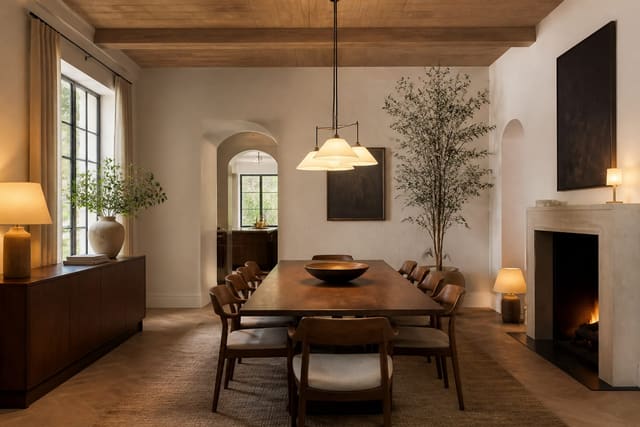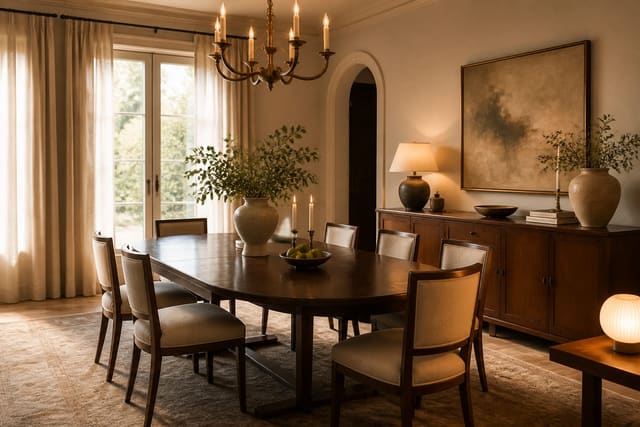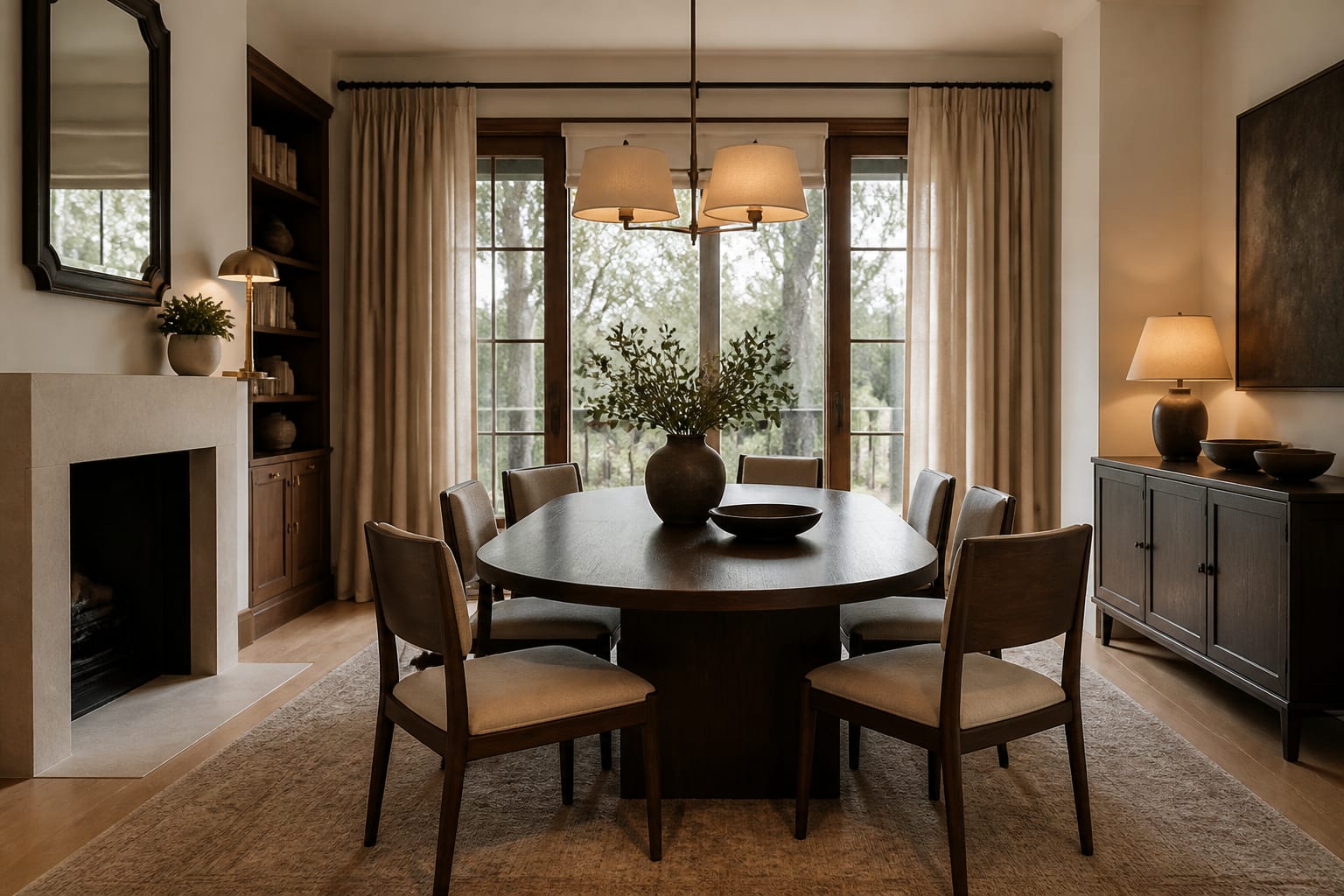
A dining room that only comes alive twice a year is a design failure, not a luxury. The rooms people actually use share a few traits: a table sized to the space rather than the showroom, lighting you can dim, and a reason to sit beyond eating. Start with the table and the clearance around it, because no amount of styling fixes chairs that can't pull out. Then give the room a focal point and somewhere to stash dishes and linens. Get those bones right and the dining room stops being a formal museum and becomes the spot where dinner runs an extra hour.
How do you choose the right dining table size?
The table is the room, so size it to the space first and your guest count second. The non-negotiable rule is clearance: you want at least 36 inches between the table edge and any wall or furniture, so chairs slide out and someone can walk behind a seated guest. If the room is tight, 30 inches is the bare minimum, but anything less and dinner becomes a game of musical chairs. Measure your room, subtract that clearance from both directions, and what remains is your maximum table footprint. For seating math, plan on about 24 inches of table width per person so elbows don't collide, plus room at the ends. A 72-inch rectangular table comfortably seats six; an 84 to 96-inch table handles eight. Round tables are the unsung hero of small or square dining rooms because they have no corners to bump and they seat people more sociably; a 48-inch round fits four, a 60-inch round fits six. Resist buying the biggest table that technically fits, because a room crammed edge to edge feels tense and nobody can move. If you host large groups only occasionally, an extension table with a leaf gives you everyday intimacy and holiday capacity from one piece. Match the table shape to the room shape, rectangular for long rooms and round or square for boxy ones, and the layout falls into place. The table you can actually walk around is the one you'll actually use, every week and not just on holidays.
See also our guide to Small Dining Room Ideas for more on dining room ideas.
How should you light a dining room?
Dining rooms need flattering, adjustable light more than almost any other room, because you're looking at faces across a table for an hour at a time. Build it in layers. The centerpiece is a pendant or chandelier hung over the table, centered on the table itself rather than the room, since the table is rarely dead-center. Hang it 30 to 34 inches above the tabletop so it lights the surface without blocking sightlines across it, and size the fixture to roughly half to two-thirds the table's width. That overhead light should be on a dimmer, full stop; bright light for homework and board games, a low glow for dinner. Add a second layer with wall sconces, picture lights, or a lamp on a sideboard to wash the walls and soften the shadows that a single overhead light throws under everyone's eyes. Candles on the table do the same job and cost nothing. Keep the bulb color warm, around 2700K, so food and skin look appetizing rather than clinical. If the room doubles as a workspace or homework station, consider recessed cans on a separate switch so you can brighten the whole room when you need to and dim back to the chandelier for meals. The classic mistake is one harsh overhead light, no dimmer, and nothing on the walls, which leaves the room feeling like a conference space. A dining room lit in warm, dimmable layers is the one people linger in long after the plates are cleared.
For a related angle on dining room ideas, read AI Dining Room Design Ideas.
What makes a dining room feel like a destination?
A great dining room has one thing every forgettable one lacks: a focal point that makes you want to sit down. Pick a single hero element and let it carry the room. A bold paint color or a moody, dark wall instantly makes a dining room feel intimate and special, since this is a room you mostly use at night where deep colors come alive by candlelight. Wallpaper on one wall, a textured plaster finish, or a wall of framed art does the same work. If you'd rather the architecture star, an oversized statement chandelier becomes the centerpiece and everything else can stay quiet around it. A large mirror on one wall is a reliable trick that bounces light, doubles a chandelier, and makes a small dining room feel twice as big. Whatever you choose, commit to one star and keep the supporting cast simple, because two or three competing focal points just create noise. Layer in texture through the chairs, a runner, or window treatments so the room has depth rather than feeling like a furniture showroom. Don't forget comfort, since upholstered or cushioned chairs are what actually keep people at the table after the meal; hard wood seats empty a room fast. The dining rooms that get used are the ones with a little drama and a little softness. Give people something beautiful to look at and a comfortable seat, and a quick dinner turns into the long conversation you hoped the room would host.
How do you add storage and function to a dining room?
The dining rooms that survive as everyday spaces all have one practical thing in common: somewhere to put stuff. A dining room with no storage is a room that empties out, because there's no reason to be there between meals and nowhere to keep what the room needs. A sideboard or buffet is the classic answer and the highest-value addition you can make; it holds dishes, linens, serving pieces, and candles, and its top doubles as a serving surface when you host. Aim for a piece around 34 to 38 inches high so it works as a buffet for plating. If you have wall space, a built-in or a tall hutch adds display for nicer glassware and closed storage for the everyday stuff below. Even a small dining room can fit a narrow console against one wall to hold the essentials. Beyond storage, give the room a second job so it earns daily use: a sideboard with a lamp becomes a homework spot, a drinks station, or a place to drop mail and keys. If you work from home, the dining table can double as a desk if you keep a basket or drawer nearby to clear work away before dinner. The principle is simple: a room with storage and a secondary purpose stays in the rhythm of the house, while a formal box reserved for holidays just collects dust. Build in the function, and the dining room stops being the room you walk past and becomes one you actually live in.
- Right-size the table to leave 36 inches of clearance on every side for chairs and traffic.
- Choose a round table in a small or square room to lose the corners and seat people sociably.
- Hang a dimmable chandelier 30 to 34 inches above the table, centered on the table itself.
- Paint one wall a deep, moody color so the room glows by candlelight at dinner.
- Add a 34 to 38-inch sideboard for dish and linen storage plus a serving surface.
- Mount a large mirror to bounce light and make a small dining room feel twice as big.
- Upholster or cushion the chairs so people stay seated long after the meal ends.
- Give the room a second job, like a homework or drinks station, so it gets used daily.
Bring the look home with Re-Design
Furniture scale and wall color are the two things people misjudge most in a dining room. Upload a photo of your space to Re-Design and preview a 72-inch table with the right clearance, a chandelier centered above it, or a deep accent wall before you commit. Seeing the table and lighting placed in your actual room tells you whether chairs will pull out and whether that moody color reads cozy or cramped.
Frequently Asked Questions
How far should a dining table be from the wall?
Leave at least 36 inches between the table edge and any wall or furniture so chairs can pull out fully and someone can walk behind a seated guest. In a tight room you can drop to 30 inches as an absolute minimum, but expect a snug squeeze. Measure your room and subtract that clearance from both directions before choosing a table size.
What size chandelier do you need for a dining table?
Size the fixture to roughly half to two-thirds the width of the table, not the room, and hang it 30 to 34 inches above the tabletop. For a 40-inch-wide table, a fixture around 20 to 26 inches across looks balanced. Center it over the table rather than the room, since tables rarely sit dead-center, and always put it on a dimmer.
Can a dining room work as a home office too?
Yes, and double-duty dining rooms get used far more than single-purpose ones. Keep a sideboard or a nearby basket to clear laptops and papers before meals, choose a table at a comfortable working height of about 30 inches, and add a separate brighter light layer on its own switch. The key is being able to reset the room for dinner in under five minutes.