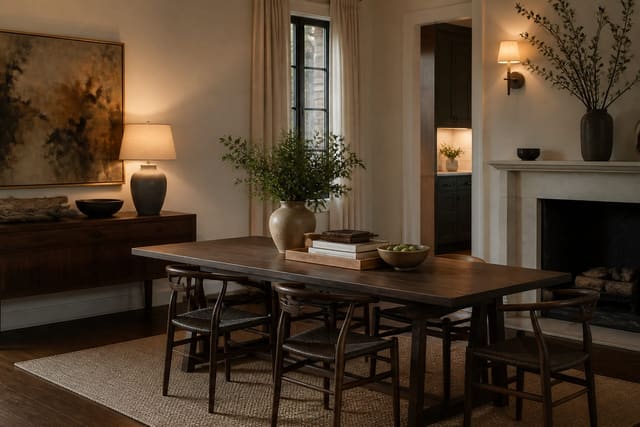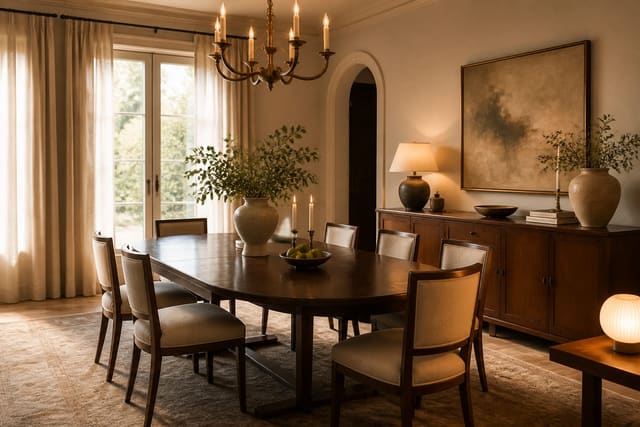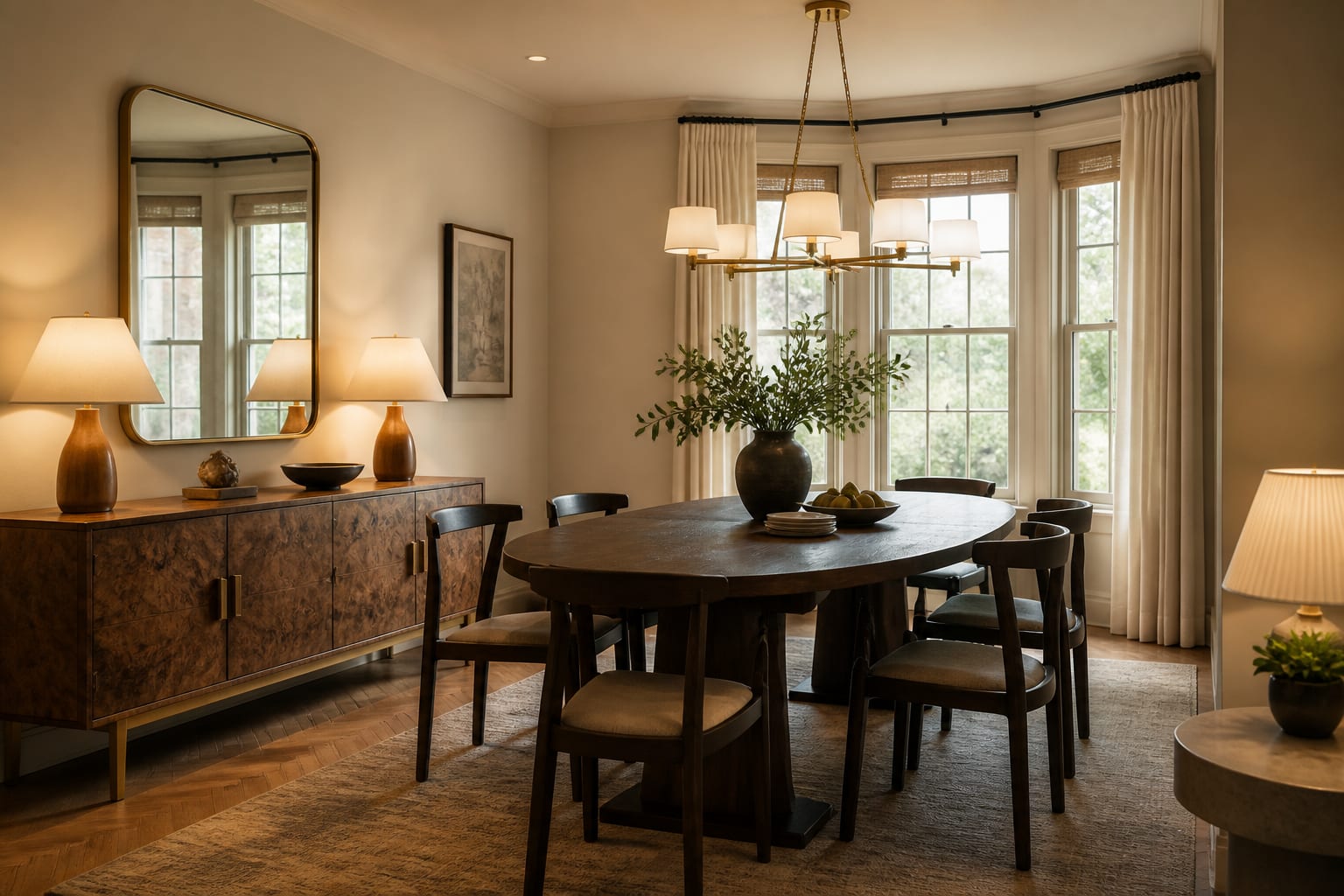
Good dining room lighting hangs a chandelier 30 to 34 inches above the tabletop, sized to half to two-thirds the table's width and centered on the table rather than the room. Layer in warm 2700K bulbs on a dimmer plus sconces or lamps so no one eats in their own shadow. Get these measurements right and any fixture will work.
How high should you hang a dining room chandelier?
For a standard 8-foot ceiling, hang the bottom of the fixture 30 to 34 inches above the tabletop. That gap lights the surface evenly while staying low enough to feel intimate and high enough that no one across the table stares into a bulb. Add about 3 inches for every additional foot of ceiling height, so a 10-foot ceiling puts the fixture closer to 36 to 40 inches above the table.
Center the fixture over the table, not over foot traffic. Hung too high, near door height, light scatters across the room and the table stays dim. Hung too low, under about 28 inches, it blocks sightlines and people knock their heads leaning in. If the fixture has exposed bulbs or a wide spread, err higher; if it's a downward-focused pendant, you can go lower. Always check the height with people seated, since that's the experience that matters.
See also our guide to styling a dining table when it's not in use.
What size and how many fixtures does a dining table need?
Match the fixture to the table, never to the room. A single chandelier or pendant should be about half to two-thirds the table's width: a 40-inch table wants a fixture roughly 20 to 26 inches across, while a 48-inch table can carry 26 to 32 inches.
For a rectangular table over about 60 inches, one round fixture looks lost. Instead:
- Run two or three pendants down the length, each centered over a seating zone, spaced at least 24 to 30 inches apart.
- Use a linear suspension fixture for even light along the entire surface from a single piece.
- Always center the run on the table, since dining tables rarely sit in the geometric center of the room.
The most common mistake is a fixture that's too small, which looks timid and underlights the food. When in doubt, size up.
For more on this, read AI dining room design ideas.
How do you layer dining room lighting beyond the chandelier?
One overhead fixture, however well chosen, casts hard shadows under everyone's eyes and leaves the room's edges dark. Layered light fixes that with three levels:
- Task/feature light: the chandelier or pendants over the table.
- Ambient light: recessed cans around the perimeter (spaced 24 to 30 inches off the walls) or sconces flanking a sideboard or mirror, mounted 60 to 66 inches from the floor.
- Accent light: a lamp on the sideboard, candles on the table, or a picture light, adding warmth at eye level.
Put each layer on its own switch and dimmer so you can go bright for homework or dim to just the chandelier and candles for a dinner party. A room lit from one point always looks flat; a layered one looks designed.
What bulb color and dimming setup works best for dining?
Color temperature decides whether the room feels like a restaurant or a cafeteria. Use warm 2700K bulbs throughout, since that tone flatters food and skin and signals relaxation. Avoid cool 4000K-plus bulbs, which read clinical, and keep every fixture, chandelier, sconces, and cans, at the same temperature so nothing looks mismatched.
Every light in a dining room should be dimmable. Confirm your bulbs are dimmable-rated and paired with a compatible dimmer, since mismatched LED-and-dimmer combos flicker or buzz. Look for LEDs with a color-rendering index of 90 or above so colors on the table read true, and consider bulbs that warm further as they dim for a candlelight effect.
Common mistakes to avoid
- Hanging the fixture too high, near door height, so light scatters and the table stays dim.
- Sizing the chandelier to the room instead of the table, leaving it undersized.
- Skipping the dimmer, leaving only one harsh brightness setting.
- Using cool 4000K bulbs that make food and skin look clinical.
- Relying on one overhead light with nothing on the walls, leaving shadows under every face.
- Mixing warm and cool bulbs across fixtures, which looks careless.
Bring the look home with Re-Design
Fixture scale and hang height are hard to judge from a product page. Upload a photo of your dining room to Re-Design and preview a chandelier at the right size over your table, two pendants down a long table, or a warmer dimmed glow before you buy. Seeing the fixture rendered at 32 inches above your actual table shows whether it reads balanced and whether the light lands where people sit.
Frequently Asked Questions
How high should a chandelier hang above a dining table?
For a standard 8-foot ceiling, hang the bottom of the fixture 30 to 34 inches above the tabletop. Add about 3 inches for every extra foot of ceiling height, so a 10-foot ceiling puts it nearer 36 to 40 inches. This keeps light over the table and out of sightlines. Always confirm the height with people seated, not standing.
What color temperature is best for dining room lighting?
Use warm 2700K bulbs throughout the dining room. This tone flatters food and skin and creates a relaxed mood, while cooler 4000K light looks clinical at a table. Keep every fixture at the same temperature, and choose LEDs with a color-rendering index of 90 or higher so colors on the table read true.
Do I need more than one light fixture over a long table?
Usually yes. A single round fixture looks lost over a table longer than about 60 inches, so use two or three pendants spaced 24 to 30 inches apart, or a linear suspension fixture, to light the whole surface evenly. Center the run over the table and put it on a dimmer to cut harsh shadows.