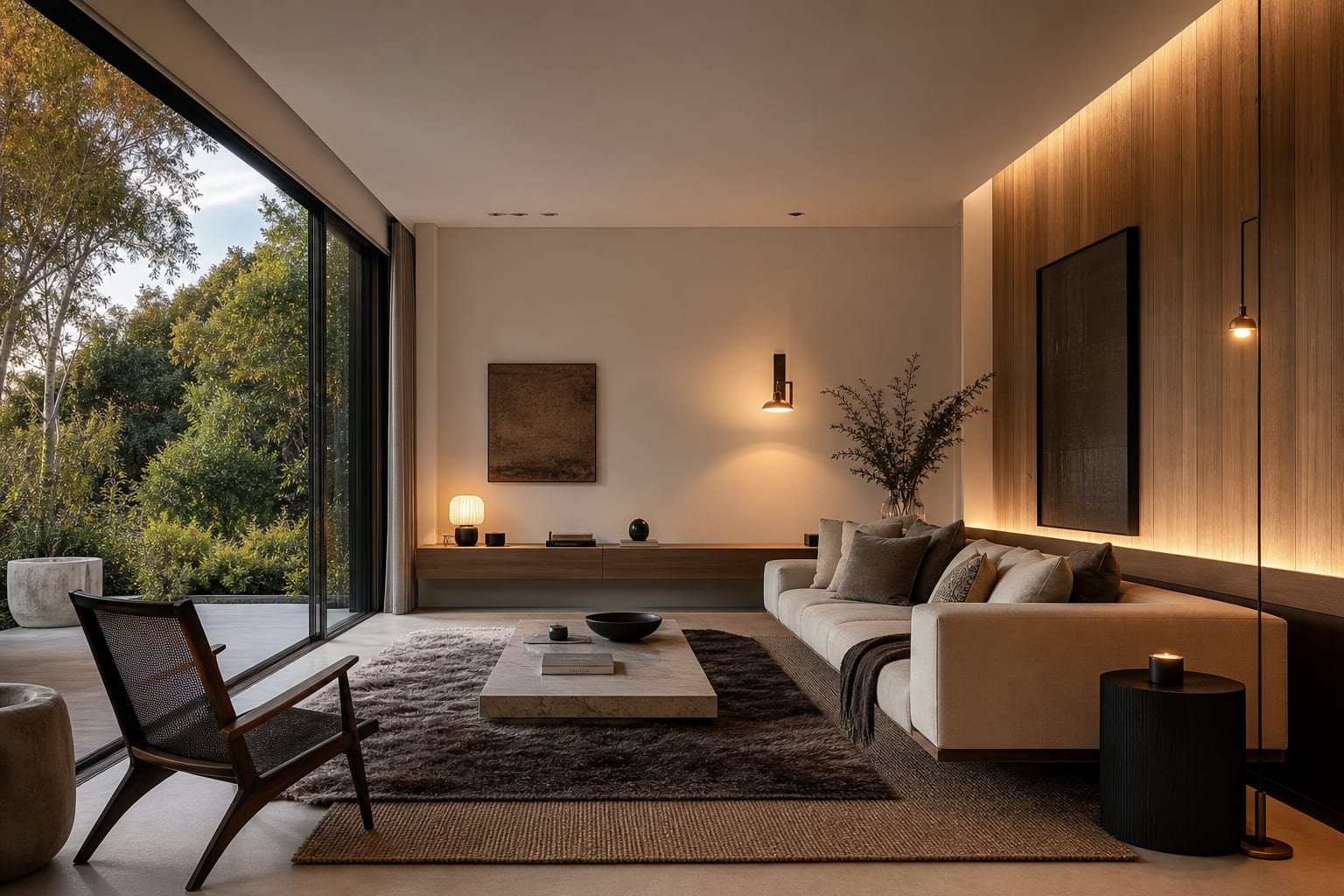
Floor to ceiling window furniture arrangement works by floating the sofa 18–24 inches off the glass, using low-profile pieces so the window stays visible, and anchoring the group with a large rug and a clear walking path. Skip pushing furniture flush to the glass — treat the window as a light source, not a wall to hide behind.
How do you arrange furniture in a room with floor-to-ceiling windows?
Float the main seating group 18–36 inches off the glass and use low-profile pieces so the room doesn't need a solid wall behind every seat.
Plan the walking route first. Protect a 30–36 inch path along any window wall leading to a balcony, fireplace, or dining area; 28 inches works only for secondary routes.
Place the largest seating piece parallel to the glass, or perpendicular if the room is deep enough for a rug, table, and walkway. Perpendicular sofas with two chairs angled toward the view often work best in real living rooms, letting the glass become atmosphere rather than the focal wall.
Keep backs low: sofas 30–34 inches, chairs 28–32 inches, consoles under 30 inches. Solve privacy with shades or panels, not taller furniture — the same logic covered in too many windows and privacy layouts applies here.
Which pieces belong near the glass, and which should float?
Low, slim, useful pieces belong near the glass; anything needing height, wiring, or storage moves to a side wall.
- A bench 16–20 inches high works well near a balcony door for extra seating or plants.
- A console 10–14 inches deep holds lamps and books without blocking the window track.
- Avoid pushing a full sofa against the glass; leave 6–10 inches behind it for airflow, drapery operation, condensation, and fading control.
- Chairs are more forgiving — swivel chairs can face the room and turn toward the view, with arms low enough to clear the glass.
Storage needs discipline: put tall bookcases or media cabinets on the most solid remaining wall. One clean 72–84 inch cabinet beats three scattered shelves. For bay or angled glass corners, borrow the logic in bay window furniture arrangement — give the glass one job and let the rest of the room breathe.
Test this on your own room photo with ReDesign before finalizing the layout.
How do rugs, lighting, and privacy treatments finish the layout?
The rug tells floated furniture where to stop. Without one, seating can look adrift in the middle of the floor.
Start with an 8' x 10' rug for most apartment living rooms; move up to 9' x 12' for a full-size sofa, sectional, or wider room. Let front legs sit on the rug by 6–10 inches, keep 14–18 inches between sofa and coffee table, and rotate the layout if the rug edge blocks the main walkway.
Lighting must replace the wall you lost. After dark, glass turns reflective, so add light at multiple heights: table lamps, a floor lamp, and a picture light or sconce on the remaining wall. Use 2700K bulbs for living-room warmth, 3000K if the space doubles as a workspace.
Privacy should support the plan, not fight it. Ceiling-track sheers mounted 2–4 inches from the ceiling soften glass without chopping it up; slim roller or solar shades work when there's no room to stack panels. In dim rooms, pair treatments with the guidance in north-facing living room colors and lighting so closed privacy doesn't turn the space gray.
Common floor-to-ceiling window furniture mistakes
- Lining every piece against the glass. Turns the window into a furniture parking lane — float the seating and let the glass side stay open for a walkway or bench.
- Buying tall pieces to fill the wall. A 70-inch bookcase in front of full-height glass looks defensive; use a low console or a pair of substantial chairs instead.
- Ignoring sun exposure. West light fades dark upholstery and heats leather; use performance fabrics, solar shades, or keep screens perpendicular to glare.
- Centering the coffee table on the room instead of the seating. Center it on the sofa and chairs with 36–48 inches of length for most sofas, larger for sectionals.
- Treating the view as the only focal point. Add one grounded interior anchor — a media wall, low cabinet with art, plant grouping, or shaded lamps — so the room works after dark too.
Use AI design to preview the full glass wall before you commit
Floor-to-ceiling windows are hard to judge from a floor plan since the missing wall changes sofa direction, glare, rug size, and privacy all at once. Preview the layout on a photo of your actual room before buying anything.
Take a photo from the room entry and one from the window side looking back. Prompt clearly: "living room with floor-to-ceiling windows, sofa floated 24 inches from the glass, two low swivel chairs, 9'x12' wool rug, slim ceiling-track sheers, warm table lamps, clear 36 inch path to the balcony." Run a second version with the sofa perpendicular to the glass, and a third with a low console at the window wall.
Judge proportion, not styling. Does the seating look intentional from the doorway? Can the window treatment operate freely? Does the rug anchor the float? Thin results usually mean a bigger rug or stronger side lighting; blocked results mean removing height from the glass wall.
Renters should preview reversible options first — tension or ceiling-track curtains, freestanding benches, plug-in lamps, lightweight swivel chairs. Owners can test built-ins, hardwired sconces, motorized shades, or custom low cabinetry before committing.
Measure before ordering: window width, door swing, track depth, sofa back height, chair depth, rug size, walkway clearance, and glass-to-furniture distance. Float the seating, keep silhouettes low, light the room after sunset, and let the windows be architecture instead of a layout crisis.
For the broader workflow, use the AI design complete guide as the parent checklist, then return here for scale, light, and layout choices.
Frequently Asked Questions
Can I push a sofa against floor-to-ceiling windows?
Float the sofa 18 to 24 inches off the glass instead. This keeps heads below the muntin line, prevents cushions from pressing against the glass, and lets the window read as a window rather than a backboard.
What furniture height works in front of huge windows?
Keep furniture backs under 36 inches in front of the glass. This preserves the window's vertical drama; save tall bookcases or art for the solid walls between window banks.
How do I handle glare and heat from floor-to-ceiling windows?
Layer a roller solar shade behind a linen drape. The solar shade cuts UV and heat for furniture and rugs, while the drape softens the room when the shade is raised; also check chair pullout, walkway width, and evening glare against real use.
Should the rug touch the wall under the windows?
Hold the rug 6 to 12 inches off the glass so the floor reveal frames the window, and extend it under the front 8 to 12 inches of the sofa to anchor the seating zone.
Does a TV work near floor-to-ceiling windows?
Place the TV perpendicular to the window wall, not opposite it. A TV facing glass picks up daytime glare and reads as a black hole against a bright window at night.
> Try this: Ready to see this on your own room? Open ReDesign and run the preview before you buy, paint, drill, or move furniture.
Three transformations to try
1. Sofa floated 24 inches off the glass with a 9x12 anchoring rug
2. Low-backed sectional under the sill with vertical art between mullions
3. Tall bookcase between window banks with reading chair angled in