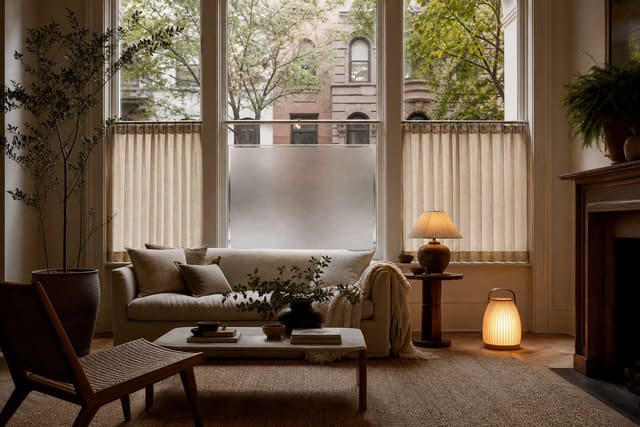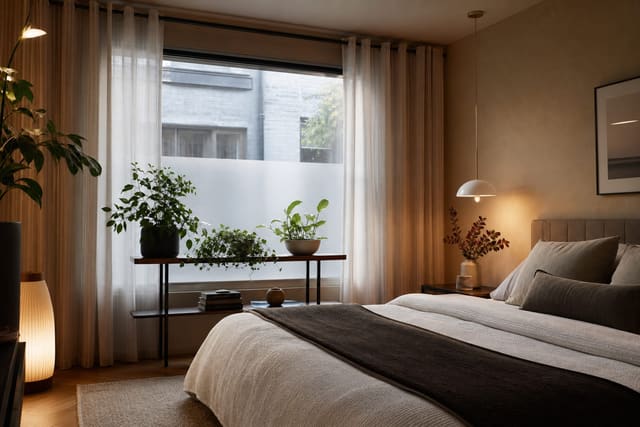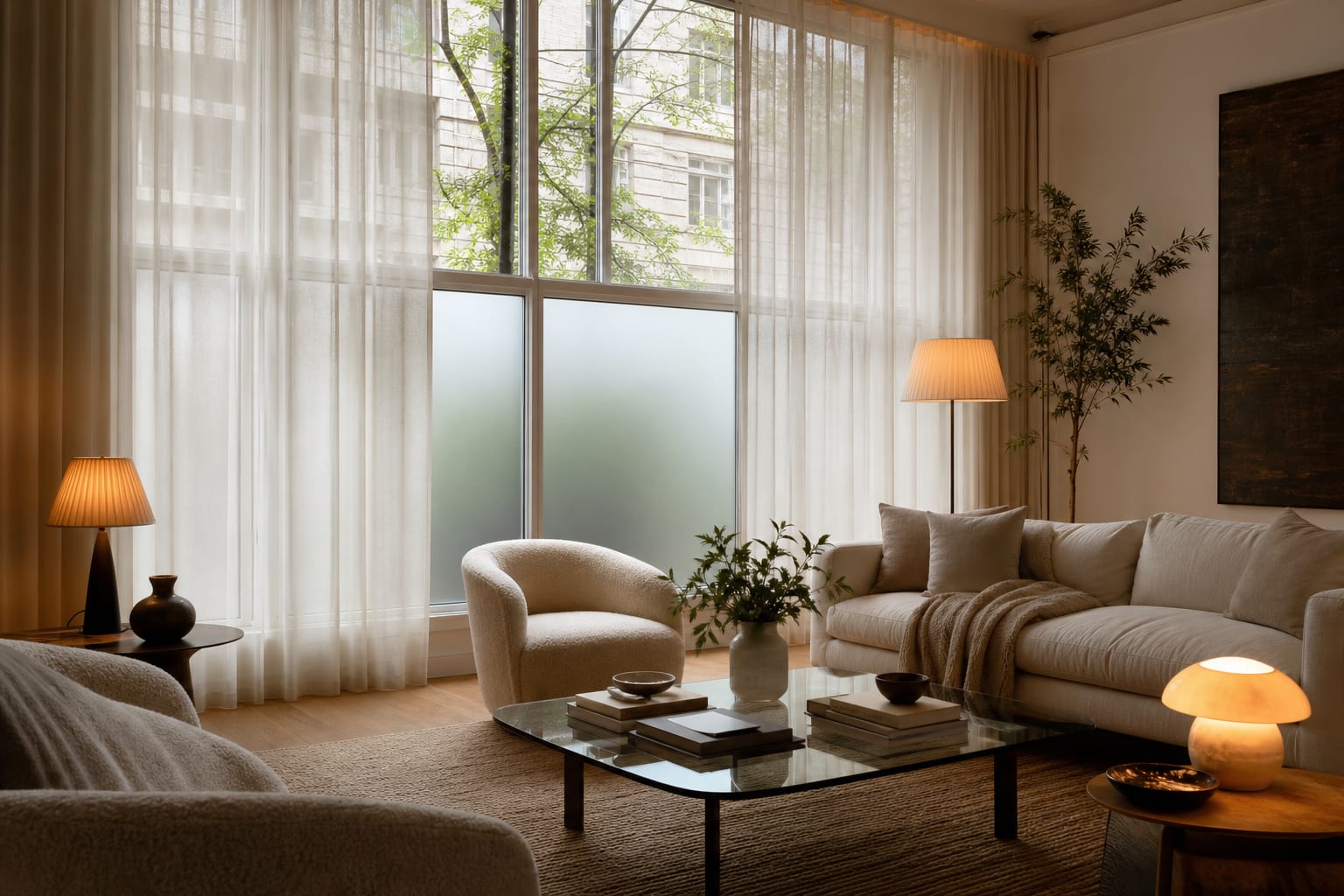
A wall of windows keeps its privacy without losing light when treatments are matched across the wall, sheers handle daytime diffusion, and only the one or two windows with the worst sightlines get opaque coverage. Bare glass isn't minimalism when it makes you feel watched. Layer translucent fabric, selective film, furniture, and lighting so sightlines break before daylight does.
What gives a wall of windows privacy without killing the light?
One product rarely solves the whole problem, because privacy changes by time of day. Daylight needs blur; after sunset, the room glows like a display case and needs real coverage.
Start with the lower half of the glass if people can see straight into the room. Frosted or reeded static-cling film on the bottom 36 to 60 inches blocks the worst sightline while leaving upper glass open for sky and light. This works well on street-facing rooms and close side-yard windows.
Add sheer curtains as the daylight layer. Use 2 to 2.5 times the window-wall width in fullness so the fabric actually folds when closed; flat sheer panels reveal silhouettes.
If the windows run near floor to ceiling, borrow the furniture logic from arranging furniture around floor-to-ceiling windows: keep the best light open, but stop placing seating where it feels exposed from behind. A sofa, console, plant, or low cabinet creates a buffer before you touch the glass.
Which window treatment layer should do the heavy work?
The right layer depends on what you're protecting against: street-level views, side-neighbor views, glare, or nighttime exposure. Drapery, shades, and film are not interchangeable.
- Solar or light-filtering roller shades: 3% to 5% openness cuts glare and blurs daytime views but gives no privacy at night with lights on. Pair with lower film or curtains on street-facing rooms.
- Full-height drapery: Mount the track 4 to 8 inches above the casing (or at the ceiling), and extend it 8 to 14 inches past the outer windows so fabric clears the glass when open.
- Roman shades: Best when each window is separate and trim is worth showing. Outside-mount hides more glass edge; inside-mount needs at least 2 inches of frame depth.
For corners, avoid two rods crashing together — use a ceiling track that turns the corner or a shared bracket. Check corner window treatment ideas before buying standard rods, since the corner joint is where plans usually look improvised.
Test this on your own room photo with ReDesign — keep the doorway, walls, windows, furniture, lighting, and fixed features visible so the preview solves the room you actually have.
How do furniture, plants, and lighting change the privacy equation?
Layout decides how exposed a room feels. If the main sofa faces away from the window wall, the room feels vulnerable even with good curtains — turn seating 15 to 30 degrees or add a console or tall plant behind it.
Use plants as partial screens, not a jungle. A fiddle-leaf fig, olive tree, ficus, rubber plant, or dracaena blocks a direct sightline without darkening the wall. Keep pots 12 to 24 inches from the glass, and repeat two or three tall plants on a long wall rather than lining up small pots.
A 28 to 34 inch console, sideboard, or bookcase under the windows anchors the wall and keeps people from standing right at the glass. Nighttime is the real test: interior lamps make the room the brighter side after dark. Keep lamps away from the glass, use downward-directing shades, and use warm 2700K bulbs, which soften silhouettes more than harsh cool light.
If privacy layers dim the room, borrow ideas from fake natural light in any room: diffuse warm light across walls and brighten corners so the room isn't punished for needing privacy.
Common window wall privacy mistakes to avoid
- Blackout everywhere. Reserve opaque drapery for bedrooms or night use; daytime rooms need sheers or light-filtering shades instead.
- Treating every pane the same. A window beside a neighbor's balcony may need film while panes facing trees stay clear — selective opacity looks intentional.
- Skimpy curtains. Measure the full span plus returns; a 144-inch wall may need 288 inches or more of sheer fabric to fold properly.
- Ignoring the outside view. Check the wall at night from the sidewalk or driveway for silhouettes, bright gaps, and edge leaks.
- Reflective film as a fix-all. Mirrored film looks commercial, may violate lease rules, and often reverses at night. Frosted, reeded, or linen-texture film is more residential.
Use AI design to preview your window wall before you commit
A sheer that looks invisible online may gray out the wall; a dark drape may feel elegant at night and heavy by noon. Photograph the wall from a diagonal corner with floor, ceiling, and nearby furniture visible, and take a second photo at night with lamps on if after-dark exposure is the concern.
Test controlled versions: sheer ceiling-track curtains, lower frosted film with woven shades, café curtains with plants, or opaque side panels that close only at night. Keep wall color and furniture steady across previews so you're judging the privacy move, not a new style.
Prompt for specifics: 2x curtain fullness, ceiling-mounted track, film on the lower 48 inches, warm 2700K lamps away from the glass, and a low console under the windows. The result should feel bright at breakfast, private at 9 p.m., and still connected to the outside.
Frequently Asked Questions
Should every window get the same treatment?
Yes — visual consistency across all windows reads intentional. Mixing shade type, curtain style, or fabric across multiple windows in the same room reads cluttered and unplanned.
How many windows can stay bare in a room?
Windows above the privacy line — roughly above eye level when standing 6 feet from the glass — can stay bare. Only windows within the privacy zone need treatments.
Do sheers actually give privacy?
During daylight, yes: sheers diffuse the outside view while letting light in. At night with interior lights on, sheers offer little privacy and need a layered blackout or shade behind them.
Should I motorize the shades if there are many windows?
Yes when budget allows. Manually closing 6 to 8 shades daily is unsustainable, and motorized cellular shades with one remote or app handle the routine automatically.
Does AI preview multi-window treatments?
Yes — upload the multi-window room photo and AI previews matched treatments and layered sheer-plus-blackout systems before any purchase.
> Try this: Ready to see this on your own room? Open ReDesign and run the preview.
Three transformations to try
1. Matched sheers across all windows 2. Layered sheer plus blackout system 3. Motorized cellular shades across room