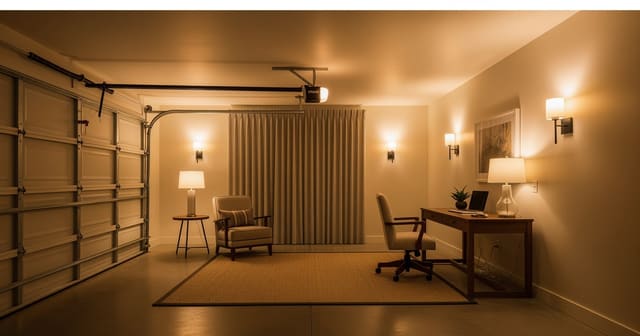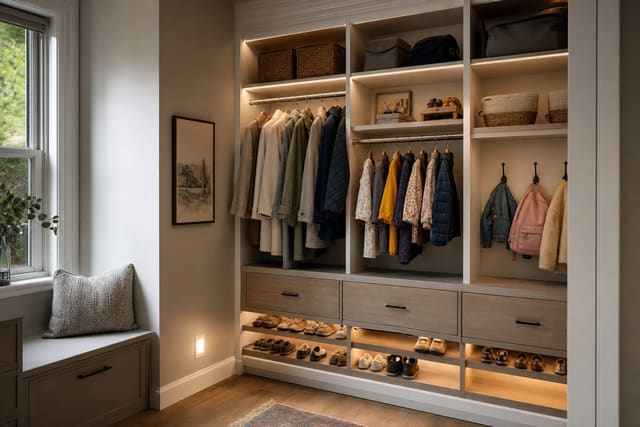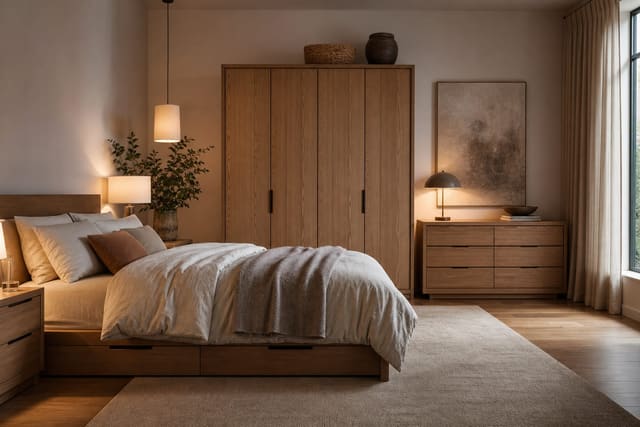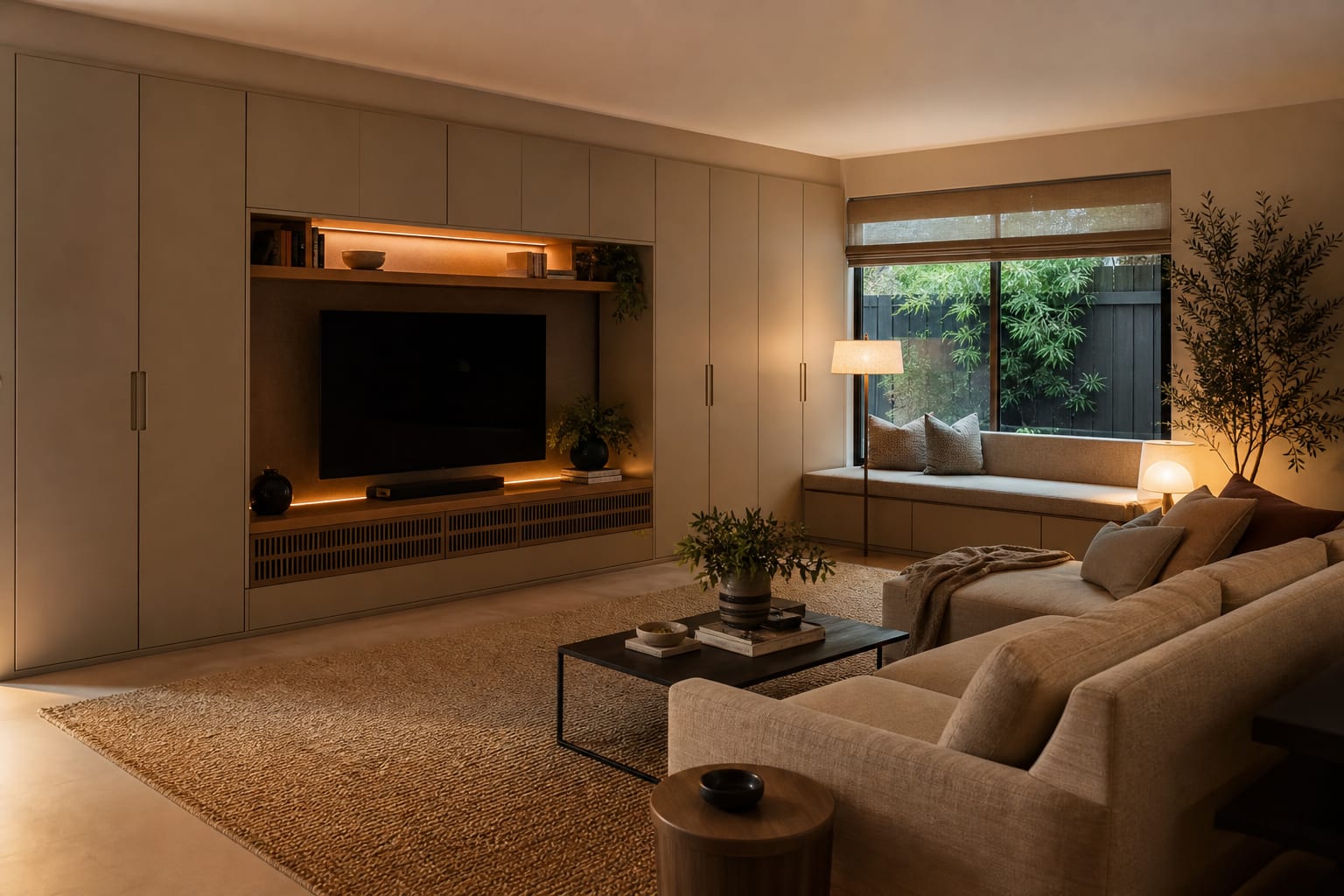
Garage conversion storage works best when you commit to three moves before demolition: a 6x10ft exterior shed for tools and equipment, a built-in wall or wardrobes for household overflow, and a strict edit of what stays. No conversion absorbs the original garage's storage volume without a parallel plan, so build storage into the room's edges before you decorate.
What storage makes a garage conversion feel like a real room?
Sort belongings into categories before buying anything: media gear, office supplies, guest bedding, toys, coats, tools you need nearby, and seasonal overflow. A single built-in storage wall is the cleanest backbone — one long run of cabinets or wardrobe modules beats scattering small pieces around every wall. A 12-foot wall can mix 24" deep tall cabinets, 15" deep bookshelves, and a 16"–20" deep media base without reading as a warehouse.
Keep the room's middle flexible. Converted garages often have a wide rectangular shell and a flat former overhead-door wall; storage that projects into the room everywhere turns the space into a corridor. Protect at least 30" of walking path around seating and 36" behind chairs or near an exterior door.
If the room is becoming an office, storage has to support work first: a printer cabinet, paper drawer, cable route, and closed supply zone matter more than open shelves. See this garage home office conversion guide for planning logic when the room must hold a desk, files, and guest overflow at once.
The built-in wall decision that controls the whole room
Put the storage wall on the least windowed, least interrupted side — often the back wall or the former garage-door wall once it's framed and finished. Don't default to the longest wall if that's also the best spot for seating or daylight.
Combine closed base cabinets with a few open shelves. An 18"–24" deep base cabinet holds blankets, games, and bins; open shelves above should stay shallow, around 10"–12", so they don't loom over seating. Leave 14"–16" of vertical space for taller items, and use adjustable shelves if the room's function might change.
Put tall storage at the ends, not the center. Two 30"–36" wide wardrobe cabinets can frame a media wall or flank a desk zone; a single tall cabinet beside a sofa often looks stranded. With an 8' ceiling, take storage to 84"–90" and finish the top with a crown or filler — stopping at 72" reads as unfinished basement.
Reserve doors for ugly categories: exercise bands, tools, extension cords, holiday bins. Open shelves are for books, ceramics, lamps, and one or two baskets that repeat the room's palette.
Lighting is part of the storage plan. Deep rooms and low windows make storage-wall shadows worse; add under-shelf strips or sconces around 2700K–3000K. See this garage conversion lighting guide to avoid relying on one harsh ceiling fixture.
Test this on your own room photo with ReDesign before committing — keep the doorway, windows, main furniture, and awkward fixed features visible so the preview solves your actual room.
How do you use low storage without shrinking the room?
Low storage adds capacity while keeping walls breathable. A bench, media console, or long low cabinet hides bulky items without lowering the ceiling visually — the key is making it look architectural, not like a row of trunks.
- Window bench: 17"–19" high, cushion 2"–4" thick; use drawers over lift-up lids for daily access, and keep the top below the sill.
- Media cabinet: widen beyond the TV (66"–84" for a 55" screen); closed doors for electronics, with ventilation for anything that runs hot.
- Storage ottoman: one 30"–36" piece for a family zone, or two 18"–20" cubes for a room that shifts between movie night, guests, and play. Keep 18" clearance from the sofa.
- Freestanding sideboard: 14"–16" deep for craft supplies and linens; keep metal shelving and rolling carts behind doors unless the design is intentionally workshop-style.
Account for the slab underneath. Polished concrete or vinyl over a garage slab can have small floor variations — use felt pads, levelers, or a continuous base so tall cabinet doors don't drift open from a 1/4" shim gap.
Common garage conversion storage mistakes
- Leaving true garage items on open shelves. Paint cans, fumes, and sharp tools don't belong in a living zone — move them to a shed or sealed cabinet.
- Relying only on open shelving. It looks generous empty and chaotic once real life arrives; aim for at least 60% closed storage if there's no closet.
- Blocking the perimeter without purpose. Pick one primary wall, one low secondary zone, and one mobile piece instead of a console under every wall.
- Ignoring access points. Don't let a storage wall trap an electrical panel, cover crawl access, or hide a damp corner; keep code-required clearances open.
- Buying furniture before deciding the room's job. A sleeper sofa needs about 80"–90" of clearance to open; a desk chair needs roughly 36" behind it; a workout mat needs an open 6' x 4' rectangle that storage shouldn't invade.
Use AI to preview your converted garage storage before you build
Storage changes the bones of a converted garage, so preview it before committing. A cabinet wall that looks reasonable on paper can feel heavy in a photo; a modest low bench can make the whole space feel finished.
Upload a straight-on photo from the entry and another from the opposite corner so the ceiling line, windows, slab floor, and awkward former-garage features stay visible. Leave bikes, bins, tools, or a guest mattress in frame if those are the problems the design must solve.
Test separate strategies before combining them: a full built-in wall, a low media-and-bench layout, a guest-room version with wardrobes, an office version with closed supply cabinets. Reject any result that solves the problem by deleting a water heater door or inventing a window that isn't there.
Turn the strongest preview into a buying brief — note cabinet depth, wall length, bench height, console width, shelf spacing, and lighting temperature. Try an AI converted garage design preview before ordering cabinetry or pricing built-ins with a carpenter.
Frequently Asked Questions
Where do I put garage tools after converting?
Build or buy a 6x10ft to 10x12ft exterior shed at $2,500 to $6,000; the shed replaces 60 to 80 percent of the displaced garage storage and keeps tools out of the new living space.
Can I keep some of the garage stuff inside the converted room?
Yes — built-in closets, wall-to-wall PAX wardrobes, or a 4x8ft bonus closet along one wall absorb seasonal storage. Without those built-ins in the plan, the garage stuff will pile back into the converted room within a year.
What about lawn equipment that needs power?
Plan an outdoor outlet on the new exterior shed circuit. Battery tools and electric mowers are the cleanest fit because they recharge inside the shed without exhaust concerns.
Where do tools that used to live in the garage go?
Hand tools and small power tools fit in a 32in tool chest inside the new shed. Large lumber and ladders need wall-hung brackets along the long shed wall to stay off the floor.
How do I edit garage stuff before the conversion?
Run a "leave or pay" test: any item unused in the last 24 months gets sold, donated, or assigned dedicated storage space. Skipping this edit means the conversion fails the storage math from day one.
> Try this: Ready to see this on your own room? Open ReDesign and run the preview.
Three transformations to try
1. Built-in PAX wardrobe wall in garage conversion 2. Exterior storage shed paired with garage conversion 3. Bonus closet plus mudroom strip inside converted garage