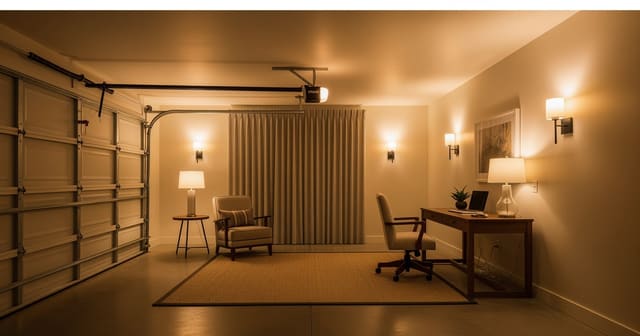
A garage to home office conversion works when you insulate the shell to at least R-13 walls and R-20 ceilings, add dedicated heating or cooling, upgrade electrical to a real sub-panel, fix the lighting layers, and either wall in or thermally upgrade the overhead door. Skip any of these and the room still reads as a garage with a desk in it, not a finished office.
How do you convert a garage into a home office?
Insulate and seal the shell, add safe heat or cooling, improve lighting and electrical access, choose durable flooring, then furnish around a clear work zone and storage plan. Treat this as a small renovation, not a styling project.
Start with the envelope. If the garage door stays, it needs weatherstripping, insulation, and a sealed bottom seam. If it's removed or walled in, check local permitting and whether the room must meet habitable-space standards. The desk wall is the glamorous decision; whether the room holds a steady temperature through a full workday is the one that matters.
Size the desk to the work: at least 42 inches wide for laptop-only tasks, 48 to 60 inches with a monitor, printer, or paper files. Keep depth at 20 to 24 inches in tight one-car conversions, 24 to 30 inches if you need monitor distance. Leave about 30 inches behind the chair for clearance.
In a small garage, borrow the discipline of a compact home office minimum layout: one real work surface, one good chair, one lighting plan, no decorative storage pretending to be useful.
The insulation and comfort decision that makes or breaks the office
Insulation separates a garage desk you avoid from an office you can actually use. Walls, ceiling, door, slab, and air gaps all leak comfort at once, so address the biggest surfaces first.
Framed walls typically take batt or mineral wool sized to stud depth — often R-13 in 2x4 walls, R-19 or higher in deeper framing. Ceilings under attic space usually need more. Exact targets depend on climate and code, but insulate before blaming the heater.
The slab is the sneaky problem: bare concrete can make a room feel cold even when the air reads fine. Seal cracks, manage moisture, then finish with garage-rated LVP, carpet tiles over proper underlayment, rubber office mats, or epoxy plus a large rug. Skip thick wall-to-wall carpet if the slab has any dampness history.
Choose heating and cooling before placing furniture. A ductless mini-split is usually the cleanest permanent fix where budget and an exterior wall allow it; portable heaters work only as backup in mild climates, never as the sole plan for year-round calls. Keep heat sources clear of paper, curtains, and desk undersides.
Treat noise with equal seriousness. Weatherstripping, insulated cavities, a dense rug pad, fabric panels, and curtains cut echo off hard surfaces. If the garage shares a wall with laundry or a workshop, put the desk on the quiet wall and closed storage against the loud one.
Test this on your own room photo with ReDesign before finalizing the layout — keep the room structure, daylight, ceiling line, and main path visible so the preview solves your actual space.
How should lighting, power, and the work wall be planned?
One center-ceiling bulb will make your face look tired on calls and the room feel like storage with a desk. Use three light layers instead.
- Ambient light — recessed fixtures, a low-profile ceiling light, or track lighting so the room isn't gloomy.
- Task light — a desk lamp or wall-mounted fixture near 3000K so screens, keyboards, and skin tones read clearly.
- Evening light — a warmer lamp near 2700K so the room can soften after work hours.
Plan the work wall around glare: put the desk perpendicular to the largest window or glass door so daylight crosses the surface instead of hitting the screen. Use lined shades or frosted film on any garage door windows — a screen facing the door looks dramatic in photos but suffers when afternoon light hits it directly.
Power is not a styling detail. Count laptop, monitor, task lamp, printer, charger, router, shredder, heater, and standing desk before assuming one old outlet is enough — a licensed electrician should add circuits or grounded outlets where needed. A garage wired for a freezer and a drill may not handle office gear, climate control, and lighting together.
Compare your fixture and glare plan against garage conversion lighting ideas before cutting drywall; lighting is far cheaper to fix on paper than after the ceiling is closed.
Keep storage close to the work, not scattered in old garage corners. Closed cabinets 12 to 15 inches deep suit paper, tech, and supplies; 18 to 24 inch cabinets suit printers or archived files. If bikes, paint, and holiday bins must stay, use a real garage conversion storage strategy so work storage and household overflow don't mix.
Common garage office mistakes to avoid
- Decorating before sealing. A rug and art won't hide drafts at the door, slab moisture, or a leaky ceiling — fix the shell first.
- Leaving the door dominant but unfixed. An insulated door with clean panels can work in a modern office; a dented, unsealed one behind your chair reads unfinished.
- Choosing delicate furniture. Garages retain grit and temperature swings even after conversion — use washable rugs, performance fabric, sealed wood, and wipeable cabinet fronts.
- Ignoring overhead hardware. Tracks, openers, ducts, and low beams affect where a standing desk, tall shelf, or pendant can go — keep clear head height on walking paths.
- Letting the office become the new junk pile. Visible tools, paint cans, and bulk supplies read as storage, not work — give what stays a closed home and remove the rest.
Use AI design to preview your garage office before you commit
This conversion hides more conflicts than a typical spare room: a desk that fits but blocks the side door, built-ins that look sharp but cut through the best light, a rug that warms the eye while the slab stays cold underfoot.
Upload a photo from a corner showing the garage door, ceiling tracks, slab, side door, windows, outlets, and existing storage — leave real constraints like the water heater, breaker panel, or tool cabinet in frame, since those decide whether the plan survives Monday morning.
Test three controlled versions, keeping wall color, flooring, and major storage consistent so you're judging layout, not style:
- Keep the garage door and build an insulated office wall in front of it with curtains or cabinetry that respects the hardware.
- Place the desk on the side wall with closed storage behind the camera view.
- Treat the back wall as a full built-in office with the garage door softened as a secondary surface.
Prompt for real constraints: insulated walls and door, sealed slab, 30 inches of chair pullback, a 48 inch desk, layered 2700K/3000K lighting, closed storage, safe outlet locations, and a camera wall clear of the garage opener. The best result is the calm, workable one — not the most dramatic.
For the broader upload workflow, use the AI design complete guide as your parent checklist, then return here for scale, light, and layout specifics.
Frequently Asked Questions
Do I need a permit to convert a garage to an office?
Almost always. Code changes around egress, electrical, insulation, and sometimes parking minimums apply. Permitted conversions keep insurance valid and add resale value; unpermitted ones become a problem when you sell.
How cold does a garage office get without proper insulation?
An uninsulated garage in a heating climate can run 20 to 30 degrees colder than the house in winter. R-20 ceilings, R-13 walls, and 1.5-inch foam board over the slab close most of that gap before you size HVAC.
What do I do with the garage door?
Frame it shut for a quiet office wall, or replace it with a thermally broken glass overhead or sliding door for daylight. Leaving the original sectional door in place reads as an unfinished garage, not an office — check chair pullout, walkway width, and glare before finalizing.
Will a garage office change my property taxes?
Often yes. When the conversion is permitted and the assessor records "conditioned living space," assessed value rises, which can raise taxes — weigh that against the lift in resale and rental value.
How do I keep the office quiet from kitchen or driveway noise?
Add resilient channel under new ceiling drywall, weather-strip the door to the house, and replace the overhead-door header with a solid wall or insulated glass. STC 45 is a reasonable target for the door and wall assembly.
> Try this: Ready to see this on your own room? Open ReDesign and run the preview before you buy, paint, drill, or move furniture.
Three transformations to try
1. Garage door replaced with wall, insulated slab, and two workstations
2. Garage door kept as glass overhead with task light and standing desk
3. Hybrid garage with one parking bay kept and a partitioned office