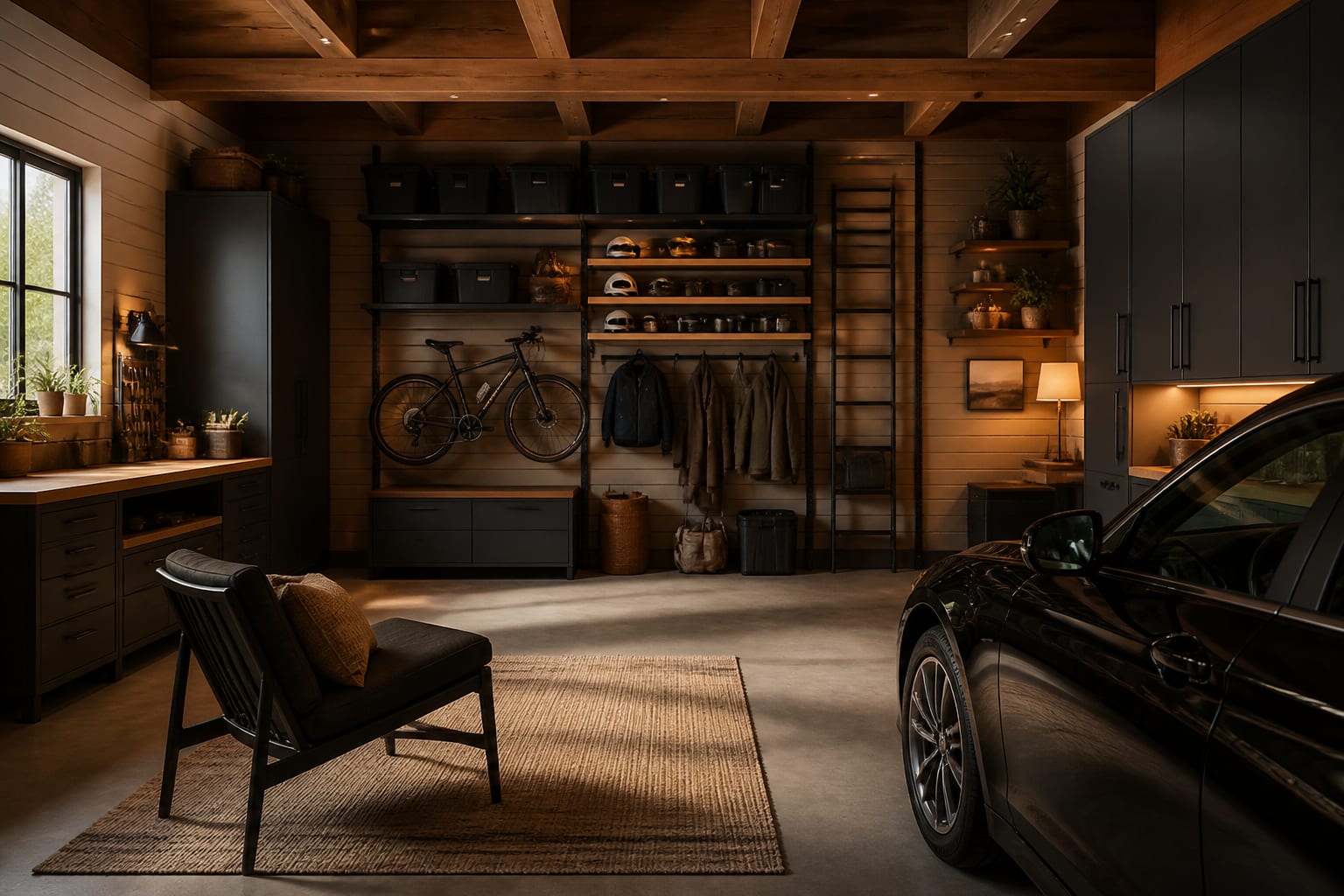
The reason garages slide back into chaos a month after every cleanup is that nothing was assigned a home. Bins get stacked on the floor, the floor fills up, and the cars end up parked outside. The fix is not another weekend of sorting; it is getting storage off the floor and onto the walls and ceiling, then giving every category a fixed spot. A garage has more usable cubic footage than almost any room in the house, and most of it is wasted air above waist height. Claim that vertical space and an organized garage tends to stay organized.
Start by going vertical
The single highest-leverage move is lifting storage off the slab. A standard two-car garage gives you roughly 400 square feet of floor but well over 1,000 square feet of wall, and the air above the hoods of the cars is almost always empty. Wall-mounted systems are where most of the win lives. Slatwall panels, French cleats, or heavy-duty pegboard turn a bare wall into adjustable storage that holds rakes, bikes, hoses, and tools without a single thing touching the ground. Anchored into studs, a quality slatwall carries 50 to 75 pounds per square foot.
Overhead is the second frontier. Ceiling-mounted racks suspended from the joists hold seasonal bins, camping gear, and luggage you touch twice a year, and a 4 by 8 foot overhead rack typically supports 250 to 600 pounds. Hang them no lower than 7 feet so you can walk under them, and keep them clear of the garage door track and opener. Bikes go up too, on wall hooks or a ceiling hoist that lifts a bike out of the walking path entirely. If you want the space to pull double duty beyond storage, our garage workshop ideas guide pairs organization with a real work area.
Zone the space by how you use it
Organization that lasts is built around activity zones, not just shelves. Walk the garage and group your stuff into a few clear categories, then give each one a defined territory on the wall and floor. A typical setup breaks down into a yard-and-garden zone near the door for easy in-and-out, a sports-and-recreation zone on hooks and racks, a household-overflow zone up high for seasonal items, and a cleaning-and-chemicals zone in a lockable cabinet up off the floor away from kids and pets.
With zones defined, the floor plan falls into place. Keep these clearances in mind so the cars and the storage coexist:
- Leave at least 3 feet of walking and door-opening space on each side of a parked car.
- Keep a 2-foot buffer at the front bumper so wall storage does not get clipped by the hood.
- Mount the most-used items between 30 and 60 inches high, the easy-reach band.
- Reserve everything above 72 inches and the overhead racks for low-frequency seasonal gear.
- Put a 24-inch-deep workbench or cabinet run along the back wall if depth allows.
Group like with like so you stop buying duplicates of tools you already own but cannot find. A pegboard with painted tool outlines keeps the most-reached items visible at a glance.
Contain, label, and keep it clear
The difference between a garage that stays sorted and one that backslides is containment. Loose items creep; contained items stay put. Standardize on a couple of bin sizes, ideally clear totes so you can see contents, in a 27-gallon size for bulky gear and a 12-gallon size for smaller categories. Color-code by zone if you want a faster system: green totes for garden, blue for sports, red for holiday. Label both the bin and its shelf position so an item has one obvious home it returns to.
Protect what you store from the conditions. Garages swing from freezing to 100-plus degrees, so keep paint, electronics, and photos in a climate-buffered cabinet rather than loose on a shelf. A pegboard panel and a set of labeled drawers turn a scattered pile of fasteners into a findable system. Budget honestly: a solid wall-and-overhead organization package for a two-car garage runs $500 to $2,500 in materials depending on whether you DIY the slatwall or buy a modular kit. That is real money, but cheaper than the living room refresh you keep postponing because the garage swallowed the boxes that belong elsewhere.
Common mistakes to avoid
Garage organization fails in predictable ways. Sidestep these and the system holds:
- Leaving everything on the floor in stacked bins instead of mounting storage on the walls and ceiling.
- Buying freestanding shelving that tips or sags instead of anchoring a wall system into the studs.
- Hanging overhead racks under 7 feet, so you crack your head or block the garage door.
- Skipping labels, so bins become mystery boxes nobody reopens and categories blur together.
- Storing paint, batteries, and electronics loose in a space that swings past 100 degrees in summer.
- Filling the walls so densely that the cars no longer have their 3-foot side clearance.
The floor-storage habit is the root of nearly every failure. Once bins live on the slab, they multiply and the cars get evicted. Anchor systems to studs, not drywall alone, since a loaded slatwall or rack can carry several hundred pounds and pull free of unsupported board. If you later convert part of the space, our garage conversion ideas guide covers reclaiming that footage for a room.
See it first in Re-Design
It is hard to commit to a wall-storage layout when the garage is still a wall of boxes. Upload a photo of your garage to Re-Design and preview slatwall runs, overhead racks, and cabinet placement against your actual walls, so you can see whether a system fits beside the car and where the zones naturally fall. You can test a full-wall pegboard against a mix of cabinets and open shelving, judge how much floor a layout frees up, and settle on a plan before you buy a single panel or drill into a stud.
Frequently Asked Questions
How do I keep my garage organized long term?
Give every category a fixed home and get storage off the floor. Mount wall systems and overhead racks, zone the space by activity, and contain items in labeled bins so each one returns to one spot. Floor stacking is what causes backsliding; when bins live on the slab they multiply and the cars get pushed out.
How much weight can garage wall storage hold?
A quality slatwall or French-cleat system anchored into studs carries roughly 50 to 75 pounds per square foot. Overhead ceiling racks suspended from the joists typically hold 250 to 600 pounds for a 4 by 8 foot unit. The key is anchoring into framing, not drywall alone, which cannot support loaded storage.
How much clearance do I need around a parked car?
Leave at least 3 feet on each side of the car for opening doors and walking, plus about a 2-foot buffer at the front bumper. Keep overhead racks no lower than 7 feet so you can pass under them, and confirm nothing intrudes on the garage door track or opener path.
What should not be stored in a garage?
Skip leaving paint, batteries, electronics, and photos loose on open shelves, since garages swing from freezing to over 100 degrees. Keep those in a climate-buffered cabinet, and lock chemicals and pesticides in a cabinet up off the floor away from kids and pets. Propane and most flammables should not be stored indoors at all.