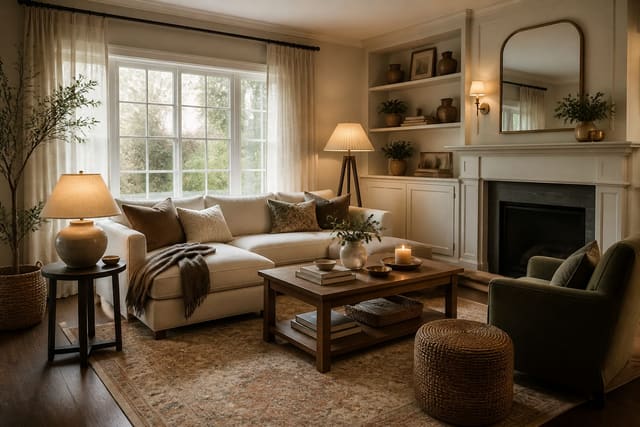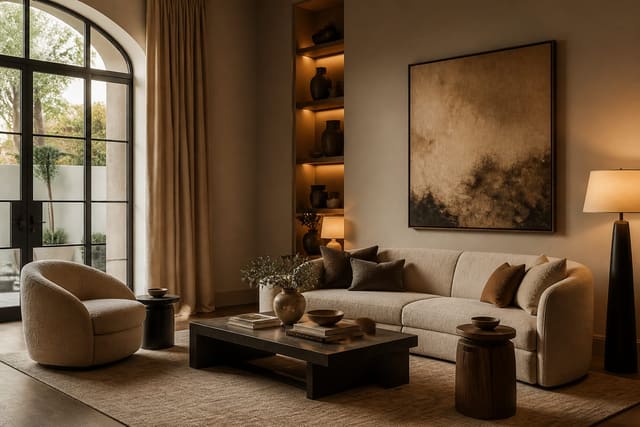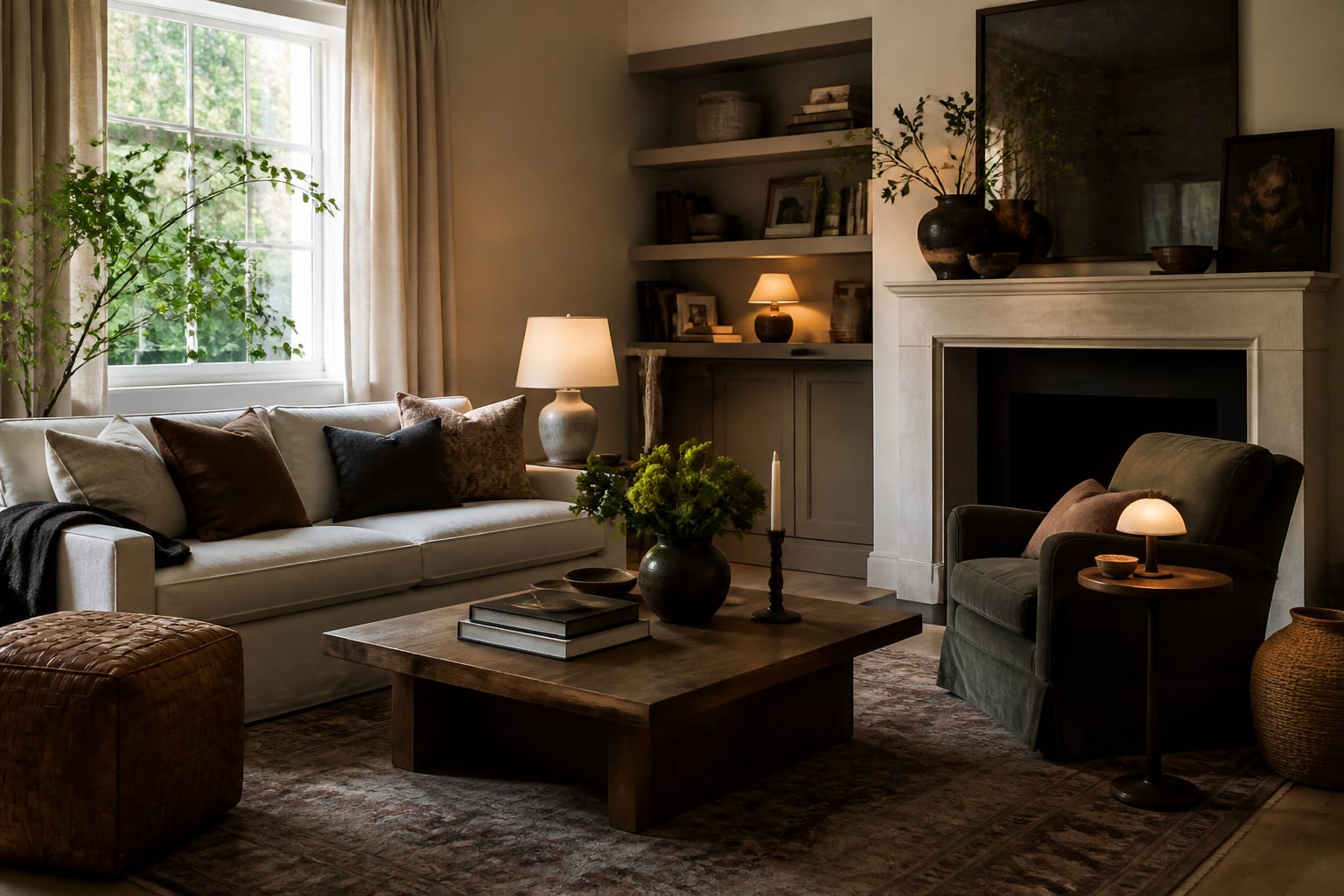
Most living rooms don't need new furniture — they need better light and a clear focal point. Swapping a flat overhead fixture for a warm 2700K pendant or floor lamp does more for the room's atmosphere than repainting every wall.
A smart refresh works in layers: first fix the light, then address the largest surface you can afford to change, then add texture through textiles. Each layer compounds the one before it, which is why a room refreshed in order always looks more deliberate than a room where expensive individual pieces were dropped in without a plan.
Start with Lighting Before Anything Else
Overhead recessed lighting is designed for utility, not atmosphere. It creates harsh downward shadows that flatten furniture and make every surface look the same. The fastest refresh fix is to add a floor lamp with a warm bulb — 2700K to 3000K — in the corner farthest from the window. That single change shifts the room from institutional to residential in about 20 minutes.
Layered lighting means at least three sources at different heights: ambient overhead, a table or floor lamp at seated eye level, and a small accent source like a table lamp on a console or a wall sconce. The interplay between levels is what creates depth in photographs and comfort in person.
If rewiring is off the table, plug-in sconces mounted with a simple anchor bracket give you wall-height light without an electrician. Set them on a smart plug timed to come on at dusk and you've built an automatic mood shift that costs about 40 dollars total.
See also our guide to Budget Living Room Ideas for more on living room refresh ideas.
The Fastest Surface-Level Updates
Cushion covers are the highest-value soft-furnishing swap in a refresh. They change the perceived color, texture, and season of a sofa without buying a new one. A sofa that looked tired in flat gray cotton reads as intentional and layered once you add two linen covers in a warm neutral and one in a contrasting deep tone. Wash before use — most covers arrive stiff and lose the right drape after a single wash.
Curtains have an outsized effect on perceived ceiling height. Hanging rods within 4 inches of the ceiling and using floor-length panels — even if the window stops well below — draws the eye upward and makes the room feel taller. This works in rooms with 8-foot ceilings as reliably as it does in rooms with 10-foot ceilings.
A fresh throw blanket draped over the arm of the sofa adds the lived-in intentionality that empty furniture lacks. Avoid blankets that are too thin or too synthetic; a woven cotton or lightweight wool reads as quality at any budget.
For a related angle on living room refresh ideas, read Make Living Room Feel Expensive.
Wall Art and the Focal Point Problem
A room without a clear focal point feels restless because the eye has nowhere to land. If the room doesn't have a fireplace or a dramatic window, a large piece of wall art — ideally at least 24 by 36 inches and hung with its center at 57 to 60 inches from the floor — creates one deliberately. Hang it on the wall the sofa faces, not above the sofa, where it can't be seen from the seating group.
Gallery walls work but they demand more time and a strong sense of spacing. If the frames aren't arranged with at least 2 to 3 inches of gap between each one and a clear outer boundary, they read as clutter rather than curation. A single oversized piece is almost always more impactful and easier to execute.
Mirrors are a valid focal-point tool, especially in darker rooms, but only when they reflect something worth reflecting. A mirror that faces a blank wall or a cluttered corner amplifies the problem. Position a large mirror so it bounces natural light from the nearest window back into the room.
Color and Texture Without Repainting
A 60/30/10 color ratio — 60 parts dominant, 30 parts secondary, 10 parts accent — gives a room visual structure without requiring a paint roller. The dominant color is usually the wall or the largest furniture piece; the secondary is the rug, curtains, or secondary seating; the accent is cushions, art, or a single statement object. Adjusting the accent tier alone shifts the room's personality season by season.
Texture does more work than most people realize before they try it. A rough jute rug, a smooth lacquered tray, a matte ceramic vase, and a woven throw in the same room together create richness that a flat, single-material space can't match even with expensive individual pieces. Mixing at least four distinct textures across any flat surface group — coffee table, console, bookshelf — is the interior-design trick that reads as 'curated' in photos.
Plants are texture, color, and life in one. A single fiddle-leaf fig or a tall snake plant in a room with good natural light earns far more visual return than a decorative object of equivalent cost. Place it in a corner that gets indirect light for at least 4 hours a day and the plant becomes a permanent fixture of the room's character.
Here are the common mistakes to avoid: - Buying new furniture before fixing lighting, which makes even expensive pieces look flat and uninspiring. - Hanging art at eye level while standing, which places it too high for a seated viewing perspective at 57 inches. - Using curtain rods mounted at window frame height, which visually compresses ceiling height by several inches. - Choosing a rug under 8 by 10 feet in a standard living room, leaving furniture legs floating on bare floor.
Bring the look home with Re-Design
Not sure whether new curtains or a larger rug will make a bigger difference in your room? Re-Design lets you upload a photo of your existing living room and preview specific refresh changes — different lighting setups, new textile colors, updated focal walls — with AI before spending a dollar. You see the impact in your actual space, not a generic showroom render.
Frequently Asked Questions
What is the cheapest way to refresh a living room?
Swap your lightbulbs to 2700K warm-white and add a floor lamp in a dim corner — this costs under thirty dollars and changes the room's atmosphere more than most furniture purchases. After lighting, new cushion covers and a throw blanket give you a seasonal shift for under fifty dollars without touching the furniture itself.
How do I make a living room feel more cozy without buying new furniture?
Layer your lighting, add a woven throw, and introduce at least two additional textures through cushions, a tray, or a ceramic object on the coffee table. Coziness is almost entirely about warm light and tactile variety, not furniture size or quantity. A 2700K floor lamp aimed at the ceiling in a corner is the fastest single change you can make.
Where should I hang wall art in a living room?
Hang the center of any piece at 57 to 60 inches from the floor — this is standard gallery height and works for seated viewing. Art hung above the sofa should sit roughly 6 to 8 inches above the sofa back so the two read as a connected unit rather than two separate floating objects. Avoid pushing art to the very top of a wall, where it disconnects from the room entirely.