You can update a glass block bathroom window without removing it by keeping the privacy glass and fixing everything around it: clean caulk and mortar, add simple flat trim, cover or film the glass if the pattern feels busy, and warm up the paint, mirror, and lighting. Replacement only makes sense when you need real ventilation or egress, not just a different look.
How do you update a glass block window without removing it?
Decide first whether the glass itself is the problem or whether yellowed caulk, skinny trim, shiny tile, or harsh lighting are doing the damage. Often the block is fine and the surround is dated.
- Scrub the glass with a non-abrasive cleaner and clean mortar or silicone lines with a toothbrush.
- Replace cracked or mildewed caulk with bathroom-rated silicone.
- Install simple casing (PVC, composite, or sealed painted wood) if the perimeter gap is uneven — a flat 2–3 inch profile beats ornate molding on a block grid.
- Leave about 1/8 inch of caulked reveal at the edge so trim doesn't look jammed against the blocks.
- Use moisture-safe materials only if the window sits inside the shower; over a tub or toilet you have more freedom for shelves, fabric, or paint.
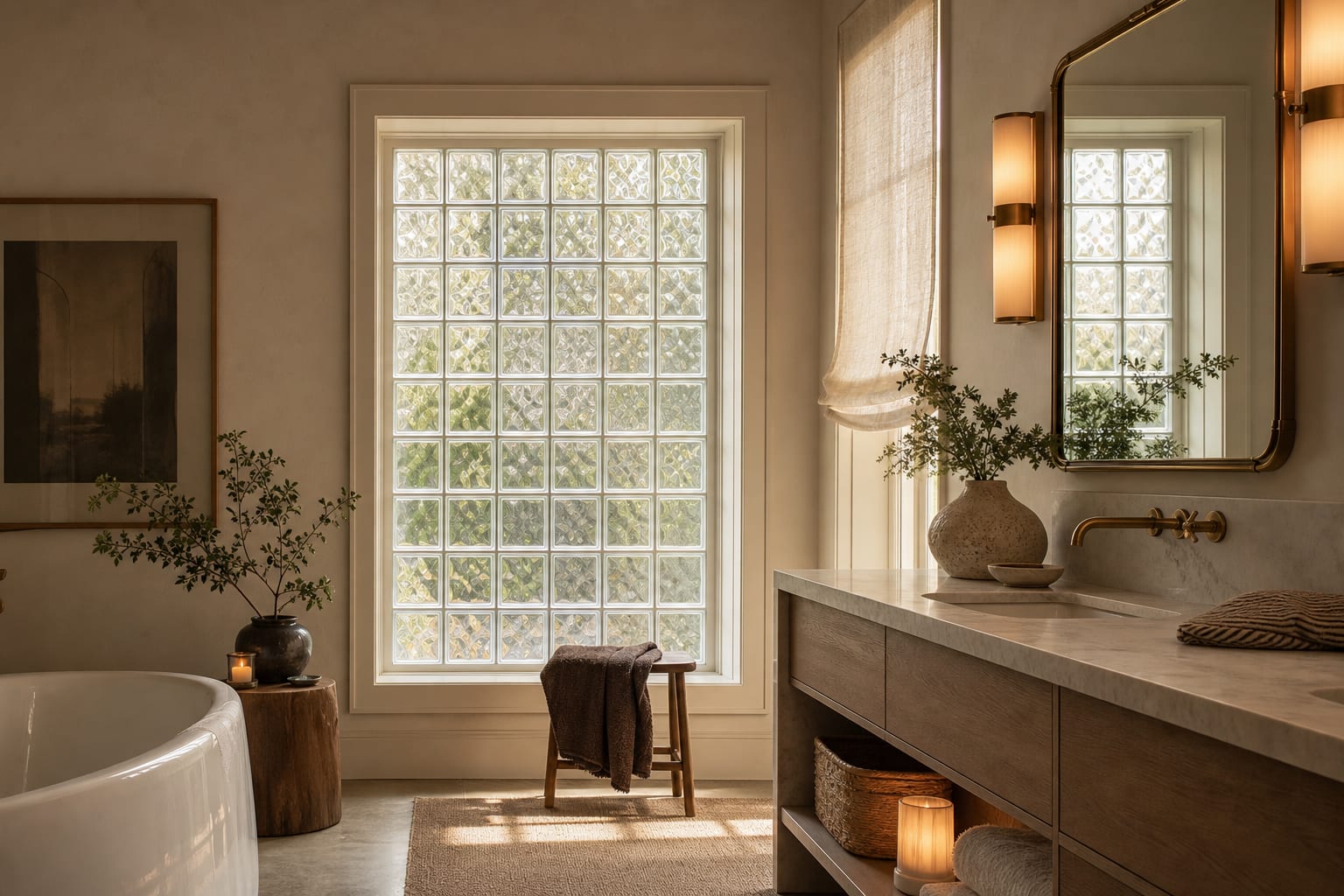
Treat the result as a framing job, not a disguise: the glass stays a frosted architectural panel while the wall around it looks finished.
Which cover, frame, or shade makes glass block look intentional?
Don't block all the daylight. If the glass block is the room's only light source, use a light-filtering layer that blurs the grid instead of a heavy curtain.
- Roman shade (outside the wet zone): mount 4–6 inches above the trim, extending 2–3 inches past each side; use linen-look polyester or washable cotton blend, not puddled heavy fabric.
- Frosted or reeded film: test one block first since textured surfaces don't always bond cleanly; use only on the room-facing side.
- Painted surround: often the cheapest fix. Warm white, pale mushroom, soft putty, muted clay, or gentle green-gray soften block more than stark blue-white paint. For restraint on a similarly dated palette, see the avocado green bathroom renovation approach.
- Shallow sill: 3–4 inches deep is enough for a plant or folded towels; slope slightly toward the room or shower pan in wet areas so water doesn't sit against trim.
Test this on your own room photo with ReDesign before finalizing a layout, keeping the daylight, ceiling line, and main path visible so the preview matches your actual space.
How do color, mirror, and lighting pull the bathroom forward?
Glass block looks dated fastest next to cold, shiny, thin finishes. Warm the room up instead of fighting the window.
- Bulb temperature: use 2700K for spa-like warmth or 3000K for task lighting; avoid cool 4000K bulbs if the block has a bluish cast.
- Mirror size: choose one 70–80% of the vanity width so it doesn't compete with the window; the bathroom mirror lighting guide recommends eye-level sconces on both sides over a single cold bar.
- Layered light: add a flush mount, damp-rated recessed light, or shower-rated fixture so the block isn't the only bright surface — the same fix used to brighten a windowless bathroom.
- Surrounding pattern: keep tile and paint quiet if the room is busy, or add texture through towels, wood, and matte hardware if it's plain. Glass block already supplies pattern.
Common glass block window update mistakes
- Hanging a dark curtain. It kills the daylight the window provides; use a light-filtering shade or framed surround instead.
- Adding fancy trim. Ornate casing or thick molding clashes with the block's square rhythm; stick to flat 2–3 inch trim.
- Painting mortar joints in high contrast. This makes the grid louder; instead clean, repair, or let a soft wall color reduce contrast so the window reads as one panel.
- Using peel-and-stick film in a wet zone. Steam and spray lift unrated adhesives; prioritize caulk, waterproof trim, and lighting inside a shower.
- Updating only the window. A glass block window needs company — warmer bulbs, a better mirror, fresh caulk, simpler hardware, and one calm paint direction.
How can AI design previews help before you commit?
Glass block shifts with daylight and reflection, so it's hard to judge from a sample board. Upload a doorway photo and a vanity-wall photo, then prompt specifically: "small bathroom with existing glass block window kept in place, flat 2 inch warm white casing, pale mushroom walls, modern vanity mirror, brass sconces, 3000K lighting, no demolition." Run variations with a Roman shade, a deeper sill, and a closer wall-to-tile color match.
Compare proportion and mood rather than waterproofing detail: does the frame make the glass look intentional, does the shade block too much light, does the paint calm the mortar lines? If everything still looks dated, the tile, mirror, or lighting is likely the real issue. Renters can preview removable options (tension shades, adhesive-safe trim, new bulbs, a larger mirror); owners can test permanent changes like composite casing, a stone sill, or a full tile refresh. Measure opening width, opening height, sill depth, mirror width, vanity width, and nearest outlet before finalizing anything.
For the broader upload workflow, use the AI design complete guide as the parent checklist, then return here for window-specific scale and light choices.
Frequently Asked Questions
Do glass block windows look dated in a modern bathroom?
Smooth, large-format glass blocks read modern; 1980s-style wavy or rippled blocks read dated and are usually the trigger to replace or face them with a frosted operable window.
Can I replace a glass block window with a regular window?
Yes — a 22 by 36 inch frosted vinyl awning or casement sash fits most common glass-block openings after the block is removed. Check the rough opening for plumb before ordering the new unit.
Will replacing glass block change bathroom ventilation code?
Often yes. Most codes require an operable window of at least 1.5 square feet or a 50 cfm fan, and fixed glass block fails the operable requirement on its own, so a replacement plan must include a fan or an operable sash.
How do I keep privacy without glass block?
Use a frosted or acid-etched laminated insulated glass unit with a fixed bottom and operable top, or add sandblasted film over clear glass if renting. Both keep privacy at a 3 foot setback.
Can I paint or skin the existing glass block?
Yes — translucent privacy film or high-bond glass paint refreshes dated blocks for a fraction of replacement cost, but neither solves ventilation if the original code path required an operable window.
> Try this: Ready to see this on your own room? Open ReDesign and run the preview before you buy, paint, drill, or move furniture.
Three transformations to try
1. Replace with frosted awning window and 3-inch trim 2. Keep block, add trim, and refresh tile field around it 3. Face existing block with sandblasted film and matching wall paint